

![MultipartFile resource [file_data]](/assets/img/articles/акар-стъбло-спанак-2.jpg)
Spinach (Spinacia oleracea L.) is a traditional leafy vegetable crop in Bulgaria, which occupies a relatively small share of the total vegetable production, but it is important for supplying the market with fresh vegetables in early spring and late autumn. Thanks to its short growing season and good cold resistance, spinach allows for early production and is often used as an intermediate crop in vegetable crop rotations.
Production is concentrated mainly in small and medium-sized vegetable farms, as well as in greenhouse complexes that ensure supply during the winter and early spring months.
In recent years, along with challenges such as climate change and increased production costs, pests that can significantly reduce yields and product quality have become increasingly important. Among them, special attention deserves Tyrophagus similis Volgin, 1949 (Acari: Acaridae) – a mite that damages the young leaves and the growing point of plants, causing deformations, growth retardation, and loss of commercial value of the production.
The species is a representative of the family Acaridae, order Acariformes, suborder Astigmata. Most species of this family feed on fungi and are often found in stored food products and decomposing organic substrates. Some species can also feed on plants, while others live in close association with insects or in nests of vertebrates. The family Acaridae is widespread throughout the world and includes about 400 known species, from approximately 90 genera, with many undescribed species presumed, mainly in tropical regions. Some genera are of great economic importance: Rhizoglyphus – includes species that attack root crops; Acarus and Tyrophagus – the most widespread and economically important mites on stored food and food products. Some species of the genus Tyrophagus also cause damage to ornamental plants and vegetables grown in greenhouses.
Tyrophagus similis is a widespread synanthropic species of the family Acaridae, inhabiting food storage facilities, agricultural buildings, greenhouses, compost, plant debris, and other environments rich in organic matter. The species develops under high relative humidity and moderate temperatures, feeding mainly on fungi, microorganisms, and decomposing plant material.
Under favorable conditions, its populations can rapidly increase and colonize stored plant products, seeds, feed, and plant growing substrates. In greenhouse production, T. similis is known as a pest of vegetable crops, especially spinach, cucumbers, and other leafy vegetables, where larvae, nymphs, and adults can damage germinating seeds, young roots, and underground plant parts. The mite is a difficult-to-detect pest with a hidden lifestyle, inhabiting the soil and the base of the leaf rosette in greenhouse-grown spinach.
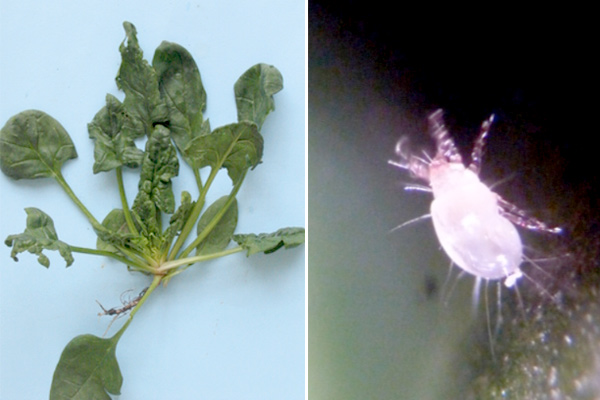
It is known as the spinach rosette mite. It is recognized as an important pest in greenhouse spinach production in Italy, the United Kingdom, and Japan, especially during periods of moderate temperatures - early spring and late autumn. The populations of the species initially develop in the soil or organic substrate, after which the mites migrate to the growing point of the plants, where they feed on young leaves.
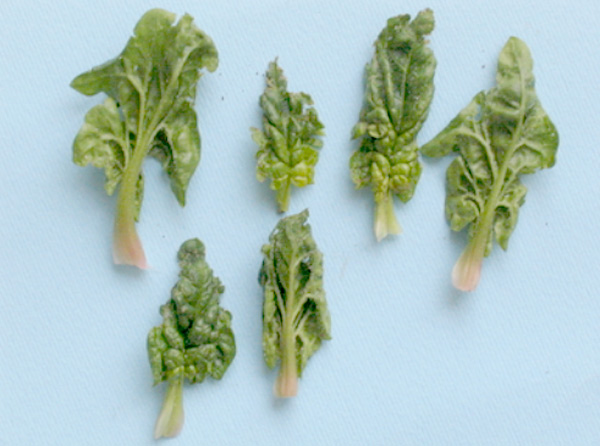
Damage manifests as stunted growth, leaf size reduction, deformations, and leaf curling
The spread and mass multiplication of T. similis are associated with the use of organic materials to improve soil fertility and with leaving plant residues on the soil surface, which create favorable conditions for the development of the species. Experimental studies on the food suitability of various substrates for the mite T. similis show that the species has a clearly expressed selectivity towards food resources. Rapeseed meal, various types of fungi (Fusarium oxysporum, Pythium aphanidermatum, Rhizoctonia solani), and most tested vegetables (including lettuce, cucumber, spinach, and other leafy crops) are identified as suitable substrates supporting the successful reproduction of the species. In contrast, organic waste (such as animal feces, sawdust, and rice straw) and various types of compost prove unsuitable for its development. The results emphasize that the population development of T. similis in agroecosystems is stimulated not so much by the organic waste itself, but by the presence of fungal microflora that develops on or within them. This explains the link between the use of organic fertilizers and the increased abundance of the species under cultivation conditions. From a practical standpoint, to limit damage to spinach and other vegetable crops, it is recommended to restrict the use of rapeseed meal during periods of high mite activity, remove plant residues before planting, and avoid using uncomposted organic materials that support the development of suitable fungal flora for the mite.
The mite has a relatively short life cycle and under favorable conditions completes one generation in approximately 11 days. Fertilized females lay an average of 18 eggs, with maximum fecundity reaching 36 eggs per female. Unlike some other representatives of the family Acaridae, no hypopus is observed in this species - a developmental stage that usually serves for dispersal and survival under unfavorable conditions. The species mainly inhabits the surface soil layer (0–5 cm), where it feeds on organic matter and soil microorganisms. Under unfavorable soil conditions, part of the population may migrate above the soil surface and colonize the above-ground parts of plants, leading to direct crop damage.
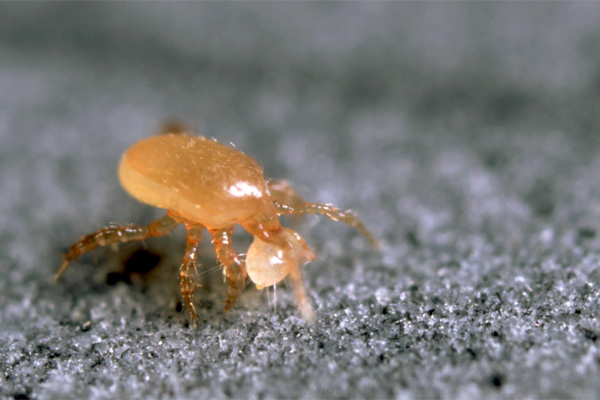
In biological control, predatory mites such as Hypoaspis aculeifer (=Gaeolaelaps aculeifer) feed on T. similis and can reduce its population in the soil
The control of the spinach rosette mite (especially in greenhouses) is considered a combination of agrotechnical, ecological, and biological measures, since chemical control is limited and often ineffective due to the soil-dwelling lifestyle of the species. The ban on the use of certain effective active substances further limits chemical control options, necessitating the search for alternative strategies. Soil disinfection through chemical means, solarization, steam, or hot water can reduce population densities, but is often associated with technological limitations and delays in the production cycle. The main control methods are:
- Agrotechnical measures
- Removal of plant residues before the new sowing, as they support fungal microbiota providing food for the mites;
- Avoiding uncomposted organic fertilizers (e.g., rapeseed meal) that stimulate fungal development and indirectly increase the population;
- Soil management through crop rotation and good substrate hygiene;
- Soil moisture and microclimate management
- Maintaining high humidity (through covering/solarization) can reduce the mite population density, but results are variable;
- Short-term irrigation is often ineffective and may sometimes stimulate the population;
- Temperature control, as the species is sensitive to high temperatures;
- Biological control
- Use of predatory mites such as Hypoaspis aculeifer (=Gaeolaelaps aculeifer), which feed on T. similis and can reduce its population in the soil. For effective control of the genus Tyrophagus, 50–100 predatory mites/m² are applied preventively and 250–500 predatory mites/m² in case of severe infestation. The carrier material (usually vermiculite) is distributed evenly over the soil or substrate surface. Best results are achieved at temperatures of 17–26°C and in moist, organic matter-rich soil;
- Sanitary and preventive measures
- Keeping greenhouses and soil surfaces clean;
- Preventing transfer through contaminated soil materials and substrates.
In summary, we can say that the most effective control of T. similis in spinach involves an integrated approach combining the management of organic matter, humidity, and the use of biological agents.
References
Al‐Safadi, M. M. (1987). The life cycle of the Acari Tyrophagus similis. Journal of Zoology, 213(1), 141-146.
Dudynska, A. T., Romanko, V. O., Dudynsky, T. T., Karabiniuk, M. M., & Zhovnerchuk, O. V. (2023). Species diversity and distribution of synanthropic acarid mites (Acariformes, Acaridia) in Transcarpathia. Zoodiversity, 57(4).
Ippolito, R. & Triggiani, O. (1988). Prove di efficacia di alcuni acaricidi nei riguardi del Tyrophagus similis Volgin (Acaridida: Acaridae) su spinacio. Informatore Fitopatologico, 38(2): 43–48.
Kasuga, S., & Honda, K. I. (2006). Suitability of organic matter, fungi and vegetables as food for Tyrophagus similis (Acari: Acaridae). Applied entomology and Zoology, 41(2), 227-231.
Kasuga, S., Kanno, H., & Amano, H. (2006). Development, oviposition, and predation of Hypoaspis aculeifer (Acari: Laelapidae) feeding on Tyrophagus similis (Acari: Acaridae). Acarological Society of Japan, 15 (2): 139-143.
Palyvos, N. E., Emmanouel, N. G., & Saitanis, C. J. (2008). Mites associated with stored products in Greece. Experimental and Applied Acarology, 44(3), 213-226.
Saito, M. (2016). Effects of soil mass watering and covering on Tyrophagus similis Volgin (Acari: Acaridae) soil densities. Journal of the Acarological Society of Japan, 25(2), 89-98.
'