

![MultipartFile resource [file_data]](/assets/img/articles/венец-еньовден-2026.jpg)
On June 24th we celebrate Enyovden – the holiday of the sun, water, and the healing power of nature. Known in various parts of Bulgaria as Ivan Bilober, Yanevden, or Ivanden, this day carries the deep roots of Slavic folklore traditions. According to beliefs, just before sunrise, plants possess the most powerful healing properties. Tradition dictates that one should gather "77 and a half herbs" – one for every known disease and half for the "disease without a name". These are woven into wreaths for health, and herbs such as St. John's wort, common St. John's wort, thyme, and linden are prepared for the winter.
Bulgaria is one of the leading exporters of herbs in Europe
Nature is exceptionally generous to our lands. Bulgarian flora includes over 4,300 species of higher plants, of which about 770 possess proven medicinal properties. Over 270 species are actively used in the pharmaceutical, cosmetic, and food industries. Between 80% and 90% of the harvested quantity (about 13,500 tons) is intended for export.
The Emblems of Our Flora: Mursalski Tea and Orpheus' Flower
Among this vast plant diversity, two unique Balkan endemics stand out, attracting the attention of scientists and healers from around the world.

Mursalski tea (Sideritis scardica Grisb.)
Mursalski tea (Sideritis scardica Grisb.), called the elixir of longevity, is a perennial plant reaching 50 cm in height. This plant is a true natural pharmacy. Discovered and described by botanist August Grisebach in the Shar Mountains (hence its Latin name scardica), it is also known as Pirin, Trigrad, or Alibotush tea.
Composition and benefits: It contains a rich complex of tannins, essential oils, and trace elements (iron, zinc, magnesium, copper). Its high flavonoid content gives it powerful antibacterial and antioxidant effects.
Due to its immense popularity, Mursalski tea is an endangered species, included in the Red Book of Bulgaria. Today, its collection from natural habitats is only in limited or permissible quantities. It is also successfully cultivated.

Rhodope silivryak (Haberlea rhodopensis)
The Rhodope silivryak (Haberlea rhodopensis) or the resurrecting miracle, also known as Orpheus' flower, holds an astonishing secret – the ability to "resurrect".
A main focus of scientific research at the Center of Excellence in Plant Systems Biology and Biotechnology - CEPSBB is the high drought tolerance of Haberlea rhodopensis - even after extreme drought and complete desiccation, upon subsequent watering the plant "resurrects" and fully recovers. Haberlea rhodopensis also exhibits tolerance to other extreme conditions such as low temperatures and prolonged darkness. Scientists at CEPSBB are studying the molecular mechanisms through which the plant adapts to these types of abiotic stress. The main goal is for the research results to be applicable to economically important crops, in order to increase their tolerance to adverse conditions.
Nature Protection – A Mission and a Law
Since the majority of herbs in our country are collected from the wild, their resource is at risk of depletion, climate change, and human negligence. To protect this wealth, since 2000 Bulgaria has introduced a specialized Law on Medicinal Plants – a precedent within the EU. The law aims to ensure their sustainable use and the preservation of natural habitats for future generations. Some species are placed under a special regime of protection and use, and the law designates the institutions that monitor the sustainable use of medicinal plants. These are the regional bodies of the ministries of environment and water, and agriculture and food.
At the beginning of each year, the Minister of Environment and Water issues an order specifying 24 species of medicinal plants that are prohibited from being collected for commercial purposes. For another 12, permissible quantities are determined. These are Mursalski tea, red peony, alder buckthorn, cowslip primrose, blessed thistle, lily of the valley, deadly nightshade, common self-heal, stemless carline thistle, biting stonecrop, sea buckthorn, and agrimony.
The Case of Gornoslav: A Warning for All
The protection of these species requires vigilant civic conscience. A striking example is the incident from April 2026, when over 400 plants of the protected Rhodope silivryak were brutally uprooted near the village of Gornoslav due to an investment intention for marble extraction. Thanks to timely reports and the efforts of the "Green Balkans" association, the Minister of Environment and Water imposed a complete ban on construction and extraction in the area until it is declared a protected area.
Enyovden – Responsibility for Future Generations
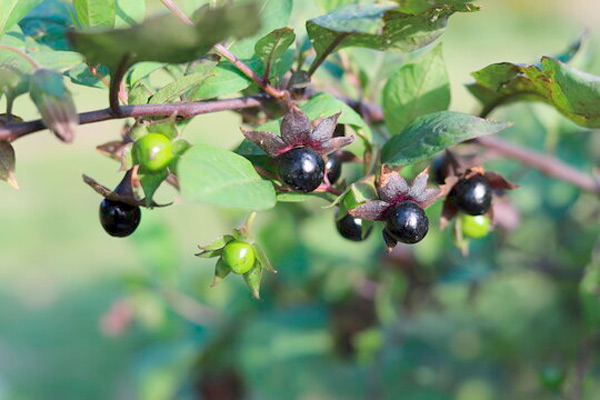
Deadly nightshade (Atropa belladonna), also called belladonna or devil's berries, is a perennial shrub from the Solanaceae family. Deadly nightshade is a highly toxic plant containing the alkaloid atropine.
Enyovden reminds us that we are inextricably linked to nature. Gathering herbs is not just a tradition or a business, but a responsibility. Experts urge us not to uproot plants unnecessarily, to collect only species we know well (as some, like deadly nightshade, are highly poisonous), and always to leave part of the populations untouched. Only then will we preserve the natural balance and bequeath the healing magic of Bulgarian nature to future generations.
More on the topic: