

![MultipartFile resource [file_data]](/assets/img/articles/заглавна-растителна-защита-юни-2026.jpg)
The meteorological conditions during the first and second ten-day periods of June will create a predisposition for an increased infectious background of fungal pathogens - late brown rot on fruit trees, apple and pear scab, if you have not previously managed these diseases. During the month, treatments against fruit worms, leaf-mining moths, and aphids on fruit trees should continue.
More suitable conditions for conducting plant protection sprays will arise during the third ten-day period of the month.
In fruit nurseries
The fight against diseases and pests continues in nurseries, seedbeds, and mother plantations with clonal and quince rootstocks.
Apple and pear nurseries and mother plantations are sprayed with a copper preparation -1% Bordeaux mixture, Funguran OH 50 WP -150-250 g/ha, Champion WP - 0.3%, Caper Key – 180-300 g/ha against scab and with a pyrethroid insecticide – Decis 100 EC - 7.5 -12.5 ml/ha, Sumicidin 5 EC (0.02%), Aphicar 100 EC (15 ml/ha), Efcymetrin 10 EC (15 ml/ha) or Dipel 2X (0.1%) against leaf-chewing insects and with one of the preparations – Afinto (14 g/ha), Mospilan (25 g/ha), Tepeki (14 g/ha), Closer 120 EC (20 ml/ha, and in case of severe infestation 40 ml/ha) against aphids. Spraying continues until the end of growth.
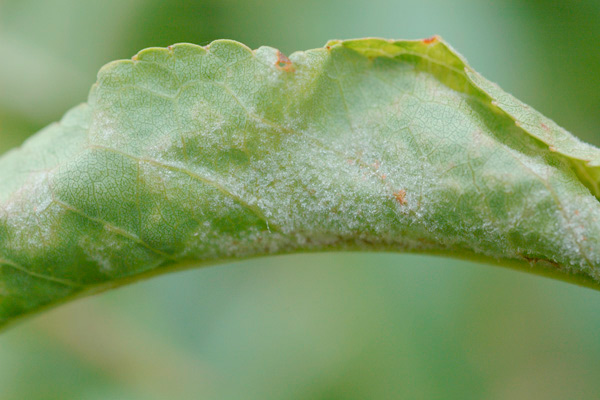
Peach powdery mildew
Apple and peach varieties sensitive to powdery mildew, as well as clonal apple rootstocks, are sprayed every 8-10 days with a sulfur-based preparation - Sulfur WG 600 g/ha, Solfo 80 WG – 750 g/ha.
Sour cherry and sweet cherry varieties, as well as mahaleb rootstocks, are sprayed every 8-10 days with Silit 544 SC – 125 ml/ha against cylindrosporiosis.
Clonal quince rootstocks and pear seedlings in seedbeds are sprayed with a copper preparation - 1% Bordeaux mixture, Funguran OH 50 WP -150-250 g/ha, Champion WP - 0.3%, Caper Key – 180-300 g/ha against brown leaf spot at 10-day intervals until the end of growth.
In the presence of San Jose scale and fall webworm, spray respectively with a pyrethroid insecticide – Decis 100 EC - 7.5 -12.5 ml/ha, Sumicidin 5 EC (0.02%), Aphicar 100 EC (15 ml/ha), Efcymetrin 10 EC (15 ml/ha) or Dipel 2X (0.1%) against fall webworm. Caterpillar nests of the fall webworm are cut out and burned.
In fruit orchards

Damage caused by caterpillars of the plum fruit moth
Poisoned trapping bands are placed to destroy caterpillars of the second generation of the plum fruit moth. Fallen wormy fruits – apples, pears, plums, walnuts – are collected to reduce the density of the second generation of fruit worms. Pheromone traps are placed to catch fruit moth butterflies, in connection with determining the timing for spraying against their second generation.
Inspections of the non-poisoned trapping bands are carried out to determine the start of the flight of butterflies from the second generation of fruit worms.
2500-3000 apple fruits from different varieties, collected from several trees scattered throughout the orchard, are inspected to determine worminess and the need for spraying against the second generation of the codling moth. If worminess is less than 2%, spraying is not performed. Fallen wormy fruits are collected and destroyed to reduce the density of second-generation fruit worms.
Wormy hazelnut fruits are collected and destroyed to reduce the density of the hazelnut weevil.
Observations are made to identify the first spots of rust on plums, the development of leaf-mining moths, and mites. The inspection of fruit orchards continues to detect trees infected with viral diseases and their marking.
Poisoned baits (potatoes, carrots, or other vegetables soaked with Actellic 50 EC, Biona Sincar - 4 L per 1 kg) are placed or Mesurol Schneckenkorn (250 g/ha) is buried against the common vole. The bait is placed in the vole's tunnels using a trowel or tweezers.

The San Jose scale (Quadraspidiotus perniciosus) is a quarantine pest and is distributed only in some regions of Bulgaria. It is a typical polyphagous species. It has been found to damage over 260 plants. It is most commonly found on white and black currants, apple, pear, Japanese quince, hawthorn, peach, plum, cherry, ash, acacia, poplar, willow, etc., and less frequently on apricot, walnut, almond, grapevine, chrysanthemum, etc. On fruits, the scales usually accumulate in the stem cavity and the calyx end. When the infestation is severe, scales can be seen over the entire surface of the fruit, as a result of which the fruit acquires a mottled red-violet spotting. Such fruits have low commercial value. For biological control of the San Jose scale, its parasites Prospaltella perniciosi, Aphytis proclia, Aphytis mitilospidis, etc., are used, which are released in the infested mapped areas within the framework of integrated plant protection.
Against San Jose scale, treat with a pyrethroid insecticide – Decis 100 EC - 7.5 -12.5 ml/ha, Sumicidin 5 EC (0.02%), Aphicar 100 EC (15 ml/ha), Efcymetrin 10 EC (15 ml/ha).
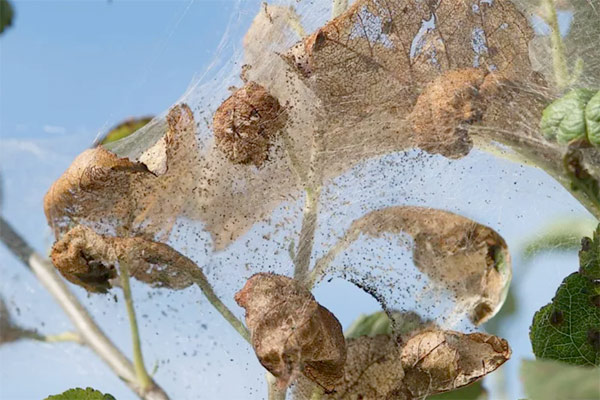
Fall webworm nests
Found caterpillar nests of the fall webworm are cut out and burned, and the infested plantations are treated with Dipel 2X (0.1%).
During the month, apple trees are sprayed twice with a sulfur-based preparation - Sulfur WG 600 g/ha, Solfo 80 WG – 750 g/ha, or one of the preparations - Systhane 20 EW – 0.03%, Luna Experience – 50-75 ml/ha, Flint Max 75 WG – 0.02% against powdery mildew.
Peach orchards are sprayed with a sulfur-based preparation - Sulfur WG 600 g/ha, Solfo 80 WG – 750 g/ha, or one of the preparations - Systhane 20 EW – 0.03%, Luna Experience – 50-75 ml/ha, Flint Max 75 WG – 0.02% against powdery mildew, and with a pyrethroid insecticide – Decis 100 EC - 7.5 -12.5 ml/ha, Sumicidin 5 EC (0.02%), Aphicar 100 EC (15 ml/ha), Efcymetrin 10 EC (15 ml/ha) against oriental fruit moth, anarsia, green beetle, aphids and scale insects, leaf-chewing caterpillars, and with one of the preparations - Valmec (60-96 ml/ha), Apollo 50 SC (40 ml/ha), Nissoran 5 EC (0.05%), Naturalis (100-150 ml/ha) against mites.
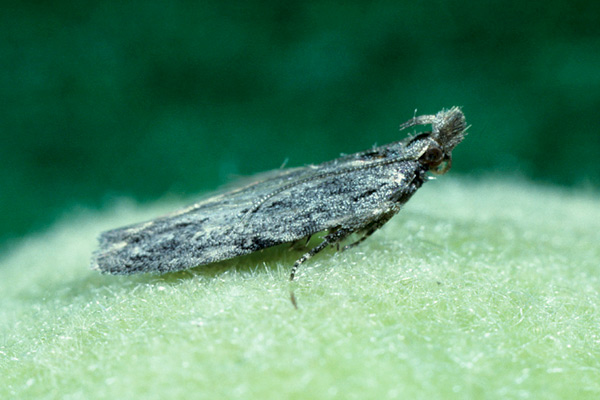
The peach twig borer (Anarsia lineatella Zell.) is distributed throughout the country, but more massively in areas where peaches and apricots are grown. It also attacks plums, almonds, sour cherries, sweet cherries, and wild plums. The caterpillar of the peach twig borer gnaws young shoots, destroying the annual growth and causing worminess in fruits. When no control measures are taken against the peach twig borer, damage can reach 15-20%.
A second spraying of peach orchards is carried out after 10-12 days with a pyrethroid insecticide – Decis 100 EC - 7.5 -12.5 ml/ha, Sumicidin 5 EC (0.02%), Aphicar 100 EC (15 ml/ha), Efcymetrin 10 EC (15 ml/ha) against anarsia, and with a sulfur-based preparation - Sulfur WG 600 g/ha, Solfo 80 WG – 750 g/ha, or one of the preparations - Systhane 20 EW – 0.03%, Luna Experience – 50-75 ml/ha, Flint Max 75 WG – 0.02% against powdery mildew.
Plum orchards are sprayed with Signum (45 g/ha) against rust and Chorus 50 WG (45 g/ha) against brown rot, and with one of the preparations - Carpovirusine (100 ml/ha), Madex Top (10 ml/ha), Dipel DF (50-150 g/ha), Sineis 480 SC (20-37.5 ml/ha), Delegate 250 WG (30 g/ha), Avant 150 EC (33.3 ml/ha), Deca EC (30 ml/ha), Decline 2.5 EC (30 ml/ha), Lamdex extra (60-100 g/ha) against plum fruit moth. In case of high density of mites and aphids, treat with one of the preparations - Valmec (60-96 ml/ha), Apollo 50 SC (40 ml/ha), Nissoran 5 EC (0.05%), Naturalis (100-150 ml/ha) and with Tepeki (14 g/ha), Mospilan (25 g/ha), Closer 120 EC (20 ml/ha, and in case of severe infestation 40 ml/ha), respectively.
Pear orchards infested with pear psyllids and bugs are treated with a pyrethroid insecticide – Decis 100 EC - 7.5 -12.5 ml/ha, Sumicidin 5 EC (0.02%), Aphicar 100 EC (15 ml/ha), Efcymetrin 10 EC (15 ml/ha).
Quince orchards are sprayed with Chorus 50 WG (45 g/ha) against brown rot and brown leaf spot, and with one of the preparations - Carpovirusine (100 ml/ha), Madex Top (10 ml/ha), Dipel DF (50-150 g/ha), Sineis 480 SC (20-37.5 ml/ha), Delegate 250 WG (30 g/ha), Avant 150 EC (33.3 ml/ha), Deca EC (30 ml/ha), Decline 2.5 EC (30 ml/ha), Lamdex extra (60-100 g/ha) against fruit worm.
Apricot orchards are sprayed with a pyrethroid insecticide – Decis 100 EC - 7.5 -12.5 ml/ha, Sumicidin 5 EC (0.02%), Aphicar 100 EC (15 ml/ha), Efcymetrin 10 EC (15 ml/ha) against oriental fruit moth, anarsia, San Jose scale, leafrollers, and with one of the preparations - Valmec (60-96 ml/ha), Apollo 50 SC (40 ml/ha), Nissoran 5 EC (0.05%), Naturalis (100-150 ml/ha) against mites.
Sweet cherry and sour cherry orchards are treated with Silit 544 SC – 125 ml/ha against cylindrosporiosis.
In strawberry plantations
Strawberry plantations infested with root weevils are sprayed with one of the insecticides - Decis 100 EC (17.5 ml/ha) or another based on deltamethrin, Mospilan 20 SP (30 g/ha), Naturalis (100 ml/ha) – by watering, beforehand.
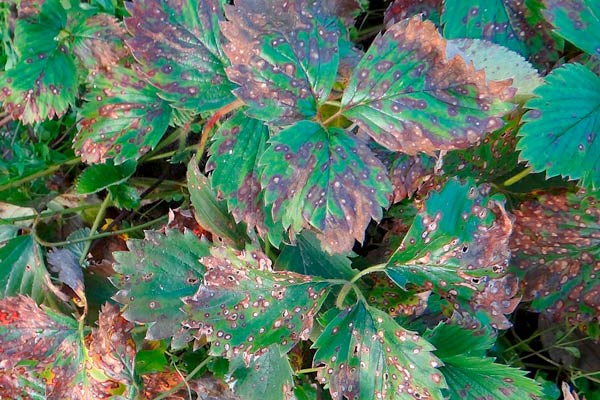
White leaf spot on strawberry is the most widespread and most damaging disease of strawberry. It appears on both cultivated varieties and wild strawberry species. The causal agent of white leaf spot on strawberry is the fungus Mycosphaerella fragariae, which infects leaves and their petioles, stolons, inflorescences, sepals, and rarely fruits. The manifestation of symptoms is most severe and typical at a temperature of 20-25°C. Highly susceptible to white leaf spot on strawberry are the varieties Eva Macherauch and Mieze Schindler, while resistant ones include Zenga Zengana, Belrubi, Madame Moutot, Early Market, Redgauntlet, Gorella, Pocahontas, Cambridge Favourite, Holiday, Sharpless, White Pineapple, and others.
After harvesting the fruits, strawberry plantations are sprayed with a copper preparation - 1% Bordeaux mixture, Funguran OH 50 WP -150-250 g/ha, Champion WP - 0.3%, Caper Key – 180-300 g/ha against white and red leaf spots.
In raspberry plantations
After harvesting the fruits, the plantations are sprayed with a pyrethroid insecticide – Decis 100 EC - 7.5 -12.5 ml/ha, Sumicidin 5 EC (0.02%), Aphicar 100 EC (15 ml/ha), Efcymetrin 10 EC (15 ml/ha) against raspberry beetle, raspberry gall midge, raspberry agrilus. In case of mite infestation, add one of the preparations - Valmec (60-96 ml/ha), Apollo 50 SC (40 ml/ha), Nissoran 5 EC (0.05%), Naturalis (100-150 ml/ha).
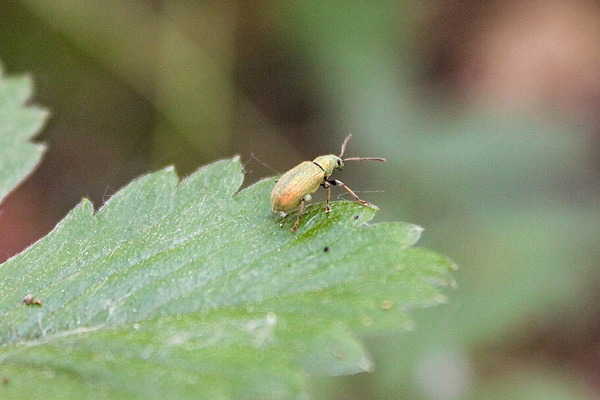
The common raspberry beetle (Byturus tomentosus) has become the economically most important pest of raspberry. It also attacks blackberry, but less severely. Damage is caused by the adult (beetle) and the larva. The adult attacks flower buds and flowers, damaging the stamens, pistil, and young fruit set, and also gnaws leaves. The larva is more harmful; it feeds on the interior of the fruits, causing them to become wormy.
Raspberry plantations are sprayed with a copper preparation - 1% Bordeaux mixture, Funguran OH 50 WP -150-250 g/ha, Champion WP - 0.3%, Caper Key – 180-300 g/ha against leaf spot.
In currant plantations
Currant plantations are sprayed 10-12 days after the last spraying with a pyrethroid insecticide – Decis 100 EC - 7.5 -12.5 ml/ha, Sumicidin 5 EC (0.02%), Aphicar 100 EC (15 ml/ha), Efcymetrin 10 EC (15 ml/ha) against currant clearwing moth.
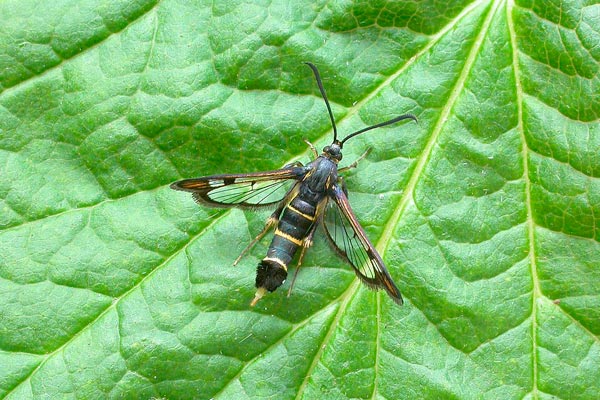
Currant clearwing moth (Synanthedon tipuliformis Cler.) is widespread in our country. It attacks currants and gooseberries. Damage to shoots reaches over 30-40%. The currant clearwing develops one generation per year. It overwinters as a caterpillar of various ages in the tunnels, most often in two-year-old stems. In case of mass infestation, entire bushes die. Damage is usually noticeable towards the end of June – mid-July. Caterpillars continue to feed until late autumn and, when it gets cold, remain to overwinter in the damaged areas.
After harvesting the fruits, the plantations are sprayed with one of the preparations - Valmec (60-96 ml/ha), Apollo 50 SC (40 ml/ha), Nissoran 5 EC (0.05%), Naturalis (100-150 ml/ha) against mite species.
The inter-rows in currant plantations are sprayed with Agroxon 500 SL (120 ml/ha) and Fusilade Max 125 EC (100-300 ml/ha). Weeds are mapped a second time.
In vineyards
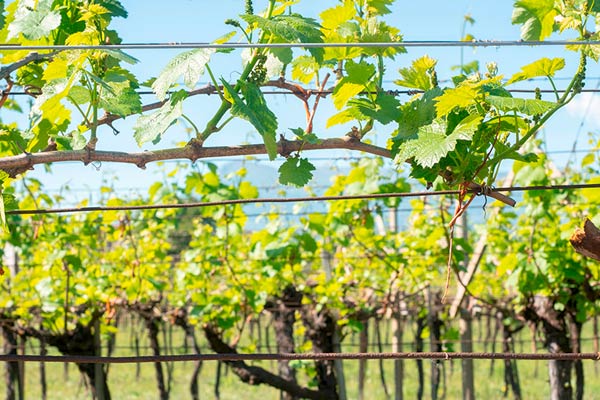
In vineyards, a fight is waged against downy mildew and powdery mildew. These diseases can destroy the leaf mass prematurely, as a result of which the yield significantly decreases.
The fight against downy mildew should start immediately after the appearance of shoots above the wires. In case of frequent rainfall and dew, spray every 3–7 days for each incubation period, and in dry weather – before each irrigation. Treat with one of the preparations - Quadris 25 SC – 0.075 – 0.1%, Ridomil Gold Combi 45 WG – 200 g/ha, Ridomil Gold R WG – 500 g/ha, Ridomil Gold SL – 20 ml/ha. If you wish to treat biologically, for prevention, before or after rain, since the mentioned fungicides are not systemic, you can use a copper preparation - 1% Bordeaux mixture – 180 - 300 g/ha solution, Funguran OH 50 WP – 150 - 250 g/ha, Champion WP - 0.3%, Caper Key – 180 - 300 g/ha. Serenade ASO is also an option, but it acts weaker than the systemic fungicides mentioned.
For contact fungicides – Akoidal WG – 0.25%, Azumo 80 WG – 400 g/ha, Cumulus – 0.2-0.5%, Solfo 80 WG – 400 g/ha, the interval between individual sprays against powdery mildew should be about 7-8 days, and for systemic ones – Flint Max 75 WG – 0.016%, Folicur 250 EW – 0.04%, Custodia 320 SC – 75 ml/ha, Dinali 090 DC – 50-65 ml/ha, Domark 10 EC – 25-30 ml/ha, Dynasty 25 EW – 40 ml/ha, Luna Experience – 12-40 ml/ha, Sinstar – 70-80 ml/ha – 12-14 days.
The fight against the causal agents of the economically most important diseases in fruiting vineyards continues. During this period, besides on the leaves, visible signs of downy mildew infection can also be observed on the clusters and bunches. Flowers and young fruit sets become covered with a gray-whitish spore-forming layer, darken, and dry up. In case of late infection, when the berries have enlarged, another form of the disease appears – brown rot. On the berry stem side, a brown necrosis with characteristic double depressions is observed, which gradually grow and lead to drying, mummification, and dropping. Unsprayed young berries can become infected until they soften during the veraison stage. This necessitates the last spray to be carried out when the berries reach the size of a pea.
Prophylactic treatments are recommended before sporulation of the pathogen and before rainfall. The timing of sprays is determined based on incubation periods. They are calculated according to the effective temperature, which equals the difference between the average daily temperature and 7.9 °C, which is the biological zero at which the parasite does not develop. One incubation period lasts until the accumulation of a sum of effective temperatures equal to 61 °C. The calculation of each incubation period begins in the presence of rain or dew for at least 2 hours. Prophylactic treatments against downy mildew are recommended for every 4-5 new leaves of growth.
Treat with one of the preparations - Quadris 25 SC – 0.075 – 0.1%, Ridomil Gold Combi 45 WG – 200 g/ha, Ridomil Gold R WG – 500 g/ha, Ridomil Gold SL – 20 ml/ha. If you wish to treat biologically, for prevention, before or after rain, since the mentioned fungicides are not systemic, you can use a copper preparation - 1% Bordeaux mixture – 180 - 300 g/ha solution, Funguran OH 50 WP – 150 - 250 g/ha, Champion WP - 0.3%, Caper Key – 180 - 300 g/ha. Serenade ASO is also an option, but it acts weaker than the systemic fungicides mentioned.
Powdery mildew also causes damage to grapes. The greatest damage occurs during the period of flowering, berry set, and the enlargement of young berries. Affected berries become covered with a gray-white coating that emits a faint smell of spoiled fish. Under the coating, small necrotic spots are visible where the growth of the skin has stopped. As a result, the berries crack.
Spray immediately after flowering and 12–14 days after that. Do not allow a massive coating to develop on the berries, because then the fight is very difficult and curing the grapes is almost impossible. You can treat with one of the following preparations - contact fungicides – Akoidal WG – 0.25%, Azumo 80 WG – 400 g/ha, Cumulus – 0.2-0.5%, Solfo 80 WG – 400 g/ha, systemic – Flint Max 75 WG – 0.016%, Folicur 250 EW – 0.04%, Custodia 320 SC – 75 ml/ha, Dinali 090 DC – 50-65 ml/ha, Domark 10 EC – 25-30 ml/ha, Dynasty 25 EW – 40 ml/ha, Luna Experience – 12-40 ml/ha, Sinstar – 70-80 ml/ha.
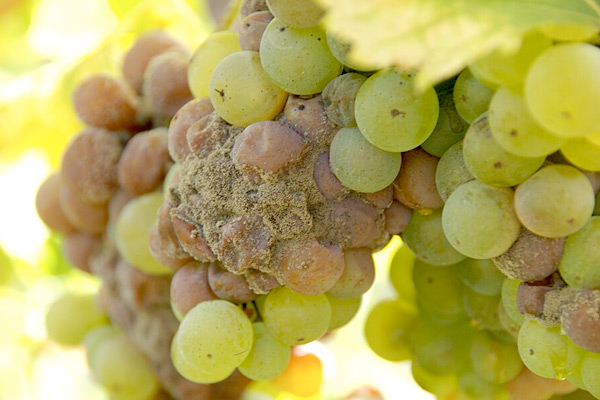
The fight against gray mold begins. Chemical control is carried out in wet and rainy weather immediately after flowering, after hailstorms, during berry enlargement, but before the bunches close, during berry clearing and veraison with some of the preparations – Switch 62.5 WG (100 g/ha), Folpan 80 WDG (0.15%) or another preparation with the active substance folpet. Among the biofungicides, Polyversum (50-100 g/ha) and Serenade Aso SC (400 ml/ha) are recommended.
Chemical treatments should be completed 2–3 weeks before harvest, and it is good to alternate preparations with different biochemical mechanisms of action, as pesticide-resistant races of the pathogen are emerging.
The fight against the second generation of the European grapevine moth continues. The ET for the second generation is 6-7 eggs or caterpillars per 100 young berries and bunches for table varieties and 10-12 – for wine varieties.
Preparations with ovicidal action are applied against the egg stage. The best in this regard are hormonal insecticides – chitin synthesis inhibitors, juvenoids, and others, such as Mimic SC – 90 ml/ha, Coragen 20 SC – 15-27 ml/ha. These preparations also act on young caterpillars, making them a suitable first choice for the next stage – treatment against caterpillars, as there are also many eggs at this time.
Against caterpillars, contact insecticides from all groups are used, such as Aphicar 100 EC – 25 ml/ha, Deca EC – 40-60 ml/ha, Decis 100 EC – 12.5-17.5 ml/ha, Lamdex extra –100 g/ha, Kedo – 40 ml/ha, Coragen 20 SC – 15-27 ml/ha, Meteor - 0.07-0.09%, Voliam – 18-30 ml/ha, Cyperfor 100 EW – 25 ml/ha, Cyclone 100 EW – 25 ml/ha, Sherpa 100 EW 25 ml/ha. The treatment should be carried out in the "black head" stage of the eggs. At higher density, at least two treatments are necessary for each generation.
Among the biological means for controlling grapevine moths, against eggs, parasites of the genus Trichogramma can be used at a rate of 80,000 - 100,000 individuals per decare, colonized 3 times per generation. Against caterpillars - bacterial preparations based on Bacillus thuringiensis - Dipel DF – 50-100 g/ha, Dipel 2X – 100 g/ha, Forey 48 SC – 250-400 ml/ha, Rapax – 100-200 ml/ha, as well as preparations obtained from the fermentation of microorganisms Milsah, Spinlai, Tulga 480 SC – 15.8-20 ml/ha, Sineis 480 EC (spinosad) – 4-18 ml/ha.
More on the topic:
Powdery mildews on fruit species caused by pathogens of the genus Podosphaera
Plant protection care for the vine in June
Resistance in viticulture and methods for controlling grapevine moths