

![MultipartFile resource [file_data]](/assets/img/articles/гъмза-заглавна.jpg)
In recent years, there has been a revival of local grapevine varieties, which are associated with the identity of Bulgarians and the old traditions in vine growing and winemaking.
For the second consecutive year, the Open Day at the Institute of Viticulture and Enology – Pleven, held on 28 August, was dedicated to a local wine variety. In the past, the red wine variety “Gamza” was grown exclusively in Northern Bulgaria, but today a considerable number of vine growers in the country choose it because of its high yield and quality.
The scientists from the Institute of Viticulture and Enology – Pleven successfully combine science, tradition and modern technologies, and the achievements and developed resistant varieties are a significant contribution to the preservation of wine production, emphasized the Deputy Minister of Agriculture and Food Yanislav Yanchev during the Open Day.
“Capricious” – this is the translation of the word “gamza”, whose roots come from Arabic. This local autochthonous grape variety is a representative of the Black Sea ecological-geographical group and in the past was grown entirely in Northern Bulgaria.
Gamza is a late-ripening variety and in the Pleven region the grapes ripen at the end of September and the beginning of October. The duration of the vegetation period from bud burst to technological ripeness of the grapes is about 170 days. The vines are of medium to strong growth, with high fertility and yield, but very often the vines are overloaded with grapes, which leads to a significant decrease in sugars, colouring matter and extract, and the quality of the wine deteriorates greatly. Therefore, the Institute of Viticulture and Enology – Pleven recommends that Gamza be grown as a high-trained vine, in Moser-type training systems, with the application of short pruning.
The variety is susceptible to the fungal diseases downy mildew and powdery mildew and is highly susceptible to grey rot, especially in years with a rainy autumn. It is not resistant to low winter temperatures, but has a high regenerative capacity. Due to its low cold hardiness, it is advisable to grow it mainly in training systems such as goblet and single Guyot. In regions without extremely low winter temperatures, it can be grown in trunk training systems with short fruiting units – on spurs. The variety develops and bears well when grafted onto all rootstocks distributed in our country.
In Gamza there are a number of low-value variations that are not propagated, but the Gamza clone N5 selected at the Institute of Viticulture and Enology – Pleven, approved by the Executive Agency for Variety Testing, Field Inspection and Seed Control in 2023, is characterized by very good economic traits.
The potential of local grape varieties
In recent years, there has been a revival of local grapevine varieties, which are associated with the identity of Bulgarians and the old traditions in vine growing and winemaking. This is due, on the one hand, to the saturation of the market with introduced popular varieties such as Chardonnay, Cabernet, Merlot, Pinot Noir and others, and on the other hand – Bulgarian wineries are small and boutique, and their strength lies in offering varieties traditional for the country, best adapted to local conditions, in which the wines offered can unfold their potential and at the same time offer something different on the world market.
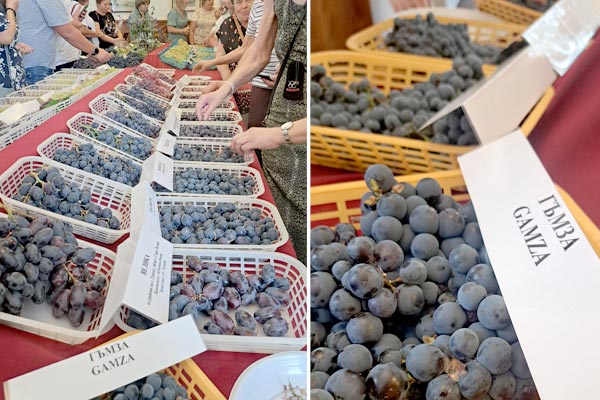
Despite the need to develop a new zoning system in viticulture, caused by changing climatic conditions, more and more Bulgarian wine producers are turning to local varieties.
Open Day at the Institute of Viticulture and Enology – Pleven
For the second consecutive year, the Open Day at the Institute of Viticulture and Enology – Pleven was dedicated to a local wine variety. Gamza is one of the emblematic varieties characteristic of the region of Northwestern and Central Bulgaria, and its history, characteristics and significance were presented by the scientists from the Institute of Viticulture and Enology – Pleven on 28 August. Last year, 395,000 litres of wine from this variety were produced, and the area under vines exceeds 300 hectares, including 9.5 hectares of newly planted vineyards in the districts of Vidin and Veliko Tarnovo.
Within the framework of the event, the influence of oak wood on the wines produced from this old local variety at the Institute was also presented. The Institute has one of the most authentic wineries on the Balkan Peninsula, founded in 1892. It has been declared a cultural monument and houses the oldest wine collection in the country.
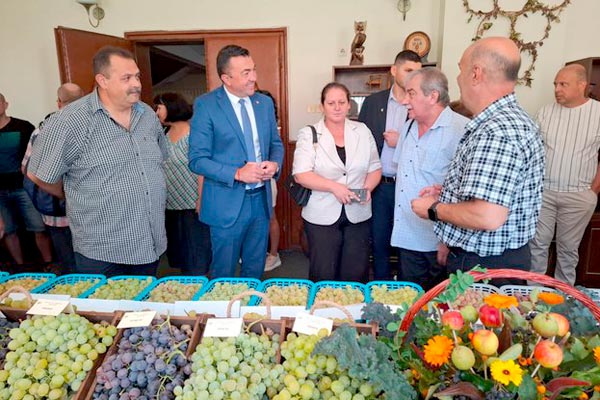
Deputy Minister of Agriculture and Food Yanislav Yanchev emphasized that the scientists at the Institute successfully combine science, tradition and modern technologies, and the achievements and developed resistant varieties are a significant contribution to the preservation of wine production. Photo © Ministry of Agriculture and Food
An important part of the Open Day was the annual exhibition of 50 grape varieties, developed by the Institute of Viticulture and Enology – Pleven, the Institute of Agriculture in Kyustendil, Obraztsov Chiflik – Ruse and the Agricultural University.
The surprises for the guests, such as ice cream and frappe, were reserved for the long-awaited moment of the Gamza tasting, in which eight wineries from the region took part this year. The frappe, which will also be available at the wine festival in Pleven, contains milk, but instead of coffee, a special emulsion of wine, fibres and proteins is added. The drink was developed by Nikolay Solakov from the Institute of Cryobiology and Food Technologies in Sofia.
The Open Day is part of the programme of the third edition of the festival of wine and farmers’ delicacies Time for wine, which will be held from 29 to 31 August in Pleven. In addition to the products of winemakers and producers of meat and dairy delicacies, the programme includes concerts, workshops, demonstrations and various techniques for cooking with wine.