

![MultipartFile resource [file_data]](/assets/img/articles/юли-край-2025.jpg)
During the last week of July, the agrometeorological conditions will continue to be determined by hot weather. The extremely high temperatures, reaching and exceeding 40°C, will further deteriorate the condition of the spring crops that have fallen into physiological stress.
In Northeastern Bulgaria (Silistra and Provadia agrometeorological stations), as a result of the deepening drought and above-normal July temperatures, part of the maize stands will prematurely terminate their vegetation and will not be harvested.
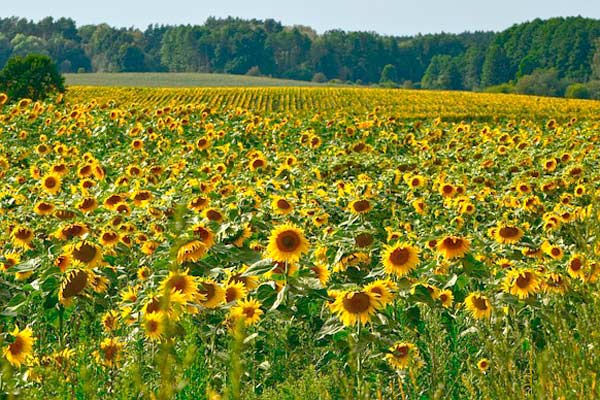
In sunflower crops in Southern Bulgaria, the ripening stage will be observed earlier than the usual periods (Plovdiv, Haskovo, Yambol). A large part of the sunflower stands, as a result of the moisture deficit, have small, poorly filled heads. In the case of the earlier maize hybrids grown under irrigated conditions, the milk maturity stage will be observed.
A decrease in temperatures, precipitation and a positive change in the agrometeorological conditions is expected during the last days of July.
In the middle of the period, conditions for hail are forecast – yet another challenge for agricultural crops. Vegetable and fruit crops affected by hail should preferably be treated with copper-containing fungicides at the first possible opportunity after the event.
Official data show that the wheat harvest in Dobrich region is in its final stage, and despite the capricious spring and the prolonged drought, farmers in the region are hoping for a successful campaign.
The highest yields so far have been reported in the municipality of General Toshevo with 684 kg/da, followed by the municipality of Krushari with 649.7 kg/da and the municipalities of Balchik and Kavarna with 630 kg/da each.
In the fields of the Dobrudzha Agricultural Institute the harvest is also in full swing and a better yield compared to last year is expected. Selection plays a key role in the good results, reports the Director, Associate Professor Iliya Iliev. In addition, this year the Institute has participated in a programme to improve soil condition through additional products for enhancing soil health, which also has an effect. When balanced nutrition of the crops is also ensured, results are not long in coming.
According to the forecast of wheat and barley yields before harvesting the 2025 crop by the Ministry of Agriculture and Food, wheat production is expected to reach 6.6–7.1 million tonnes, and barley production – 0.9–1.2 million tonnes.

The barley harvest in Dobrich region has been completed and the obtained barley yields in some places in Eastern Bulgaria are over 600 kg/da (Silistra agrometeorological station – 700 kg/da, Balchik, Kavarna and General Toshevo – around 700 and over 700 kg/da).
Despite the good results, and that under stressful climatic conditions in recent years, interest in this crop is still not increasing.
The good news is that in the current farming year the barley stands total 154,000 da, compared to last year – 137,000 da.
Farmers can choose between foreign and Bulgarian breeding, which offers extremely good feed and malting barley varieties on the market. In recent years, breeders from the Dobrudzha Agricultural Institute and the Institute of Agriculture – Karnobat have been developing high-yielding varieties with great plasticity, which are suitable for various climatic conditions and regions. Some of them are included in the variety lists of neighbouring countries such as Moldova, North Macedonia and Turkey. Bulgarian breeding is characterised by high drought tolerance combined with high winter hardiness and copes well with problems such as lodging and economically important diseases.
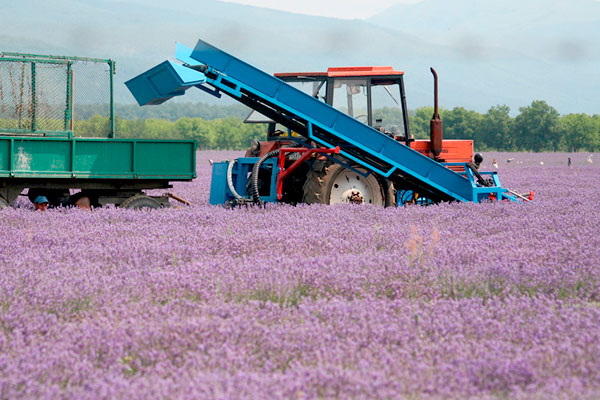
In parallel with the wheat harvest in Dobrudzha, lavender harvesting is also underway, with the largest areas under the aromatic crop in General Toshevo – over 8,000 decares. Currently, the yield there is about 300 kg/da.
In the current year, the total number of lavender fields is almost 20,000 da, while last year a total of 27,000 da were harvested. After the massive boom of the purple blossom in 2016, when the essential oil crop covered areas of 100,000 da, a sharp decline in its cultivation is currently being observed. This year in Dobrudzha only 90 da of new plantations have been established.
In Kazanlak and Pavel Banya the campaign has also started, with average yields between 280 and 320 kg/da.
The leading factor in the cultivation of this essential herb is the quality and price of lavender oil. The oil recovery rate from lavender depends primarily on the variety, but also on climatic conditions, cultivation technology and the harvest period. Thus, in dry and hot weather the oil accumulates in the inflorescence, while in cool and rainy conditions the oil yield is low. The essential oils market in recent years has been quite dynamic and if 7 years ago prices for a kilogram of lavender oil ranged from BGN 250 to 300, in the following year they failed to exceed BGN 50 per kilogram. An exception in price exists only for organically certified producers, which confirms the quality-to-market ratio.