

![MultipartFile resource [file_data]](/assets/img/articles/слънчоглед-температура-юли-2025.jpg)
In July, the development of agricultural crops will proceed at temperatures above climatic norms. A determining factor for the vegetation of spring crops will be soil moisture reserves, which sharply decreased at the beginning of summer. In some places in Northwestern Bulgaria (Buzovets agro-station) and in the southern regions, moisture is absent in the 50cm soil layer, and in the 100cm layer, the level of moisture reserves is low - below 60% of Field Capacity.
Subnormal rainfall is also forecast for July, and the soil moisture deficit will deepen, necessitating the application of an appropriate irrigation regime for agricultural crops.
Increased irrigation norms will be necessary for spring crops during the second and third ten-day periods of July, when relatively dry and hot weather, with extremely high temperatures, is forecast.
Extreme heat and lack of rain pose a serious threat to the spring crop harvest
During the month, various phases will be observed in corn, depending on its earliness. In the first ten days, earlier hybrids will undergo tasseling, anthesis, and silking, while by the end of the third ten days, the milky maturity stage will be observed in some crops.
Sunflower will undergo flowering, fertilization, and seed filling. By the end of the month, the beginning of the ripening stage will be observed in crops in some parts of the Danubian Plain and in the southeastern regions.
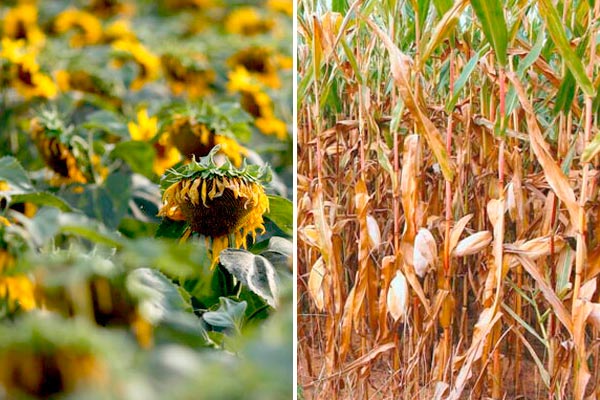
The forecasted high maximum temperatures in July, above 38-40°C, will have an unfavorable impact on flowering and fertilization in sunflower and corn, disrupting the normal course of physiological processes in agricultural crops. Above 35 °C, the pollination process in sunflower stops.
The dry and hot weather during the first ten days of July, with maximum temperatures reaching 40 – 42°C in some parts of the Danubian Plain (Nova Selo, Svishtov, Ruse, Silistra), calls into question the survival of some spring crops grown under rainfed conditions. In some places in Northeastern Bulgaria (Shumen, Ruse, Silistra, Provadia, Preslav) and the southern regions, corn and sunflower show severely impaired turgor, and in some crops, yellowing and drying of leaves from the lower tiers of the plants are observed.
During the second ten days of July, rainfall is expected in the western regions, but against the backdrop of the deepening drought, it will be extremely insufficient to overcome the soil moisture deficit. The application of an appropriate irrigation regime remains a priority measure for agricultural crops.

During the month, meteorological conditions will limit the development of a number of fungal diseases, with the exception of powdery mildews on fruit trees, vines, and vegetable crops. For fruit crops unaffected by spring frosts, treatments against the second generation of fruit worms should continue, and for vines – against the caterpillars of the second generation of the grape berry moth. Treatments against diseases and pests should be carried out during the cooler hours of the day.
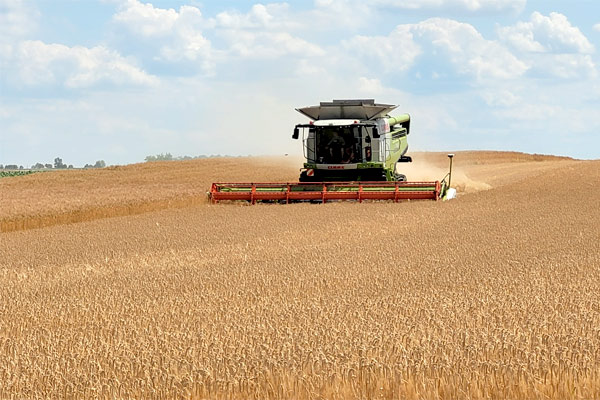
Under conditions of increased fire danger, the wheat harvest continues in July.
Official data show that the wheat harvest in Dobrich region is in its initial stage, but despite the vagaries of spring and the persistent drought, farmers in the region hope for a successful campaign. Currently, only 95,630 decares have been harvested out of a total of 1,298,724 decares of sown areas, representing only about 7.4% of the total sown area. So far, 58,201 tons of wheat have been produced with an average yield of 608.6 kilograms per decare.
The highest yields to date have been reported in General Toshevo municipality with 684 kg/decare, followed by Krushari municipality with 649.7 kg/decare, and Balchik and Kavarna municipalities with 630 kg/decare each.
In the fields of the Dobrudzha Agricultural Institute, the harvest is also in full swing, and a better yield compared to last year is expected.
Selection plays a major role in the good results, reports the director Assoc. Prof. Iliya Iliev. Furthermore, this year the institute participated in a program to improve soil conditions with additional products for enhancing soil health, which also has an impact. And when balanced nutrition for the crops is included, the results are not long in coming.
The barley harvest is almost complete in the country, and the yields obtained from barley in some parts of Eastern Bulgaria are over 600 kg/decare (Silistra agro-station - 700 kg/decare).
The lavender harvest continues throughout the month, with the largest areas of the aromatic crop located in General Toshevo – over 8,000 decares. Currently, the yield there is around 300 kg/decare. The campaign has also started in Kazanlak and Pavel Banya with average yields between 280 and 320 kg/decare.