

![MultipartFile resource [file_data]](/assets/img/articles/прогноза-3-юни-царевица-2025.jpg)
After the high temperatures in mid-June, which reached and exceeded 35-36° in some southern regions, no changes in agrometeorological conditions have been observed. The expected rainfall at the beginning of the period will be without economic significance. Due to sub-normal rainfall and above-normal temperatures during the first and second ten-day periods of June, soil moisture reserves for spring crops significantly decreased. In some southern regions, the level of moisture reserves in the 50cm layer for corn and sunflower is unusually low for the beginning of summer - below 60% of field capacity.
For most days of the upcoming period, the vegetation of spring crops will proceed at temperatures around and above the climatic norms for the third ten-day period of June, and in many field regions – also with a deficit of soil moisture. This is the third consecutive year with a sharp drought during the summer months, which is detrimental to the corn and sunflower crops.
During the period, inflorescence formation will occur in sunflowers.
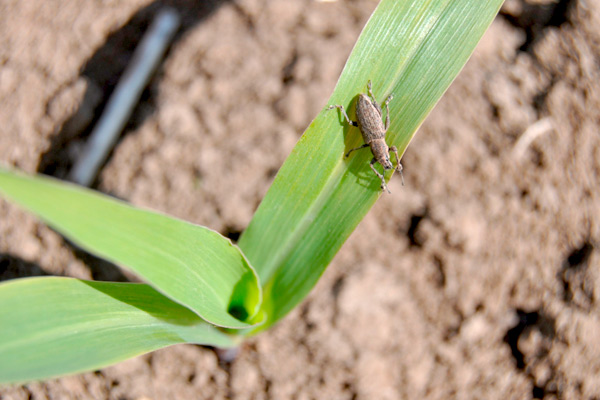
Attack by the gray corn weevil is particularly dangerous for spring crops. Scientists from the Agricultural Institute – Shumen conducted a survey of corn and sunflower fields in the regions of Veliko Tarnovo, Targovishte, Ruse, Razgrad, and Shumen and found significant damage from the pest.
Leaf formation will occur in corn. At the end of June, the beginning of the tasseling phase will be observed in early corn hybrids.
During the third ten-day period of June, the inspection of corn crops for the presence of one of the most dangerous pests – the European corn borer – should continue, and if the numbers exceed the economic threshold (10 egg masses per 100 plants), an insecticidal treatment against the larvae is necessary before they bore into the stalks.
The European Corn Borer (Ostrinia nubilalis Hübner) – an Important Economic Pest of Corn
During the period, wax and full maturity will be observed in wheat in the field regions. For crops in high-altitude fields, milky maturity and a transition to wax maturity will occur.
High maximum temperatures and a risk of fires during grain harvest are forecast.