

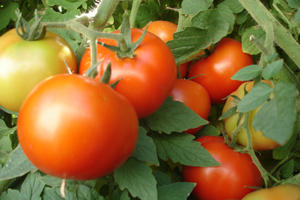
Field production. Under frequent, light rainfall and high humidity, conditions exist for the appearance of potato blight on tomatoes and potatoes, downy mildew on onions and cabbages, and phytophthora rot on tomatoes; under intense rainfall – brown leaf spot (alternaria); when rainfall is accompanied by strong wind - bacterial spot and blossom end rot on tomatoes and peppers. The development of potato blight on tomatoes and potatoes is year-round. Conditions are particularly favorable for its harmful activity in facilities with plastic coverings, where abundant dew forms. The incubation period depending on conditions is 3-10 days. The fungus develops under a specific combination of meteorological conditions – "critical periods", which are:
- Light rainfall lasting for two or more days.
- Relative air humidity during the period above 75%.
- Cloud cover above 8 on the scale.
- Average daily temperature – around 16°C (min. 10-12°C; max. 18-25°C).
Retention of water droplets on the surface of plants for more than 4 hours is also a prerequisite for new infections.
When critical periods are present, forecasting services issue a signal for crop treatment. When conditions are present and upon detection of bacterial diseases, spraying is done with 0.3% Champion; 0.3% Kocide; 0.3% Funguran, and for cucumbers – with 0.15% of the same. In phytophthora rot, the base of the stem, leaves, petioles, and fruits of tomatoes lying on the soil rot. The damage to fruits is known as "buckeye rot", due to the characteristic spots with concentric rings. For control, 0.25% Acrobat R; 0.4% Cupertin M; 0.25% Copper oxychloride 50 WP; 0.25% Corsair R DF; 0.3% Cuproxat FL; 0.15% Funguran OH; 0.15% Champion WP can be used, and it is good to also spray the soil surface around the plants. Against the other mentioned diseases, as well as against downy mildew (Cuban) on cucumbers, the plant protection products (PPPs) recommended for greenhouse production are applied.
Usually in the first ten days of June, the leafhopper Hyalesthes obsoletus appears, which transmits stolbur to peppers, tomatoes, eggplants, celery, etc. Control is carried out upon signal from forecasting services, with several sprays at 10-12 day intervals using 25 g/da Mospilan 20 SP; 125 ml/da Eforya 045 ZK. Against the vector of tomato spotted wilt virus on tomatoes, peppers, eggplants, etc. – the tobacco thrips, the insecticides recommended for seedlings and greenhouse production are applied. Upon appearance of other pests, also mentioned for seedlings and greenhouse crops, the respective insecticides are used. Against Colorado potato beetle on potatoes, eggplants, tomatoes, spray 10 ml/da Vaztak New 100 EC; 30 ml/da Nexide 015 CS; 10 ml/da Fury 10 EC; 50 ml/da Nurelle Dursban; 20 ml/da Biskaya 240 OD; 6 g/da Actara 25 WG; 6 g/da Mospilan 20 SP; 10 ml/da Calypso 480 SC; 20 ml/da Alverde 240 SC; 6 ml/da Coragen 20 SC and 4-6 g/da Dantop 50 WG. Appearance of grasshoppers may be observed, against which treatment is done with 120 ml/da Dursban 4 E; 20 ml/da Vaztak New 100 EC; 50 ml/da Karate Zeon 5 CS.
The first hailstorms also occur this month. The inflicted damage is assessed after 2-3 days. On small areas, severely damaged plant parts are removed. After about a week, the affected crops are sprayed with 0.15% Champion WP, with the mandatory addition of 0.05% sticker. Top dressing is done with 10-20 kg/da ammonium nitrate. At discretion, the pesticide solutions are combined with foliar fertilizer.
When treating onion and cabbage crops, 0.05% sticker is added to the pesticide solutions.
All requirements for application (registered PPPs, quality spraying, dosages, pre-harvest intervals), transport, and storage of chemical plant protection products must be observed. Hygienic-sanitary norms for working with toxic substances must be observed. A treatment log must be kept.