

![MultipartFile resource [file_data]](/assets/img/articles/праз-заглавна-отглеждане.jpg)
It is grown in all regions of the country. It contains less essential oil than onion and garlic and therefore is less pungent, with a more pleasant taste, and can be consumed in larger quantities. It is mainly grown through seedlings.
Suitable predecessors are lettuce, green peas, kohlrabi, early cabbage, etc. Leek occupies the area from the end of June or the beginning of July until the beginning or middle of December.
For raising seedlings, the seeds are sown at the end of February – beginning of March on an open seedbed. For 1 sq. m, 6–8 g of seed are used, and for 1 decare 250–300 g and 40–50 sq. m seedbed area are required. Seedling care includes: regular irrigation, fertilization, and weeding. When sowing is done around mid-March, the seedlings are ready for transplanting in the second half of June. The criteria for good quality seedlings are an average weight of a single plant over 4 g and a diameter of the pseudostem at its lower part of 5–7 mm.
After the predecessor is harvested, the soil is ploughed to a depth of 20–22 cm, and then cultivated and harrowed. Leek is grown on a high flat bed or flat surface in a four-row strip 60+30+30+30/8–10 cm; it can also be planted two plants together at a distance of 15 cm.
Immediately after planting, more frequent irrigations are carried out to ensure establishment. The stands must be irrigated regularly. For weed control in leek cultivation, Lentagran WP can be used – 200 g/da against annual broadleaf weeds – applied once in spring, after planting, when the third leaf is clearly visible (>3 cm).
With the first cultivation of the plants, it is advisable to apply top dressing with ammonium nitrate at a rate of 10–15 kg/da. Leek is cultivated with a cultivator 2–3 times shallowly (5–6 cm) or manually. The second top dressing with ammonium nitrate, also at a rate of 10–15 kg/da, can be carried out in the second half of September.
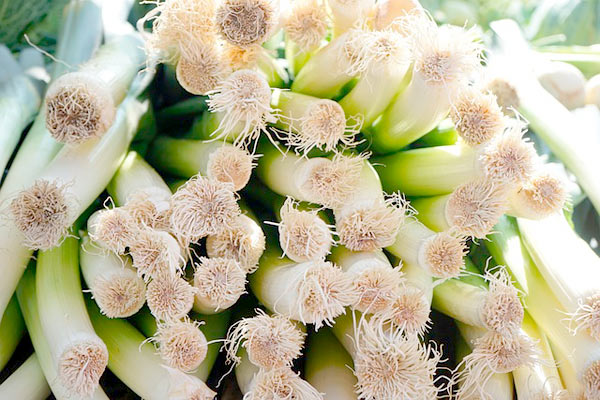
Leek is harvested late in autumn, in the first half of November. The plants are undercut with a knife-scoop. The dried or yellowed leaves of the uprooted plants are removed, the soil around the roots is cleaned off, and the leaves are cut 15–20 cm above the pseudostem. The cleaned plants are tied into bundles of 25–30 pieces. Average yields are about 3.0–3.5 t/da, but yields of 5–6 t/da can be achieved.
For weed control in leek cultivation, the following herbicides can be used: LENTAGRAN WP (200 g/da against annual broadleaf weeds) – applied once in spring; FOCUS ULTRA / STRATOS ULTRA (200 ml/da) against annual grassy weeds and volunteer cereals (wheat, barley) and perennial grassy weeds, including rhizomatous johnsongrass; CHALLENGE 600 SC (400 ml/da against annual grassy and broadleaf weeds) in leek for seed production, applied after sowing and before emergence.