

![MultipartFile resource [file_data]](/assets/img/articles/заглавна-нови-сортове-1.jpg)
Over the last 2–3 decades, significant economic damages in many regions of the world have been caused by changes in agroclimatic resources. The Balkan Peninsula is no exception to the increase in temperatures, changes in the distribution of precipitation and the growing frequency of extreme events – mainly droughts and frosts.
It is known that Bulgarian agriculture develops under specific agrometeorological conditions. The climate of the country is characterized by a deficit of atmospheric and soil moisture during the active vegetation of crops and yield formation.
A team of scientists working under the National Scientific Programme “Healthy Foods for a Strong Bioeconomy and Quality of Life” undertook a detailed study of the problem. The aim of this research is to assess the changes in the agrometeorological conditions for the growth of the main cereal crops and the possibilities for response through agrotechnologies. In the scientists’ observations, an important role is played by the characteristics of modern varieties and hybrids of spring and winter cereal crops. The next important factor is the specific requirements for hydrothermal conditions in the different phenological phases of the development of agricultural crops, i.e. the sums of temperatures and precipitation.
For the adaptation of agrotechnologies in activities aimed at overcoming adverse conditions, as well as the increased frequency of extreme events, maximum use of natural agroclimatic resources must be included. An in-depth assessment of the agrometeorological conditions is also required for the selection of appropriate agrotechnological activities. The study examined the changes in agrometeorological conditions during the recent 30-year period (1986–2015) compared to the reference period (1961–1990) for the cultivation of the main cereal crops and the possibilities for response through agrotechnological measures. The result of the work of scientists from the National Institute of Meteorology and Hydrology, the Agricultural Academy and the Agricultural University is the article “Climate Change – a Challenge for Bulgarian Farmers” (https://www.mdpi.com/2077-0472/12/12/2090).
The outlined trends in the change of hydrothermal conditions necessitate the undertaking of corresponding changes in technology, in the zoning of crops and in the development of varieties and hybrids with high plasticity for maximum utilization of natural agroclimatic resources in each of the regions of the country. This will help to:
1. Draw up accurate and up-to-date forecasts of agrometeorological conditions, crop growth and development, and expected yields;
2. Guide breeders in the development of new varieties and hybrids;
3. Update the agroclimatic zoning of agricultural crops;
4. Optimize the varietal and hybrid composition of the cultivated crops for maximum utilization of agroclimatic resources;
The application of the obtained scientific results in agricultural management programmes, with a view to their multiplication, can be implemented through:
• Shifting sowing dates in order to adapt crops to rising temperatures. This will allow crops to develop during a period with temperatures closer to the most favourable, optimizing the duration of cultivation, especially the grain-filling period in cereal crops;
• Growing winter varieties with an appropriate development period, which will allow them to make maximum use of the accumulated soil water and temperatures above 5 °C during the months of December, January and February.
• Using varieties and hybrids with a shorter vegetation period as spring crops in areas with summer drought, and those with a longer vegetation period in areas with winter drought;
• Focusing on early and medium-early varieties during the vegetation period from April to October under conditions of drought and drought with a tendency for rising temperatures, which will allow crops to complete their development earlier and eliminate yield loss from extreme agrometeorological conditions;
• Seeking advice and expertise from specialists for the introduction of precision agriculture in the context of dynamically changing agroclimatic conditions, which will minimize costs and increase the competitiveness of production.
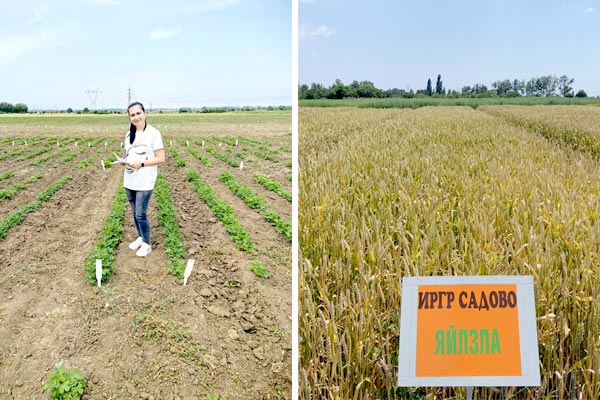
The newest wheat variety Yailzla, developed at IRGR-Sadovo. Group A, i.e. with excellent baking quality, combined with stable yield.
The best response to changing agroclimatic conditions is the development of new varieties. Interest in plant breeding and its importance has been demonstrated since her student years by Daniela Slavcheva, a PhD student at IRGR-Sadovo. The topic of her dissertation is “Establishment of the Genetic Nature and the Modes of Inheritance of Important Economic Traits in Self-Pollinating Crops – Peanut Arachys hipogaea L. and Common Winter Wheat Tritiсum aestivum L”.
The aim of the study is to establish the genetic nature and the modes of inheritance of important economic traits in self-pollinating crops – peanut and common winter wheat, to develop methods for the selection of parental pairs and to obtain investigated hybrid material.
The implementation of the scientific research will be carried out through the following tasks:
1. Study of the bio-morphological traits of ecotypes and varieties of peanut and wheat.
2. Development and verification of methods for the selection of parental pairs.
3. Study of the modes of inheritance and the genetic nature of the investigated traits in F1 hybrid progeny.
In the dissertation, the following accessions will be used and studied as parents
– for peanut: 10 accessions from North America, 10 accessions from South America, 10 accessions from Africa, 10 accessions from Asia and 51 accessions from Bulgaria
– for wheat: 10 accessions from Hungary, 10 accessions from Serbia, 10 accessions from Kazakhstan and 50 accessions from Bulgaria.
With the development of the topic, the study and selection of parental pairs for hybridization, the type of inheritance and the genetic effects in the obtained progenies will be established and defined. The selection of parents will be verified and hybrid material will be obtained and studied.
The selection of parental pairs is an important stage of the breeding process in order to develop new Bulgarian varieties of wheat or peanut that are well adapted to the cultivation conditions. The development of a single variety is a long process, lasting 10 or more years. Approval of a new variety by IASAS and the Patent Office means that it is the best response to changing agroclimatic conditions.
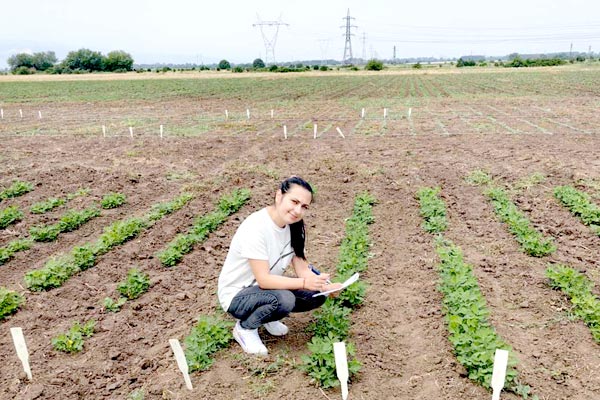
PROFILE
In February 2024, after successfully passing a competitive procedure, Daniela Slavcheva Toncheva was enrolled as a full-time PhD student at IRGR-Sadovo, within the Agricultural Academy.
The topic of her dissertation is “Establishment of the Genetic Nature and the Modes of Inheritance of Important Economic Traits in Self-Pollinating Crops – Peanut Arachys hipogaea L. and Common Winter Wheat Tritiсum aestivum L”.
She has been part of the team of the Breeding-Genetic and Variety Maintenance Department at IRGR, Sadovo since October 2021. Her work as an agronomist is related to the breeding process of triticale.
PhD student Daniela Toncheva is a graduate of the Agricultural University – Plovdiv. Her Bachelor’s degree is in “Ecology” and her Master’s degree in “Plant Protection”.
Daniela clearly stands out with her desire for creative thinking and analysis of results, and not only routine application of the protocol for the implementation of breeding methods, laboratory and field studies and their documentation. She seeks answers to some challenges in plant breeding, more specifically to climate change,expressed in an increase in average monthly temperatures and in the annual amplitude between maximum and minimum air temperatures. Data from phenological observations show faster plant development by 7–15 days in different climatic regions, among other effects.
For Daniela, changing the properties of plants in order to obtain new desired characteristics is a virtuoso process comparable only to the creation of art. She is a young scientist capable of modelling and implementing the creative breeding process that responds to contemporary problems in agriculture and to the changing conditions of the climatic environment.