

![MultipartFile resource [file_data]](/assets/img/articles/заглавна-фасул-1.jpg)
Beans are a traditional leguminous crop that occupies a significant share in feeding the population due to its high biological and economic qualities.
Beans actively participate in crop rotations, enriching the soil with nitrogen and serving as an excellent preceding crop for all field crops.
Beans originate from Asia and the tropical regions of America, but nowadays they are widely distributed in Europe.
In April, a comparative field experiment was set up at the IPGR-Sadovo experimental field to study the biological, morphological, and economic characteristics of a collection of 120 bean samples with diverse geographical origins (Fig. 1). FAO country codes were used in preparing the graph.
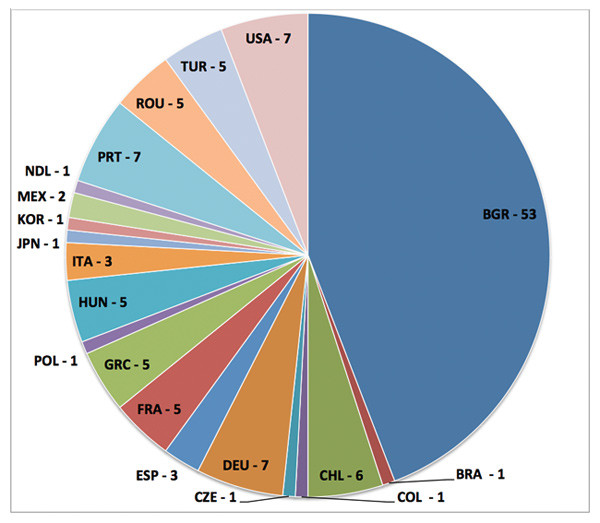
Fig. 1. Origin of Ph. vulgaris samples included in the study
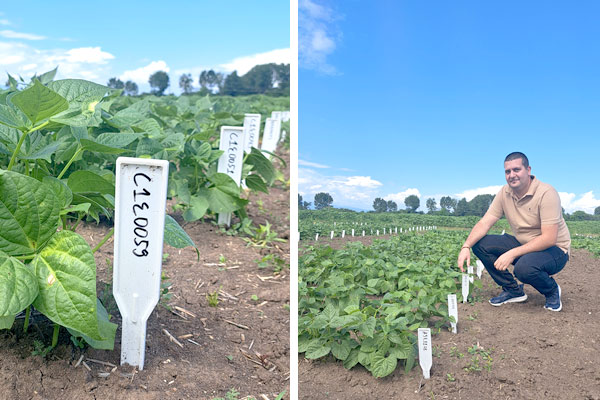
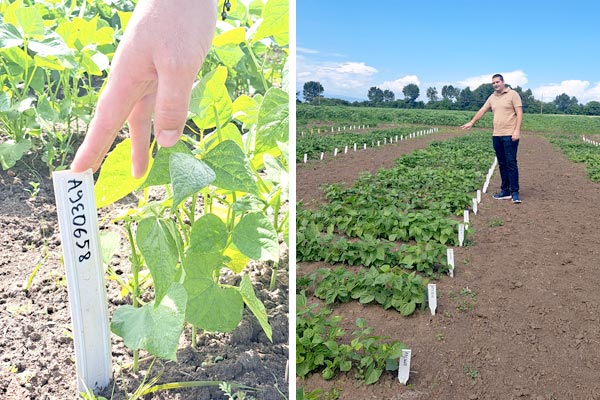
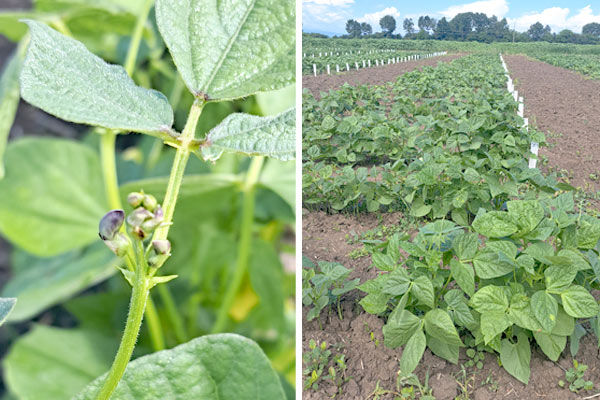
Photos by RZ magazine, taken on May 29, 2024, during the open „Farmer's Day“ at IPGR-Sadovo
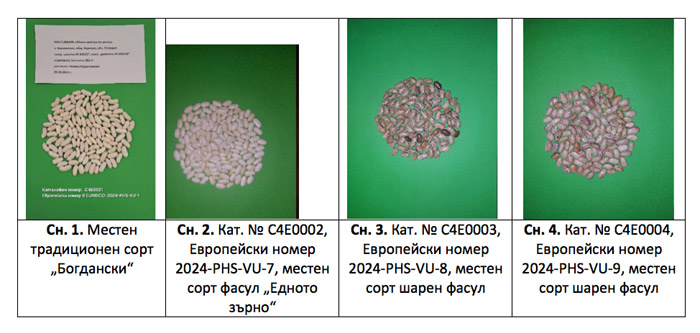
Samples were selected from the gene pool preserved in the seed gene bank in Sadovo. The literature review conducted at the beginning of the experiment hypothesizes that local and traditional varieties, comprising 53 samples (44% of the sample set), are characterized by great diversity in terms of habitus, shape, coloration, and biological content of the seeds. Introduced samples account for 56% and originate from the following continents: North America, South America, Asia, with the most being from Europe (43 samples). Nine samples were selected from North America, eight from South America, and two from Asia. Most of the samples were taken from long-term storage in the gene bank or are from the Institute's working collection. Five samples from the gene bank in Suceava, Romania, were also obtained for the study through an international non-currency exchange upon request. The local samples included in the study were selected from various regions of the country – from mountainous, semi-mountainous, and lowland areas. Among them are four samples from an expedition conducted by Assistant Valcho Neshev in 2024 in the village of Karavelovo, Karlovo municipality, Plovdiv region (photos 1, 2, 3 and 4).
The collection has a complete passport characteristic, described according to the FAO/Bioversity descriptor. The samples included in the experiment are climbing and non-climbing forms. The evaluation of the collection follows the UPOV and IBPGR descriptors for Phaseolus vulgaris L. Development phenophases will be recorded, noting the dates of emergence, flowering, pod formation, ripening, important morphological characteristics, as well as susceptibility to economically important diseases and pests. For biometric data, 20 plants from each sample will be measured. The experiment and the evaluation of the samples are conducted under the guidance of scientific supervisors. The data will be organized in an electronic database, which will allow for statistical processing. The experiment will be carried out in the period 2024-2026 and will serve for writing a doctoral dissertation.
I express my gratitude to the Director of IPGR-Sadovo, Assoc. Prof. Dr. Katya Uzundzhalieva, to my scientific supervisors Prof. Dr. Tsvetelina Stoilova and Assoc. Prof. Dr. Nikolaya Velcheva, and to all colleagues who in one way or another support me at the beginning of my career development as a young scientist. The friendly creative environment in the team and the support from scientists with proven experience in the field of plant genetic resources motivate my desire for research work.
PROFILE
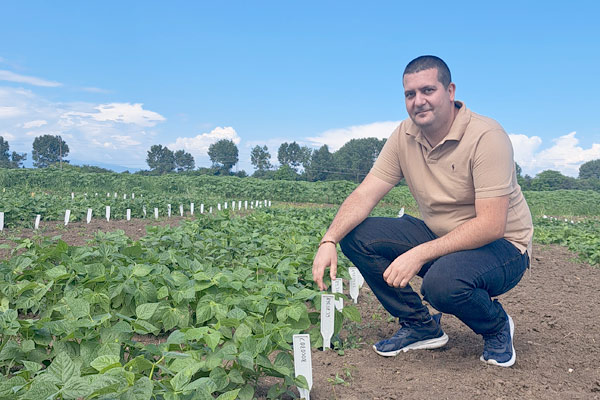
Valcho Stoyanov Neshev was appointed as an assistant in the Department of „Plant Genetic Resources“ at IPGR „K. Malkov“ in February 2024. The topic on which the young scientist is working is „Assessment of genetic diversity in a bean (Ph. vulgaris) collection to increase access to the biological potential of the preserved gene pool of the crop.“
Assistant Valcho Neshev completed his master's and bachelor's degrees at the Faculty of Agronomy, Agricultural University – Plovdiv. Before embarking on a scientific career, he worked at a company near Plovdiv specializing in greenhouse and field vegetable production, where he familiarized himself with modern technologies for cultivating high-quality produce. Assistant Valcho Neshev is proficient in the production technology of crops such as green beans, cabbage, cucumbers, eggplants, peppers, tomatoes, and leafy vegetables. He shows interest in innovative practices related to challenges like climate change. Environmentally friendly approaches have been a focus of his interest since his student years. The preservation of plant biodiversity is his cause. He loves plants and the earth, is not afraid of field work, and believes that science will open new horizons for his development.