

![MultipartFile resource [file_data]](/assets/img/articles/заглавна-май-защита-1.jpg)
The expected rainfall at the end of May can lead to fruit cracking, especially in cherries and sour cherries, as well as intensify fungal and bacterial disease infections in fruit trees. Due to the warm weather, preventive fungicide sprays will certainly be necessary then. Insecticide treatments are also essential, as higher temperatures favor insect development.
More suitable conditions for carrying out plant protection sprays against a number of diseases – early brown rot, shot-hole disease, scab on pome fruit species and insects that develop actively during the month will be available at the end of the first ten-day period, at the beginning and end of the second, and during most days of the third ten-day period of May.
For perennial crops affected by hail, treatment with copper-containing fungicides is recommended to reduce the risk of secondary infections with pathogens.
In fruit nurseries
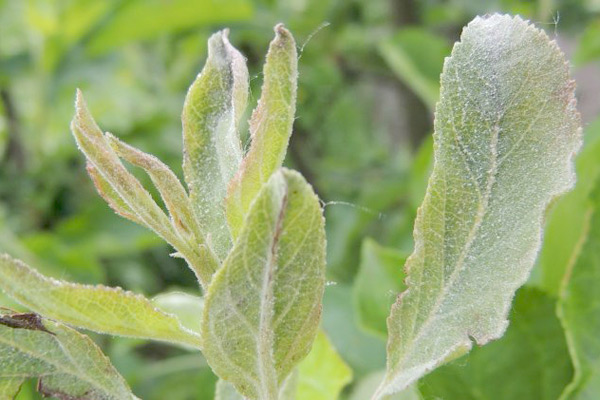
Powdery mildew on apple
The fight against diseases and pests on fruit trees in nurseries and seedbeds continues. Against apple and pear scab, 2-3 sprays are carried out with one of the following copper preparations – 1% Bordeaux mixture, Funguran OH 50 WP -150-250 g/dka, Champion WP - 0.3%, Capper Key – 180-300 g/dka, against powdery mildew on apple and peach – 3-4 sprays every 8-10 days with a sulfur-based preparation - Sulfur WG 600 g/dka, Sulfo 80 WG – 750 g/dka or one of the preparations - Sistan 20 EW – 0.03%, Luna Experience – 50-75 ml/dka, Flint Max 75 WG – 0.02%, against Cylindrosporium with Silit 544 SC – 125 ml/dka, against aphids and leaf-eating insects with an insecticide with deltamethrin active base - Deca EC – 30-50 ml/dka, Decis 100 EC - 7.5 -12.5 ml/dka, Delmur – 50 ml/dka, Meteor – 0.06 -0.09% or another pyrethroid preparation.
In fruit orchards
Trapping bands, soaked with a pyrethroid insecticide – Decis 100 EC - 7.5 -12.5 ml/dka, Sumicidin 5 EC (0.02%), Afikar 100 EC (15 ml/dka), Efcimetrin 10 EC (15 ml/dka) are placed on the trunks of apples, pears, plums and walnuts against fruit worms. Corrugated cardboard strips 15-20 cm wide encircle the trunks below the first skeletal branch, after cleaning the old bark of the entire trunk. The band is tied only at the upper end.
Non-toxic corrugated cardboard trapping bands are placed to observe the flight of moths from the second generation of fruit worms.
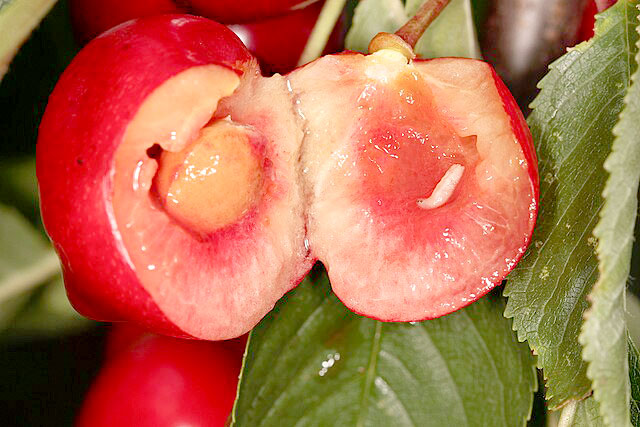
Cherry fruit fly larva
Worm-eaten fruits from cherry fruit fly are collected and placed under frames – isolators, to track its development in the following year. 500-1000 fruits are needed – 50-100 under 5-10 cages.
From the middle of the month, every 8-10 days, apple orchards are inspected to determine the density of leaf mining moths, mites, and aphids.
Plum orchards are inspected for plum pox disease. Infected trees, if they are not tolerant varieties, are marked for uprooting in autumn.
Fruit trees suffering from chlorosis are fertilized with green vitriol - 150 g/ 10 l water.
Fruits with false caterpillars of the plum fruit sawfly are collected and placed under isolator frames to track its development in the spring of the following year. 500 – 1000 fruitlets are taken and equally distributed under five isolators.
Orchards infested with fall webworm are treated with DiPel 2X (0.1%) or another Bacillus thuringiensis-based preparation.
Stone fruit orchards infested with black buprestid beetle are treated several times every 8-10 days with one of the following pyrethroid preparations - Decis 100 EC (7.5 -12.5 ml/dka), Sumicidin 5 EC (0.02%), Afikar 100 EC (15 ml/dka), Efcimetrin 10 EC (15 ml/dka). Spraying is aimed at adult insects when they emerge from their shelters.
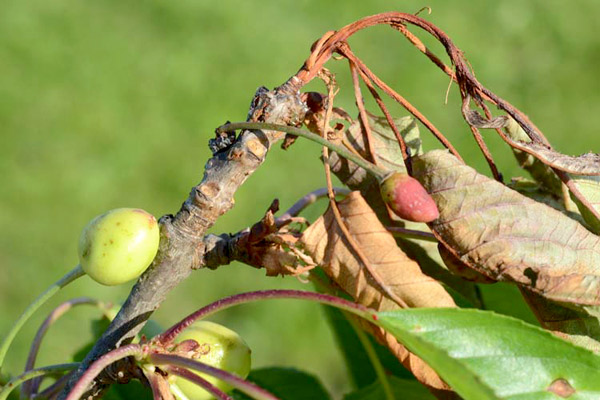
Early brown rot on cherry
A third post-blossom spray of pear orchards is carried out 10-12 days against scab, brown rot, white leaf spots, rust, and pear fruit sawfly, pear psyllid respectively with one of the preparations – Kuracium (200 ml/dka), Horus 50 WG (50g/dka), Captan 80 WG (150-180 g/dka) and with one of the following pyrethroid preparations - Decis 100 EC (7.5 -12.5 ml/dka), Sumicidin 5 EC (0.02%), Afikar 100 EC (15 ml/dka), Efcimetrin 10 EC (15 ml/dka).
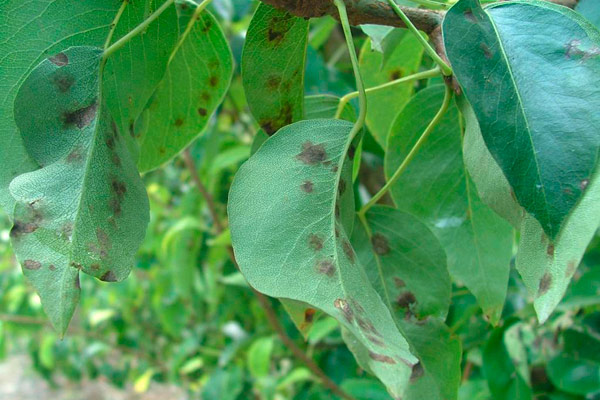
Pear Scab
Apple trees are sprayed with one of the preparations – Kuracium (200 ml/dka), Horus 50 WG (50g/dka), Captan 80 WG (150-180 g/dka) against scab, with a sulfur-based preparation - Sulfur WG 600 g/dka, Sulfo 80 WG – 750 g/dka or one of the preparations - Sistan 20 EW – 0.03%, Luna Experience – 50-75 ml/dka, Flint Max 75 WG – 0.02% against powdery mildew, with one of the following pyrethroid preparations - Decis 100 EC (7.5 -12.5 ml/dka), Sumicidin 5 EC (0.02%), Afikar 100 EC (15 ml/dka), Efcimetrin 10 EC (15 ml/dka) against the first generation of fruit worm, woolly apple aphid, leaf mining moths, aphids, with one of the preparations Decis 100 EC (7.5 -12.5 ml/dka), Sumicidin 5 EC (0.02%), Afikar 100 EC (15 ml/dka), Efcimetrin 10 EC (15 ml/dka), Harpoon (30 ml/dka) against California armored scale and with one of the acaricides - Apollo 50 SC (40 ml/dka), Nissorun 5 EC (0.05%), Naturalis (100-150 ml/dka) against mites.
Pear orchards are sprayed with one of the preparations – Kuracium (200 ml/dka), Horus 50 WG (50g/dka), Captan 80 WG (150-180 g/dka) against scab and with one of the following pyrethroid preparations - Decis 100 EC (7.5 -12.5 ml/dka), Sumicidin 5 EC (0.02%), Afikar 100 EC (15 ml/dka), Efcimetrin 10 EC (15 ml/dka) and others against fruit worm, leaf mining moths and pear leaf sawfly, pear bug, pear psyllid.
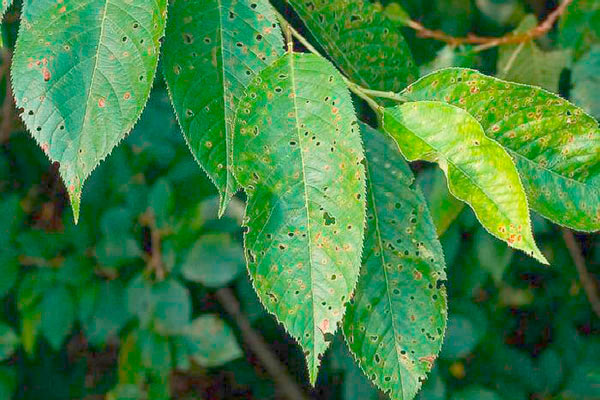
Shot-hole disease
A fourth post-blossom spray of apricot orchards is carried out with one of the preparations - Carpovirusine (100 ml/dka), Madex Top (10 ml/dka), Dipel DF (50-150 g/dka), Syneis 480 SC (20-37.5 ml/dka), Delegate 250 WG (30 g/dka), Avant 150 EC (33.3 ml/dka), Deca EC (30 ml/dka), Declin 2.5EC (30 ml/dka), Lamdex extra (60-100 g/dka) against oriental fruit moth. Apricot orchards are sprayed with one of the preparations – Kuracium (200 ml/dka), Horus 50 WG (50g/dka), Captan 80 WG (150-180 g/dka) against shot-hole disease and with one of the following pyrethroid preparations - Decis 100 EC (7.5 -12.5 ml/dka), Sumicidin 5 EC (0.02%), Afikar 100 EC (15 ml/dka), Efcimetrin 10 EC (15 ml/dka) against oriental fruit moth, anarsia, etc.
A third post-blossom spray of cherry orchards is carried out with Silit 544 SC – 125 ml/dka against Cylindrosporium, with one of the preparations – Kuracium (200 ml/dka), Horus 50 WG (50g/dka), Captan 80 WG (150-180 g/dka) against shot-hole disease, brown rot and with one of the following pyrethroid insecticides - Decis 100 EC (7.5 -12.5 ml/dka), Sumicidin 5 EC (0.02%), Afikar 100 EC (15 ml/dka), Efcimetrin 10 EC (15 ml/dka) against cherry fruit fly and Mediterranean fruit fly, weevils, aphids and scale insects, leaf-eating caterpillars.
It is carried out 10-12 days after the first cherry fruit flies are caught. Early-ripening varieties are not sprayed against cherry fruit fly.
Approximately 12-15 days after the third, a fourth post-blossom spray of cherry and sour cherry orchards is carried out with Silit 544 SC – 125 ml/dka against Cylindrosporium, with Kuracium - 200 ml/dka, Horus 50 WG - 50g/dka, Captan 80 WG - 150-180 g/dka against brown rot and shot-hole disease and with one of the following pyrethroid preparations - Decis 100 EC (7.5 -12.5 ml/dka), Sumicidin 5 EC (0.02%), Afikar 100 EC (15 ml/dka), Efcimetrin 10 EC (15 ml/dka)... against cherry fruit fly, Mediterranean fruit fly, spotted-wing drosophila, sour cherry sawfly, aphids and other pests.
A second post-blossom spray of walnut trees is carried out with a copper preparation - 1% Bordeaux mixture, Funguran OH 50 WP -150-250 g/dka, Champion WP - 0.3%, Capper Key – 180-300 g/dka against anthracnose and bacteriosis and with one of the preparations – Closer 120 SC – 20 ml/dka, Teppeki 14 g/dka, Mospilan 20 SG – 25 g/dka against aphids.
Walnut trees are treated with a copper preparation - 1% Bordeaux mixture, Funguran OH 50 WP -150-250 g/dka, Champion WP - 0.3%, Capper Key – 180-300 g/dka against anthracnose and bacteriosis and with one of the preparations - Carpovirusine (100 ml/dka), Madex Top (10 ml/dka), Dipel DF (50-150 g/dka), Syneis 480 SC (20-37.5 ml/dka), Delegate 250 WG (30 g/dka), Avant 150 EC (33.3 ml/dka), Deca EC (30 ml/dka), Declin 2.5EC (30 ml/dka), Lamdex extra (60-100 g/dka) against fruit worms.
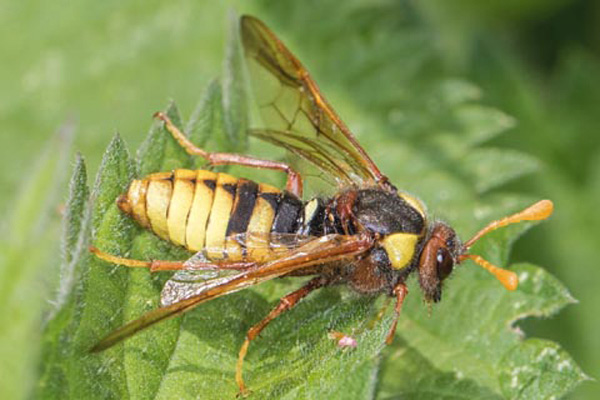
Almond leaf sawfly
A fourth post-blossom spray of almond trees is carried out 10-14 days after the third with one of the preparations – Kuracium - 200 ml/dka, Horus 50 WG - 50g/dka, Captan 80 WG - 150-180 g/dka against shot-hole disease, scab, cercosporosis and with one of the following pyrethroid preparations - Decis 100 EC (7.5 -12.5 ml/dka), Sumicidin 5 EC (0.02%), Afikar 100 EC (15 ml/dka), Efcimetrin 10 EC (15 ml/dka) against almond leaf sawfly, almond seed wasp.
A second spray after flowering of hazelnut orchards is carried out with a sulfur-based preparation - Sulfur WG 600 g/dka, Sulfo 80 WG – 750 g/dka or one of the preparations - Sistan 20 EW – 0.03%, Luna Experience – 50-75 ml/dka, Flint Max 75 WG – 0.02% against powdery mildew and with Coragen 20 SC (18-30 ml/dka), but contact insecticides from all groups can be used - Decis 100 EC (12.25 ml/dka), Sumi Alpha 5 EC (0.03%), Karate Zeon 5 CS (15 ml/dka), Lamdex extra (100-120 g/dka) against hazelnut weevil.
In strawberry orchards
At the end of flowering, spraying is carried out with Signum (75 g/dka) against powdery mildew, white and red leaf spots, gray mold and with one of the preparations - Valmec (60-96 ml/dka), Apollo 50 SC (40 ml/dka), Nissorun 5 EC (0.05%), Naturalis (100-150 ml/dka) against strawberry mite.
After harvesting the fruits, strawberry orchards are sprayed 1-2 times every 7-8 days with one of the acaricides - Valmec (60-96 ml/dka), Apollo 50 SC (40 ml/dka), Nissorun 5 EC (0.05%), Naturalis (100-150 ml/dka) against various mites – strawberry, spider, Atlantic.
In case of slug infestation, Mesurol Schneckenkorn - 300 g/dka is spread.
Strawberry plants infested with viral diseases and root weevils are uprooted.
In raspberry orchards
Post-blossom, raspberry semi-shrubs are sprayed with Signum (100 g/dka) for control of didymella, coniothyrium, rust, anthracnose, leaf spots and with Decis 100 EC (7.5 -12.5 ml/dka) or another pyrethroid insecticide against raspberry moth, aphids, leaf-eating caterpillars and Bermeectin (15-100 ml/dka) against raspberry mite and common spider mite.
Raspberry plants infested with viral diseases are uprooted.
In blackcurrant orchards
A second post-blossom spray of blackcurrant orchards is carried out 10-14 days after the first with a copper preparation - 1% Bordeaux mixture, Funguran OH 50 WP (150-250 g/dka), Champion WP (0.3%), Capper Key (180-300) g/dka or Silit 544SC (125 ml/dka) for control of anthracnose and leaf spots, with Topaz 100 EC (0.05%) against American powdery mildew and with Mospilan 20 SG (25 g/dka) against aphids, Bermeectin (15-100 ml/dka) against mites.
To control powdery mildew on blackcurrant, another spray is carried out 10-14 days after the second post-blossom spray with Topaz 100 EC (0.05%) or a sulfur-based preparation - Sulfur WG 600 g/dka, Sulfo 80 WG – 750 g/dka.
Blackcurrant orchards are treated with Silit 544SC (125 ml/dka) against leaf spots, with Topaz 100 EC (0.05%) or a sulfur-based preparation - Sulfur WG 600 g/dka, Sulfo 80 WG – 750 g/dka against powdery mildew. In case of severe mite infestation, Bermeectin (15-100 ml/dka) is added.
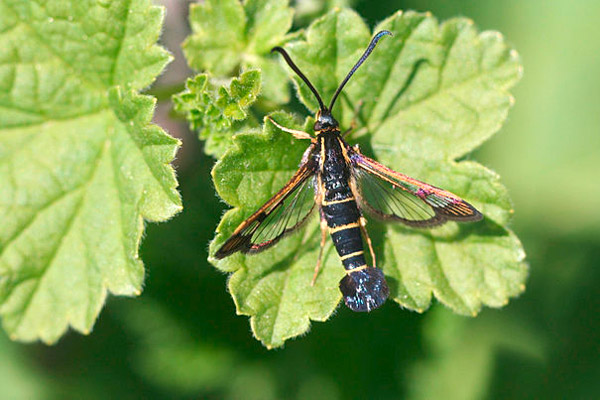
Currant Clearwing
Spraying against clearwing moth is effective when about 50% of the moths have emerged.
Weeds in blackcurrant orchards are sprayed with Stomp Aqua 250-300 ml/dka.