

![MultipartFile resource [file_data]](/assets/img/articles/заглавна-grapes-1.jpg)
Against the backdrop of the continuously changing situation on the grape and wine market, the increasing level of agrotechnology and the dynamically occurring changes in climatic conditions, the need for the creation and implementation of resistant varieties is an extremely prestigious and modern field with great economic and social significance. Over the years, part of the breeding work on grapevine at the Institute of Viticulture and Enology, Pleven, has been directed towards the creation of productive varieties with improved quality of the grapes and the products obtained from them, with wide adaptive potential to local and specific environments, resistant to various abiotic stress conditions, diseases and pests. The table (Lyubimets, Vita, Druzhba, Garant, Plevenski favorit, etc.) and wine (Misket Kailashki, Dunavski lazur, Srebrostruy, Pomoriyski Biser, Plevenska rosa, Storgozia, Nikopolski mavrud, Mizia, Plevenski kolorit, Naslada, Kaylashki rubin, Trapezitsa, etc.) varieties obtained through interspecific hybridization are high-yielding and, in terms of grape quality and the products obtained from them, are very close to the varieties of the European grapevine (Vitis vinifera L.). The ampelographic characteristics of all interspecific varieties make them suitable for growing and producing organic grapes and wine in all viticultural regions of the country.
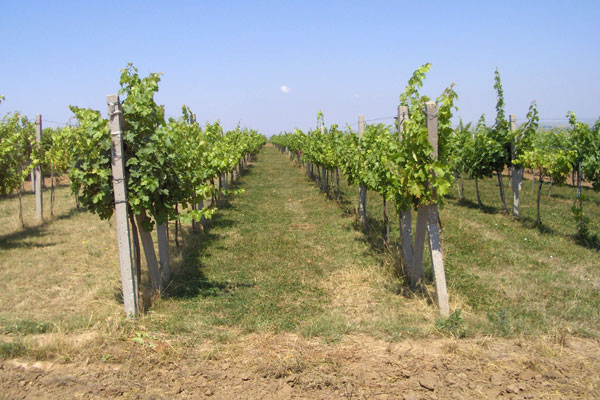
IVE-Pleven holds the patent for 13 varieties: table – Mechta, Pleven, Super Rann Bolgar, Misket Plevenski, Brestovitsa, Kondarev 10; wine – Misket Kailashki, Slava, Storgozia, Rubin, Buket; dual-purpose – Druzhba, Naslada.
All selected and established over the years intraspecific table and wine grapevine varieties, together with the valuable local varieties, constitute a rich gene bank that allows meeting the needs of the different production directions. Some of the bred table grapevine varieties are still considered a “peak” in the world grapevine breeding, due to their valuable economic and excellent organoleptic characteristics – Mechta, Super Rann Bolgar, Pleven, Brestovitsa, Misket Plevenski, etc. Part of the bred wine varieties are characterized by very good agrobiological and technological properties, and the wines obtained from them have a unique and specific organoleptic profile – Rubin, Buket, Misket Varenski, etc.
Approved newly bred grapevine varieties and clones
Among the new proposals are the table varieties “Miro”, “Naiden” and “Yoanna”. In recent years, the institute has been working on varieties that are not susceptible to winter injury and fungal diseases.

Variety Yoanna
Variety Yoanna is an early ripening red seedless table grapevine variety, obtained through intraspecific hybridization. The duration of the vegetation period is about 150 days. The bunch is large, conical, from loose to medium compact, with an average weight of 600 – 700 g. The berry is large, ovoid, with dark blue, thin and fragile skin, with an average weight of 5 – 6 g. The variety is characterized by good fertility and yield. It is sensitive to low winter temperatures, downy mildew and powdery mildew. The grapes have a harmonious taste and are suitable for fresh consumption and for meeting market demand for high-quality seedless table grapes in the second half of August. The variety is in high demand by some of the institute’s clients because it is used for raisin production.
Yoanna is suitable for cultivation in all viticultural regions of the country where the risk of winter injury to the vines is lower.

Variety Naiden
A medium ripening red table grapevine variety, obtained through intraspecific hybridization. The duration of the vegetation period is about 170 days. The bunch is large, conical, from loose to medium compact, with an average weight of 750-850 g. The berry is very large, drop-shaped (specific), dark violet in colour, with an average weight of 8 – 9 g. The variety is characterized by high fertility and yield. The grapes have a harmonious neutral taste and are suitable for fresh consumption and storage. It has very good transport stability. After storage it retains its appearance and taste qualities. It is suitable for cultivation in all viticultural regions of the country where the risk of winter injury to the vines is lower.
Variety Miro
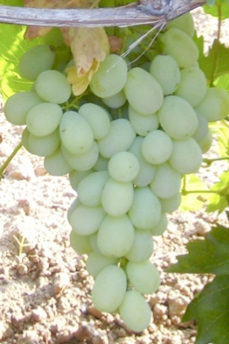
An early ripening white table grapevine variety, obtained through interspecific hybridization. The duration of the vegetation period is about 150-160 days. The bunch is very large, cylindrical-conical, medium compact, with an average weight of 700 - 800 g. The berry is very large, oval, greenish-yellow in colour, with an average weight of 8 – 9 g. The variety is characterized by high fertility and yield. It exhibits increased resistance to low winter temperatures and fungal diseases (1-2 points). The grapes have a harmonious taste and are suitable for fresh consumption and storage. It has good transport stability. After storage it retains its appearance and taste qualities. It is suitable for cultivation in all viticultural regions of the country.
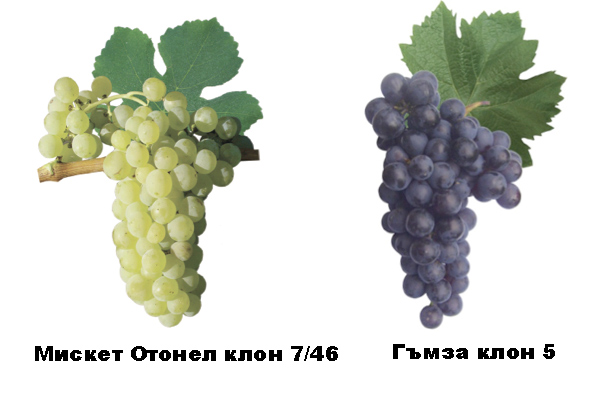
The institute also offers two new clones „Gamza N 5“ and „Misket Ottonel N 46“.
Misket Ottonel clone N 46
Misket Ottonel clone N 46 is a medium ripening white wine variety. The bunch is medium large, cylindrical-conical or conical, with one well-formed wing, medium compact, with an average weight of 150 -160 g. The berry is medium large, round, with an average weight of 2 – 2.3 g. It is sensitive to the fungal diseases downy mildew and powdery mildew. The vines have good resistance to low winter temperatures. Misket Ottonel clone N 46 develops and bears well when grafted on the rootstocks Chasselas x Berlandieri 41B and Berlandieri x Riparia SO4. The clone accumulates a sufficient amount of sugars while maintaining a higher titratable acidity. The grapes of clone N 46 are used for the production of white dry wines with a delicate, pleasant muscat aroma and moderate freshness. The good winter hardiness of the vines allows them to be grown in different trunk training systems in all viticultural regions of the country.
Gamza clone N 5
Gamza clone N 5 is a medium ripening red wine variety. The bunch is medium large, cylindrical-conical, with one medium large wing, compact, with an average weight of 350 - 400 g. The berry is medium large, almost spherical, with an average weight of 3-4 g. The skin is dark blue, thin, fragile, with abundant waxy bloom. The consistency is fleshy and the taste is harmonious. The vines are characterized by medium to strong growth, and their fertility is very good even under short pruning – to spurs. It is sensitive to the fungal diseases downy mildew, powdery mildew and grey rot. Its resistance to low winter temperatures is satisfactory. The clone exhibits good affinity to the rootstocks widespread in the country. At technological maturity, the grapes of clone N 5 contain about 20-22% sugars and 5.5 - 6.6 g/dm3 titratable acids. The red dry wines from clone N 5 of variety Gamza are characterized by a bright ruby-red colour, delicate fruity aroma and typical resinous taste. They are harmonious, soft, with pleasant freshness.
The road of wine passes through Pleven
To meet the increased demand, the Institute of Viticulture and Enology in Pleven is establishing mother plantations
The breeding work of the institute enjoys great interest from growers who wish to cultivate high-quality vineyards. Along with the old Bulgarian varieties, farmers are, of course, also seeking the new, recently created and registered varieties by the Executive Agency for Variety Testing, Field Inspection and Seed Control – Miro, Naiden and Yoana, which is seedless. Demand for planting material often exceeds supply, which is why the institute’s team decided to establish mother plantations and hopes that next year it will be able to offer its new varieties on the market.
The Institute of Viticulture and Enology – Pleven is offering this year nearly 20 different grapevine planting material varieties.
The prices of grapevine planting material range from 3 to 5 BGN per piece, according to the information from IVE - Pleven, with the clarification that seedless and more disease-resistant varieties are more expensive.
Orders for vines are accepted only by e-mail: lozi.ilv@abv.bg
For more details, visit the institute’s Facebook page: https://www.facebook.com/ilvpleven
The material is part of the topic of issue 8-9/2021 of the magazine „Plant Protection“