

![MultipartFile resource [file_data]](/assets/img/articles/малини-есен-1.jpg)
Raspberry has a number of advantages over other fruit species – it flowers later, does not suffer from spring frosts and bears fruit every year. Its fruits are tasty, nutritious, with good medicinal properties. They strengthen cardiac activity, enrich the organism with vitamins and mineral substances, and increase the appetite. They are known for their antipyretic effect, which is due to the presence of salicylic acid.
The choice of site for planting raspberries is made in accordance with the crop’s requirements for climatic and soil conditions. Pre-planting soil preparation includes ploughing at 30–35 cm, shallow ploughing for incorporation of the fertilizers and cultivation. Farmyard manure is applied.
The most suitable period for planting is from the end of October until the onset of cold weather. Planting is also possible in spring – until the end of March. The spacing between the rows is between 1.8–2 m. Planting is done manually in furrows with a depth of about 35 cm.
New plantations are fertilized with 8–10 kg/da nitrogen, and fruit-bearing ones with 8–12 kg/da. In heavier soils, nitrogen is applied once, early in spring, and if they are lighter, early in spring and at the end of May. Top-dressing of fruit-bearing plantations is carried out after flowering. If rainfall is insufficient, irrigation is applied as necessary until mid-August. Pruning is carried out every year, during which the fruiting 2-year-old canes are removed and the one-year-old canes are thinned. In the second year after planting, 2–3 canes per plant are left for fruiting and the remaining ones are cut back low. In the third and fourth year, the number of fruiting canes increases and the plantations enter full fruiting. In spring, pruning is carried out at bud swelling, removing those damaged by winter frosts, diseases and pests.
Care for soft fruit semi-shrubs during the summer
Raspberries are damaged by the diseases didymella, cane blight, rust, anthracnose, and among the viruses – mosaic and vein chlorosis. The most common pests of raspberry are the raspberry beetle, aphids, Agrilus, raspberry gall midge, raspberry gall fly.
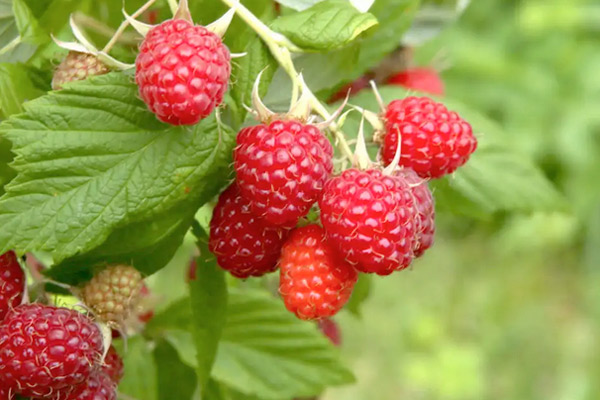
In Bulgaria, the following raspberry cultivars are the most widely distributed:
Lyulin – the fruits ripen from 27 August – 3 October. They are large, intensely red, glossy, firm, with very good taste and moderate aroma. The plants are vigorous and moderately growing. The cultivar is highly productive and can be grown without a support structure.
Willamette – a moderately productive American cultivar. The fruits ripen in the period 6–8 July. They are medium-sized, conical with small seeds. They have a good sweet-acid taste and aroma. The plants are moderately growing and are cultivated in cooler regions under irrigated conditions.
Bulgarski Rubin (Bulgarian Ruby) – the fruits ripen in the period 28–30 June. They are medium-sized, slightly conical, ruby-red, do not crumble into individual drupelets, and have a pleasant sweet-acid taste and moderate aroma. The cultivar is highly productive.
Shopska Alena – the fruits ripen in the period 3–5 July. They are medium to large, bluntly conical, bright red, with moderate gloss and small seeds. They detach easily, with a very good sweet-acid taste and moderate aroma. They are suitable for processing and freezing. The plants are strongly growing, slightly covered with fine prickles. The cultivar is highly productive.