

![MultipartFile resource [file_data]](/assets/img/articles/лозе-август-1.jpg)
In this period, the vines are in the phenological stage from „veraison” to „berry ripening”.
Downy mildew of grapevine
The disease develops when there is rainfall, heavy dew and a drop in temperature. On ageing leaves the disease appears in the form of numerous small mosaic spots, delimited by the veins. On enlarged berries the form ”brown rot” appears, which spreads from the pedicels. Infected berries wilt, turn brown and mummify. Grapes that have already reached veraison and softened are not attacked. With the ageing of the tissues, downy mildew ceases its activity.
Pest control strategy: In order to reduce the late manifestations of the disease, good coverage of the leaf mass with PPP is necessary.
Authorised contact-action products: Bordo Mix - 500-600 g/ha, Vitra 50 WP - 0.15%, Kocide 2000 WG - 0.12%, Cuproxat FL - 0.3%, Cuprocin 35 WP - 200-300 g/ha, Pergado F 45 WG - 140-200 ml/ha, Polyram DF - 0.2%, Funguran OH 50 WP - 0.15%, Champion WP - 0.15 %.
When climatic conditions are favourable for the development of downy mildew – frequent showers and cooler weather – the first spraying must be carried out with systemically acting fungicides.
Authorised products with locally systemic and systemic action: Alial 80 WG - 75-330 g/ha, Folpan 80 WDG - 0.2%, Delan 700 WDG - 300 ml/ha, Cabrio Top - 0.15%, Quadris 35 SC - 0.075%, Melody Compact 49 WG - 150-175 g/ha, Mikal Flash - 0.3%, Ridomil R WG - 500 g/ha, Ridomil Gold Combi 45 WG - 200 g/ha, Folpan 80 WDG - 0.15%, Profiler 71.1 WG - 200-225 g/ha, Solofol - 188 g/ha.
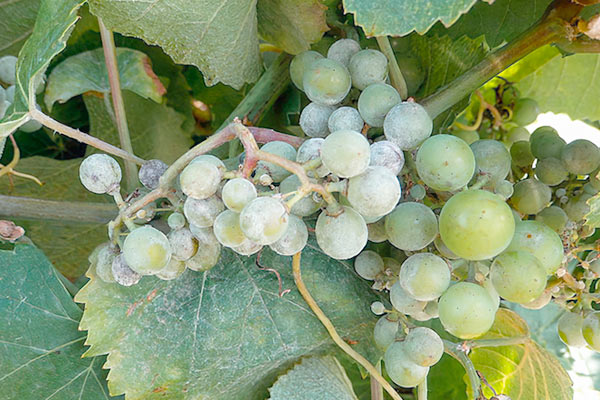
Powdery mildew (oidium)
While frequent rainfall favours infections with downy mildew on grapevine, warm weather accompanied by high relative air humidity promotes the development of powdery mildew. On berries enlarged and infected with oidium, dark brown spots appear, which become visible when the powdery coating is wiped off. Oidium develops superficially, the inside of the berry remains healthy and continues to grow, the skin cracks, the seeds become exposed and part of the juice flows out. After the berries soften and reach veraison, powdery mildew no longer attacks them and develops only on the peduncles, lateral shoots and green shoot tips.
Pest control strategy: Upon detection of infection, spraying is continued.
Authorised plant protection products: Eminent 125 ME - 24 ml/ha; Carbicure 500 g/ha; Collis SC - 0.04%; Quadris 25 SC - 0.075%; Kumulus DF - 800 g/ha; Kusabi - 30 ml/ha; Microthiol - 1210 ml/ha; Talendo 20 EC - 20-25 ml/ha; Thiovit Jet 80 WG - 0.3%; Topaz 100 EC - 0.015%; Flint Max 75 WG - 0.016%; Sulgran - 1250 g/ha; Taegro - 18.6-37 g/ha; Dinali - 65 ml/ha; Domark 10 EC - 100 g/ha; Password 25 WG - 50 g/ha, Reviona - 130 ml/ha; Riza 25 EW - 50 ml/ha; Sercadis - 50 ml/ha; Systiva - 0.012%, Spirox - 60 ml/ha; Vivaldo - 20 ml/ha; Domark 120 EC - 25-30 ml/ha.
Grey mould
The most typical damage from the disease on the berries is observed around the period of their ripening. In case of infection, on the berries pale brown spots appear, on which the skin peels off easily. The disease quickly affects the whole bunch and passes on to neighbouring ones. In humid weather, the attacked plant parts are abundantly covered with grey mould. With the ripening of the grapes, the spread and degree of attack by grey mould increase.
Pest control strategy: At berry softening and veraison, spraying is carried out with one of the registered fungicides.
Authorised plant protection products: Akoidal - 0.25%, Carbio Top - 0.2%, Orius 25 EW - 0.04%, Thiovit Jet 80 WG - 0.3%, Flint Max 75 WG - 0.016%, Folicur 250 EW - 0.04%, Folpan - 0.15%, Geox WG - 100 g/ha, Mevalon - 160-400 ml/ha, Prolectus 50 WG - 120 g/ha, Switch 62.5 WG - 100 g/ha, Flow 80 WG - 187.5 g/ha.
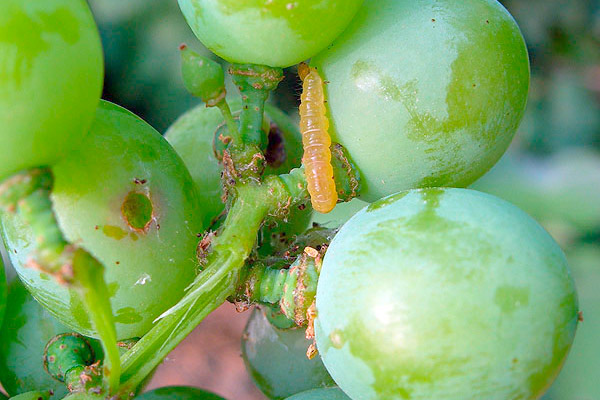
European grapevine moth
During August, until the second half of September, the flight of butterflies of the third generation of the pest continues. The larvae of this generation damage ripening and already ripe grape berries by entangling them with silken threads. As a result of the damage, conditions are created for the penetration of the causal agent of grey mould.
Pest control strategy: Treatment should be carried out at the ETL: for table grape varieties 7-8 larvae per 100 bunches, and for wine grape varieties 10-12 larvae per 100 bunches.
Authorised plant protection products: Lamdex Extra - 100 g/ha, Coragen 20 SC/Voliam - 15-27 ml/ha, Meteor - 70-90 ml/ha, Decis 100 EC - 12.5-17.5 ml/ha.
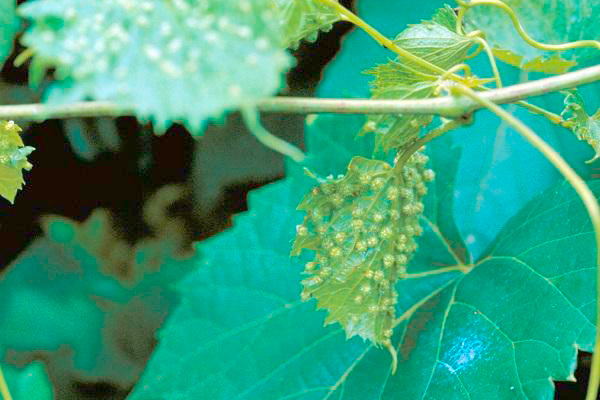
Yellow grapevine mite
During August, overlapping of populations from several generations is observed. In case of severe infestation, vine leaf blades become deformed, coarse and crunch when crushed. Temperatures above 32-35°C are lethal for mite populations. In the first half of September, females move under the old bark of the grapevine plants in order to overwinter.
Pest control strategy: Treatment is carried out against adults and larvae when the ETL - 9-10 individuals/leaf – is reached, until the end of August.
Authorised plant protection products: Danitron 5 SC - 100 ml/ha, Nissorun 10 WP – 75 g/ha, Nissorun Plus – 120 ml/ha, Thiovit Jet 80 WG – 2000 g/ha, Shirudo - 25 g/ha.
* The article was updated on 15.08.2025.