

![MultipartFile resource [file_data]](/assets/img/articles/заглавна-череши-1.jpg)
The average monthly temperature in June is between 18-20°C for the lowland areas and 11-16°C for the higher fields. Precipitation during this month ranges from 60 to 90 l/sq.m.
In June, sweet cherries, sour cherries and strawberries ripen massively, as well as the early cultivars of raspberries, apricots, peaches, pears and apples. Care for the protection of the fruit crop and the trees continues.
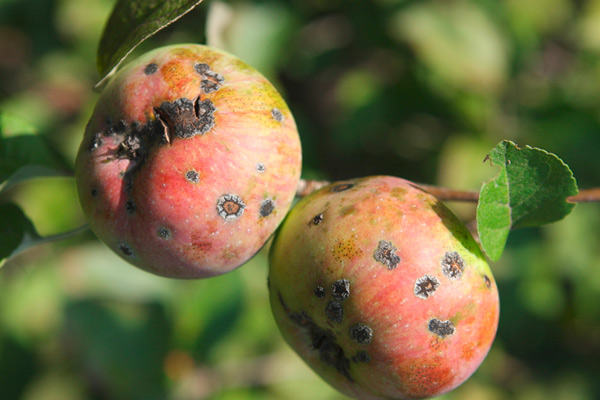
apple scab (Venturia inaequalis)
In June, for apple, spraying against scab must continue, as the risk of primary infections still exists. The release of ascospores usually continues for about two months, starting from the beginning of their maturation, which under the conditions of our country occurs at bud burst. In addition to scab, the June sprays are also aimed at powdery mildew. Usually during this month, two or three sprays are carried out against these two fungal diseases, depending on the conditions for pathogen development and the duration of action of the fungicides.
For simultaneous control of both diseases, one of the following fungicides is used: Belis - 80 g/da, Sulgran - 750 g/da and Kumulus - 600-900 g/da against powdery mildew, and Chorus 50 WG - 0.03%, Difcor 250 EC - 15 ml/da, Copration Duo - 300 g/da, Scab - 300 ml/da and Captan 80 WG - 150-180 g/da against scab. For simultaneous control of both diseases, the following are suitable: Flint Max 75WG – 0.02%, Score 250 EC – 0.02%, Luna Experience – 20-75 ml/da, Thiovit Jet 80WG - 600 g/da, Reviona - 200 ml/da.
To prevent the occurrence of resistance of the fungus causing scab (Venturia inaequalis), it is best to alternate fungicides with different modes of action on the pathogen or to use fungicide mixtures for its control.
In cultivars highly susceptible to powdery mildew – Jonathan, Jonafree, Moira and others, green pruning must continue to remove the infected shoots.
Cultivars resistant to scab – Prima, COOP-10, Frolina, Liberty, Jonafree, Jonathan, Pioneer, Macfree, Pilot, Topaz, Novamak, Sava, Rubinola and others, are sprayed only against powdery mildew. At high temperatures, sulfur-containing fungicides should not be used, as they may cause scorching in some cultivars.
For pear, spraying against scab, white and brown leaf spots must continue. For control of these diseases, one of the following fungicides is used: Difcor 250 EC - 15 ml/da, Luna Experience – 20-75 ml/da, Captan 80 WG – 150-180 g/da, Thiovit Jet 80WG - 600 g/da.
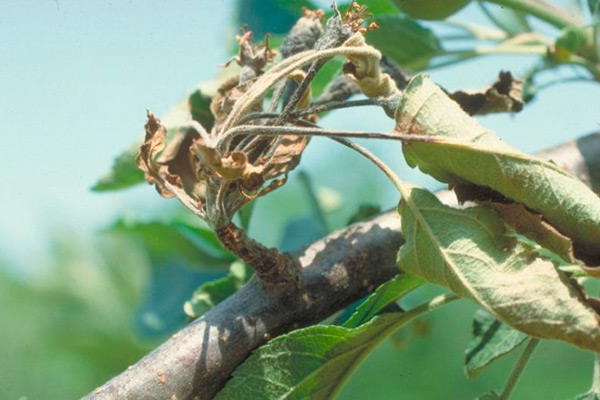
fire blight on fruit tree species
In June, the measures for protection of pear, quince and apple from fire blight continue. To limit the damage, sanitary pruning is carried out to remove the infected branches and shoots (cutting is done 30-40 cm below the infection site), after which the wounds are covered with oil-based paint to which copper-containing products are added - Bordeaux mix 20WP, Bordeaux mixture, Funguran OH 50WP, Champion WP.
Pruning tools are disinfected after each cut with denatured alcohol or in bleach diluted with water in a ratio of 1:10.
In addition to pruning, to protect the trees from infection, sprays are also carried out with: Bordeaux mixture – 1%, Funguran OH 50WP – 0.15%, Champion WP – 0.15%.
Under favourable conditions for disease development, susceptible cultivars, cool and humid weather, as well as the presence of infection that was not contained in May, preventive sprays are carried out at 5-7 day intervals.
At the beginning of June, harvesting of the early-ripening sweet cherry cultivars usually starts and they are not sprayed. During harvesting, all fruits infected with brown rot can easily be removed and taken out of the orchard.
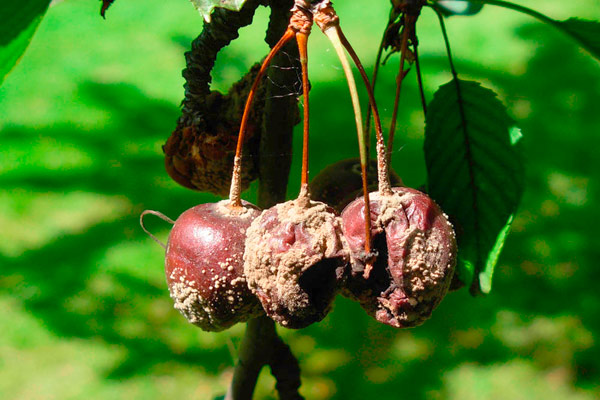
late brown rot on sweet cherry
For medium- and late-ripening sweet cherry cultivars and sour cherries, the sprays at the beginning of June are aimed at cylindrosporiosis (white rust) and late brown rot. For cylindrosporiosis, one of the following fungicides is used: Signum WG - 30 g/da, Score 250 EC – 0.03%, Syllit 40 SC - 0.15%, Delan 700WDG - 0.05% and Flint Max WG - 30 g/da.
In case of frequent showers during the fruit ripening period and the presence of strong infection with brown rot, one or two sprays against it are required with: Signum WG – 30 g/da, Chorus 50 WG – 0.045%, Prolectus 50 WG - 80 g/da, Switch 62.5 WG - 72 g/da and Luna Experience – 50 ml/da. The fungicide Signum WG is also effective against cylindrosporiosis, therefore it is recommended for simultaneous control of both diseases at the second post-bloom spray in sweet cherry and sour cherry.
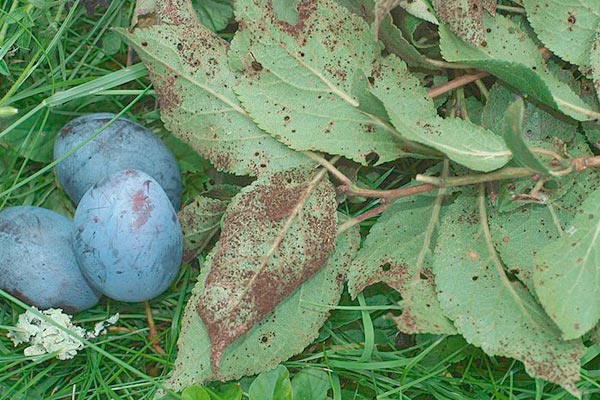
rust on plum
For plum, during this period sprays against brown rot and rust continue. For brown rot, spraying is done with one of the fungicides: Difcor 250 EC – 20 ml/da, Captan 80 WG – 150-180 g/da, Chorus 50 WG – 0.045%, Geoxe - 40-60 g/da. For rust, Signum WG – 45 g/da is approved, which is also effective against brown rot.
For peach, sprays against powdery mildew, shot-hole disease and brown rot continue. For powdery mildew, one of the following fungicides is used: Score 250 EC – 0.02%, Luna Experience – 50 ml/da, Topaz 100 EC – 0.03%, Thiovit Jet 80WG – 600 g/da. For control of brown rot, spraying is carried out with Delan 700 WDG – 0.05%, Chorus 50WG – 0.045% or Luna Experience – 63-75 ml/da.

At the beginning of June, for apricot, spraying is carried out against brown rot and gnomonia. For brown rot, one of the following fungicides is used: Difcor 250 SC – 20 ml/da, Captan 80 WG - 150-180 g/da, Chorus 50 WG – 0.045%, Delan 700 WDG – 0.05%, Luna Experience - 63-75 ml/da, Signum – 60-75 g/da, of which Delan 700 WDG and Signum are also effective against gnomonia.
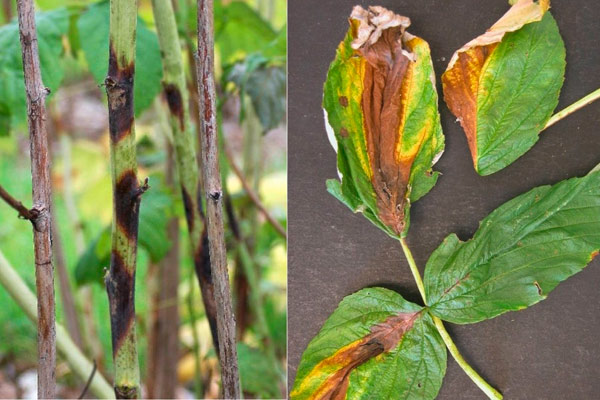
didymella on raspberry
For raspberry, at the beginning of June, spraying is carried out against didymella, anthracnose, cane base blight (leptosphaeriosis), and grey mould.
For control of these diseases, Signum WG – 100–150 g/da is used.
In June, strawberries are harvested and this fruit crop is not sprayed.