

![MultipartFile resource [file_data]](/assets/img/articles/заглавна-лозе-юни.jpg)
* During this period the vines are from phenophase „full flowering” to phenophase „pea size” - „cluster closing”
Main pests for the period:
Downy mildew of grapevine Plasmopara viticola, powdery mildew Oidium tuckeri, grey mould Botrytis cinerea, European grapevine moth Lobesia botrana, grapevine scale Pulvinaria vitis, yellow grapevine mite Schizotetranychus viticola
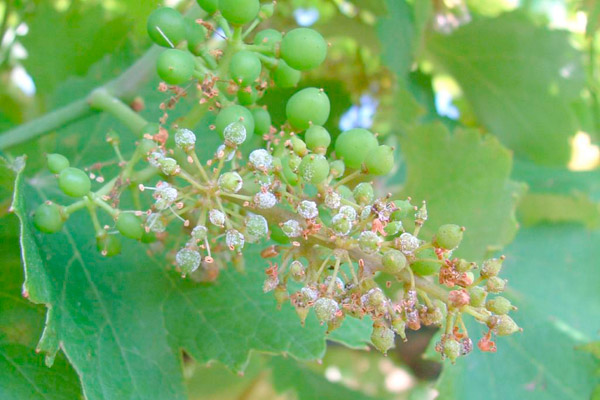
Downy mildew of grapevine Plasmopara viticola
Downy mildew of grapevine
On young leaves the disease appears in the form of pale green, rounded, oily spots which are visible against the light. The spots expand and turn yellow-brown, and on their lower surface a white sporulating growth is formed. In case of severe attack, the leaves become deformed, dry out and fall prematurely. The inflorescences, pedicels and bunch stalks of the clusters attacked are covered with white growth, dry out and some even drop. The enlarged berries become infected from the pedicels, with the skin around them turning pale brown, the berries wilt, turn brown and mummify.
The variable weather, frequent showers, as well as the intensive growth of vines in June, necessitate the continuation of treatments against downy mildew of grapevine. When using contact fungicides, the intervals between sprays are 3 to 7 days, with locally systemic fungicides 7 to 10 days, and with systemic ones 10 to 14 days. With frequent showers and presence of infection, the intervals are shortened.
LEYMAI and LIETO - successful control of DOWNY MILDEW in vineyards, potatoes and tomatoes
Authorised plant protection products: Bordo Mix - 500-600 g/da, Vitra 50 WP, Cuprohyd 50 WP - 0.15% (150 g/da), Kocide 2000 WG - 0.12%, Coprantol Duo - 200 g/da, Cuproxat FL - 0.3%, Cuprocin 35 WP - 200-300 g/da, Pergado F 45 WG - 200 g/da, Funguran OH 50 WP - 0.15%, Champion WP - 0.15%.
When climatic conditions are favourable for the development of downy mildew – frequent showers and cooler weather – it is necessary that the first spraying be carried out with systemically acting fungicides.
Zorvec™ Vinabel™ - a revolution in the control of downy mildew in vineyards
Authorised fungicides with locally systemic and systemic action: Alial 80 WG - 75-330 g/da, Folpan 80 WDG - 0.15%, Delan Gold - 70 ml/1000 m2, Quadris 25 SC - 0.075%, Melody Compact 49 WG - 150-175 g/da, Mikal Flash - 0.3%, Orondis Ultra - 67 ml/da, Ridomil Gold R WG - 500 g/da, Ridomil Gold Combi 45 WG - 200 g/da, Folpan 80 WDG - 0.15%, Profiler 71.1 WG - 200-225 g/da, Solofol - 188 g/da, Zorvec Vinabel - 50 ml/da, Leymai - 37.5 ml/da, Vitene Tripolo R - 400-450 g/da,
Coprantol Duo – the new contact fungicide with double COPPER and stronger EFFECT
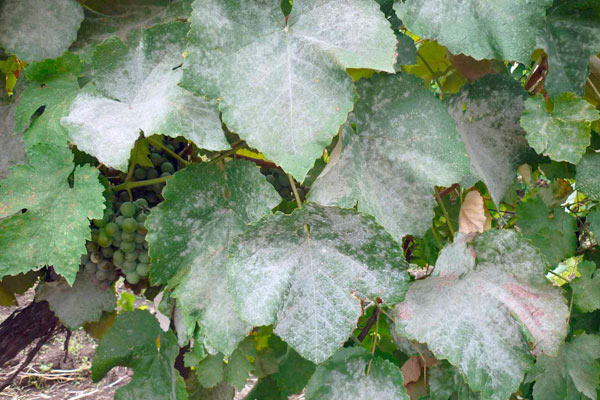
powdery mildew Oidium tuckeri
Powdery mildew
High atmospheric humidity and the sustained warming of the weather during the month are prerequisites for the development of the disease. On the upper side of the attacked leaves, yellowish‑green spots with a grey‑white growth are formed, under which the tissues become necrotic. The attacked leaves become deformed, scorch, but remain on the vines. The infected shoots are also deformed. On the attacked berries small spots appear, covered with grey‑white growth. When rubbed off, the berry tissues underneath are visible, having a net‑like brown structure. The berries crack deeply and the seeds become exposed.
Treatments should be carried out every 8-10 days, depending on climatic conditions, varietal susceptibility, degree of attack and mode of action of the fungicide used.
Authorised plant protection products: Eminent 125 ME - 24 ml/da; Carbicur - 500 g/da; Collis SC - 30-40 ml/da; Quadris 25 SC - 0.075%; Kumulus - 200/300 g/da; Kusabi - 30 ml/da; Microthiol - 1210 ml/da, Talendo 20 EC - 20-25 ml/da; Thiovit Jet 80 WG - 0.3% (before flowering) and 0.2% (after flowering); Topaz 100 EC - 30 ml/100 l spray solution; Flint Max 75 WG - 0.016%; Sulgran - 1250 g/da; Taegro - 18.5-37.0 g/da; Dinali 090 DC - 50-65 ml/da; Domark 10 EC - 25-30 ml/da, Password 25 WG - 30-40 g/da, Reviona - 130 ml/1300 m2; Riza 25 EW - 40 ml/da; Sercadis - 15 ml/da; Spirox - 60 ml/da; Domark 120 EC - 25-30 ml/da.
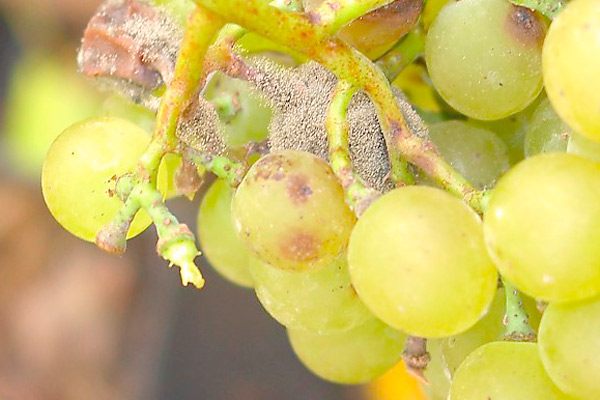
grey mould Botrytis cinerea
Grey mould
In the phenophase „full flowering” brown spots are formed on the flowers and pedicels, which become covered with the sporulation of the pathogen. These symptoms are known as early grey mould.
In rainy and warm weather, immediately after flowering, at the appearance of berry set and at cluster closing, spraying is carried out with one of the registered plant protection products.
Authorised plant protection products: Avalon - 250 ml/da, Banjo - 100-150 ml/da, Botrybel - 0.4-1.5 l/da, Cantus - 100 g/da, Orius 200 EW - 50 ml/da, Folpan - 0.15%, Geox WG - 50 g/da, Mevalon - 160-400 ml/da, Prolectus 50 WG - 120 g/da, Switch 62.5 WG - 100 g/da, Follow 80 WG - 187.5 g/da.
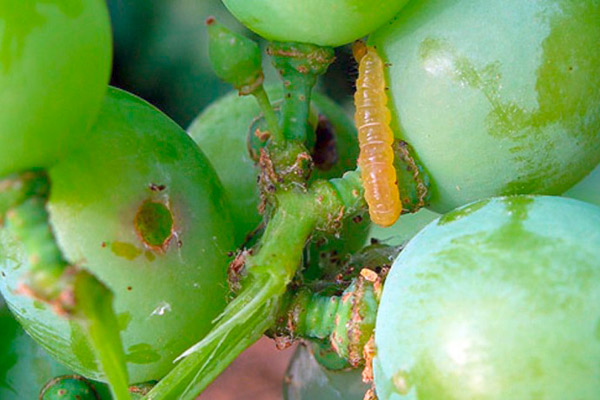
European grapevine moth Lobesia botrana
European grapevine moth
In June, the moths of the second generation of the pest are flying. They lay their eggs on berries of pea size (berry set). The larvae damage the berry set by gnawing and eating out the inside of the berries together with the seeds. The damaged berries are loosely webbed with silk threads. One larva damages from 7 to 24 berries.
Treatment should be carried out at ETL: for table grape varieties 6-7 larvae per 100 berry set, and for wine varieties 11-12 larvae per 100 berry set.
Coragen® 20 SC – stop the pests at the right moment
Authorised plant protection products: Afikar - 40 ml/da, Beltirul - 50-100 g/da, Delmur - 50 ml/da, Lamdex Extra - 80 g/da, Coragen 20 SC - 15-21.6 ml/da, Meteor - 70-90 ml/da, Decis 100 EC - 12.5-17.5 ml/da.
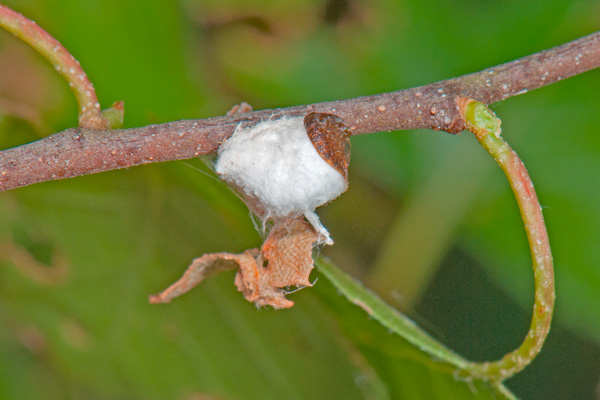
Grapevine scale
During the month the larvae hatch en masse and disperse over the leaves, shoots and bunch stalks, from where they suck sap. As a result of the damage, the vines become weakened.
Chemical control is carried out against the young larvae.
Authorised plant protection product: Oviphrom Top EC - May-August – 1000-2000 ml/da, Linecoil - 1.5 l/da
Pay attention to grapevine scab
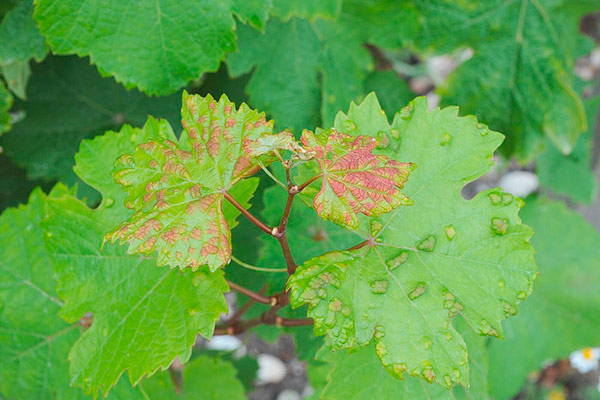
yellow grapevine mite Schizotetranychus viticola
Yellow grapevine mite
During the month all stages are harmful - larvae, protonymphs, deutonymphs and adult mites from the different generations of the pest. They suck sap from the underside of the leaves. During feeding they secrete enzymes which break down the pigments in the leaves and their colour changes, depending on the variety, to yellow, yellow‑green, brown, rusty brown, violet or violet‑red. The leaves become deformed, coarser and, when crushed, crackle. The shoots of heavily infested vines lag in their development.
A treatment should be carried out against adults and larvae when the ETL is reached - 5-8 individuals/leaf - by the end of June.
Authorised plant protection products: Danitron 5 SC - 100 ml/da, Shirudo - 25 g/da, Nissorun - 0.05%,
* The article was updated on 15.06.2025.