

![MultipartFile resource [file_data]](/assets/img/articles/Sadovo-institut-sait-2.jpg)
This year is special for the Institute of Plant Genetic Resources (IPGR) in Sadovo, which is part of the structure of the Agricultural Academy. In 2022 we mark 140 years since the start of agricultural science in Bulgaria, 120 years since the opening of the State Agricultural Experimental Station Sadovo, 120 years since the birth of the most remarkable scientist who worked in Sadovo – Acad. Pavel Popov, and 45 years since the transformation of the regional experimental station into an Institute of national importance. On 28–29 September 2022, an International Scientific Conference will be held at the Institute of Plant Genetic Resources in Sadovo on the topic: “140 years of Agricultural Science in Sadovo and 45 years of the Institute of Plant Genetic Resources”.
Thematic areas of the conference:
1. Plant biodiversity, genetic resources and bioinformatics.
2. Breeding, biotechnologies and smart crop production.
3. Ecology, plant protection, agrotechnologies, food and innovations.
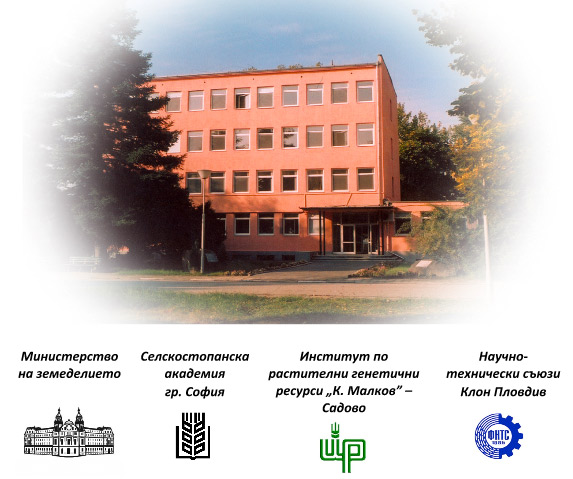
This year is a festive one for us, and you are always welcome – there is much to see and much to learn.
Sadovo is the cradle of agricultural science in Bulgaria
The establishment and development of agricultural science in Sadovo passes through several stages:
In the period from 1882 to 1902, the “experimental” field at the Agricultural School shed light on a number of issues related to the introduction of new crops unknown to our agriculture at that time – cotton, peanuts, fodder and sugar beet, hops, alfalfa, clover.
In September 1902, the Sadovo Agricultural Experimental Station was officially opened, representing a qualitatively new, pivotal moment in the development of agriculture in our country.
In the period 1922–1944, a laboratory was established, the experimental field was expanded and appropriate equipment was supplied to meet the needs of the agricultural process. Breeding work began on a number of crops important for the country, such as wheat, rye, barley and common bean, as well as research on the technology of their cultivation.
Until 1976, the main scientific activity during this period was related to the breeding of common wheat and the development of varieties ensuring high yields under the specific environmental conditions of Southern Bulgaria. Targeted improvement work was also conducted with southern oil crops – peanuts, sesame and poppy. Research was also carried out on the agronomy of these crops.
During this period, a number of new wheat varieties were bred at the Experimental Station. The most famous among them – variety Sadovo 1 – was on a par with the highest achievements of world breeding and for many years remained the leading variety for Southern Bulgaria. In addition to wheat varieties, new high-yielding varieties of rye, cotton, peanuts, poppy, sesame and others were developed for the country.
In 1977, by Council of Ministers Decree, the Institute for Introduction and Plant Resources was established, which was later renamed Institute of Plant Genetic Resources “K. Malkov”. The plant resources were relocated from Sofia to Sadovo. The scientific areas at IPGR include research, applied and service activities in the field of plant genetic resources, breeding and biotechnologies. During this period, the National Seed Genebank, a Plant Biotechnology Laboratory, a botanical garden, a computer centre, a museum and a herbarium were established.
More than 69,000 accessions are preserved in the National Plant Genebank. It was built under an FAO project and opened in 1984. Its main task is the implementation of the scientific programme for long-term and medium-term conservation of germplasm through seeds under controlled conditions. The genebank in Sadovo maintains contacts and carries out non-monetary exchange with more than 100 genebanks, botanical gardens and international PGR centres worldwide. In 2002, a specialised botanical garden was also established for in vivo conservation of valuable species, national and Balkan endemics. The biotechnology laboratory is engaged in in vitro conservation of vegetatively propagated crops, medicinal, aromatic and other species.
In addition to its rich history, the Institute is also proud of its achievements. IPGR works with all field crops and has established experts for them. The main scientific areas are Plant Genetic Resources and the Breeding and Genetics Department. In its 140-year history, 152 varieties of 29 crops have been developed here, 27 of which are currently included in the Official Variety List of Bulgaria for 2022. For wheat, the following have been developed here: variety Katya – the most drought-tolerant variety in Europe; the unique variety Sadovo 1, which for more than 45 years has been a standard in our country; variety Pobeda – our most winter-hardy variety, with excellent bread-making quality, which for more than 30 years has been a standard for group A (strong wheats); the varieties Prelom, Sadovo 772 and Geya 1, exceptional for their yield potential; the “economic” variety Boryana and many others, including the newest ones – Gizda, Nikibo, Nadita, Sashets and Blan.
Attempt to revive Bulgarian peanut production
Another crop for which Sadovo is renowned is peanuts. The varieties Kalina, Kremena, Orfei and Tsvetelina, developed at the Institute, have excellent taste characteristics and on all markets are labelled “Sadovo peanuts”, which is a guarantee of quality. As a result of global warming, interest in them has increased in many other European countries, and now the predominant share of the seeds is increasingly destined for Italy, Ukraine, Austria, Germany, Switzerland, France, Portugal and others, whereas until recently Southern Bulgaria was considered the northern boundary of this thermophilic crop.
At the Institute, the first European sesame varieties with non-dehiscent capsules – Nevena, Aida and Valya – have been developed, which can be grown fully mechanised from sowing to combine harvesting. Thus, the manual labour typical of all sesame varieties worldwide (except in the USA), which increases production costs and makes sesame cultivation unattractive, is completely eliminated.
With the help of the plant genetic resources at the Institute, the following have been bred: the only Bulgarian rye variety included in our Official Variety List – Milenium, the best winter forage pea variety for green forage – Mir, the first Bulgarian winter naked-oat variety – Marina, the high-yielding varieties with very good winter hardiness Potok in barley and Denitsa in durum wheat, as well as many others in various vegetable species.
At IPGR Sadovo, work is also carried out with many alternative species suitable for organic farming, such as einkorn, grass pea, phacelia, chickpea, flax, millet, saffron and others.
The Institute is one of the main centres of agricultural science in our country, with outstanding international authority in countries such as Italy, China, Korea, France, Russia, Sweden, Switzerland, on the Balkan Peninsula, even in the USA and many other states.