

![MultipartFile resource [file_data]](/assets/img/articles/заглавна--перспективни-сортове.jpg)
The highlight of this year’s Cherry Festival in Kyustendil was the presentation of promising cherry cultivars for the country. The most important objective for the Institute of Agriculture in Kyustendil, which the breeders are striving for, is for the new cultivars to be tolerant to changing climatic conditions. The selected cultivars have excellent economic characteristics, but the lack of an assured market hinders the implementation of modern and sustainable fruit growing in the region.
At the “Cherry Festival” held at the end of June, the Institute of Agriculture – Kyustendil presented ten promising cherry cultivars for the country – Daneliya, Vasinika, Summit, Kordia, Ferrovia, Stefania, Rainier, Regina, Sweetheart and Staccato.
The Institute is the successor of the Fruit-Growing Experimental and Control Station in the town of Kyustendil, established by Order of the Ministry of Agriculture and State Property No. 2646/19.12.1929. At the end of 1944, the Experimental and Control Station was transformed into a Fruit-Growing Testing Institute. Three independent departments were formed: breeding and cultivar study, agrotechnics and plant protection.
Today, the Institute of Agriculture – Kyustendil has at its disposal 180 cherry cultivars and hybrids, with 11 cultivars created in recent years, 3 of which in 2015.
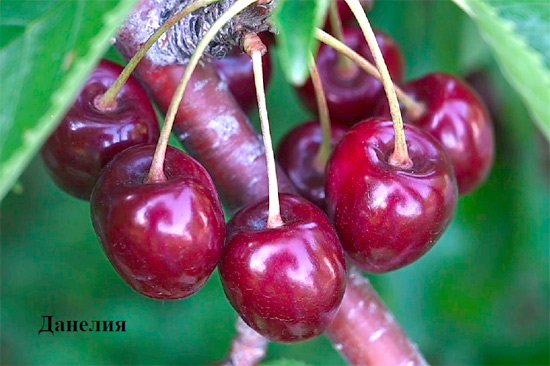
Daneliya
A cultivar of the Institute of Agriculture – Kyustendil. The fruits are large with an average weight of 7.2–8.0 g, with an attractive dark mahogany-red coloration, firm flesh and very good organoleptic qualities, ruby-red juice and a stone that separates easily. They ripen around mid-June, about ten days before Bing and thus fill the gap between Bigarreau Burlat and Bing. They are also suitable for processing. The tree is of medium vigour, with very good productivity. It has good winter hardiness and relatively good tolerance of blossoms and young fruitlets to late spring frosts. Flowering is semi-late – 3–5 days after that of Bing.
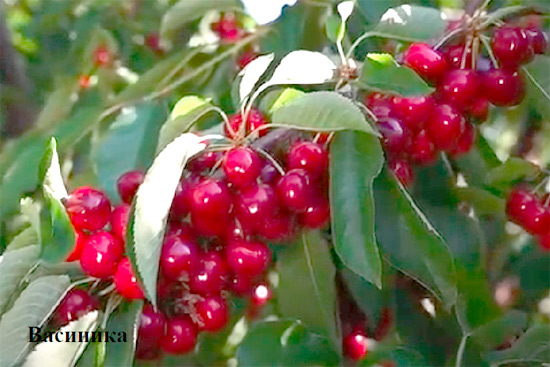
Vasinika
One of the newly bred cultivars from the Institute of Agriculture – Kyustendil, approved in 2015. The fruits are very large (8.6 g), broad heart-shaped to rounded, with a black-red coloured skin. The fruit flesh is firm with excellent organoleptic qualities. It was obtained by crossing the cultivars Van and Stella. It is relatively tolerant to cracking, somewhat more than Van. The fruits ripen around mid-June, about 5–6 days before Van, thus successfully filling the period between early-ripening (Bigarreau Burlat) and mid-ripening (Van) cultivars. The tree is of medium vigour, stronger than Van, forming a moderately dense crown. An early-bearing and extremely productive cultivar. Flowering is early. The average date of the beginning of full bloom is 10 April, about three days before Van. Stella is a suitable pollinator.
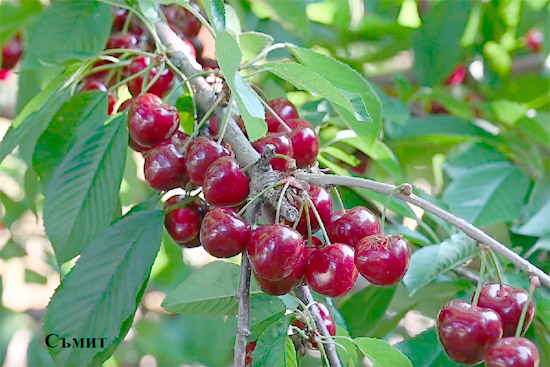
Summit
Canadian cultivar. Moderately vigorous, extremely productive and large-fruited, with a very attractive appearance and heart-shaped form. Exceptional organoleptic qualities, similar to those of Van. With a medium-long stem. Late flowering. Ripens in the period 30.05–10.06. A cultivar tolerant to low winter temperatures and late spring frosts. Hardly susceptible to cracking.
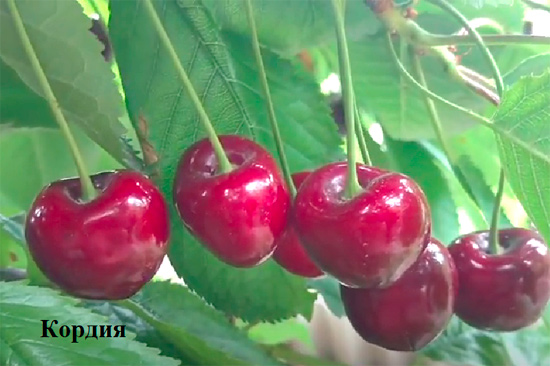
Kordia
Czech cultivar. Very widespread in Europe. With very late flowering. Ripens at the end of June. Fruit weight is about 12–13 g. The fruits are very large, heart-shaped, dark red, juicy, sweet, fleshy and crisp, with a long stem. The skin is glossy, dark red, with a low likelihood of cracking. The tree has medium vigour, high productivity and a compact, conical crown. It is tolerant to late spring frosts and fruit cracking. Suitable pollinators are Van and Regina.
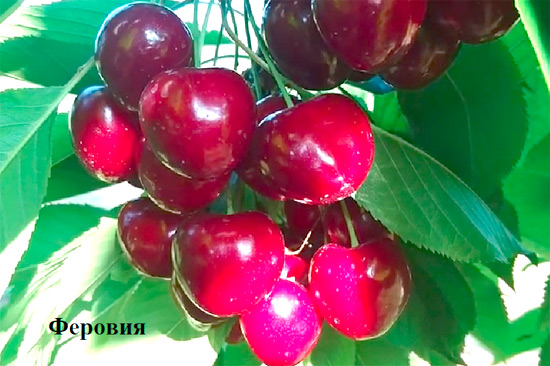
Ferrovia
The most widely grown cultivar in Italy. Very productive. An exceptional fruit, with a broad heart-shaped form, very crisp, firm flesh and outstanding taste. Fruit size reaches up to 10 g. The stem is long. It ripens at the end of June – first five days of July. It has medium to good tolerance to fruit cracking. The cultivar is self-fertile.
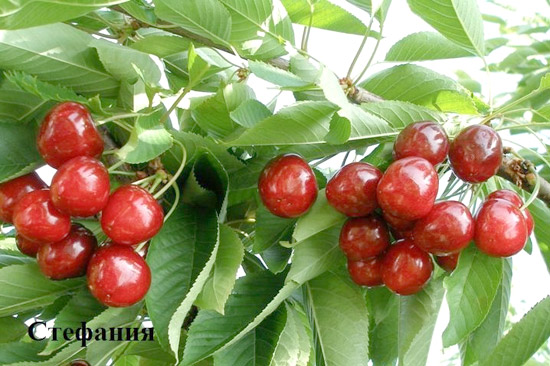
Stefania
The pride of the breeding activities of the Institute of Agriculture – Kyustendil, successfully marketed even in China. The tree is vigorous, with high productivity. The fruits are large to very large (average weight 8.3 g), broad heart-shaped, dark mahogany-red, with a long stem, with firm pinkish-yellowish flesh of very good organoleptic qualities, pink juice and a stone that separates easily. Their appearance is highly attractive. Flowering is late. They ripen in the third ten days of June – beginning of July. Under prolonged rainfall during ripening, only single fruits crack. With very good winter hardiness and good tolerance to returning cold spells and late spring frosts.

Rainier
American cultivar, developed by crossing the cultivars Bing and Van. The tree is vigorous, with a pyramidal to broad-pyramidal, moderately dense crown. With large yellowish-red fruits, with a broad heart-shaped to globular form and a short, thin stem. The skin is of medium thickness, glossy, yellowish-pink-red to dark red, with darker red patches on a yellowish background and numerous subcutaneous dots. The flesh is yellowish, very firm, juicy, very sweet, slightly acidic, with very good organoleptic qualities. The stone is small, separating from the flesh, almost ovoid. Its fruits ripen in the third ten days of June and require more careful handling. Very good productivity. Suitable pollinators are Bing, Van and Sam.
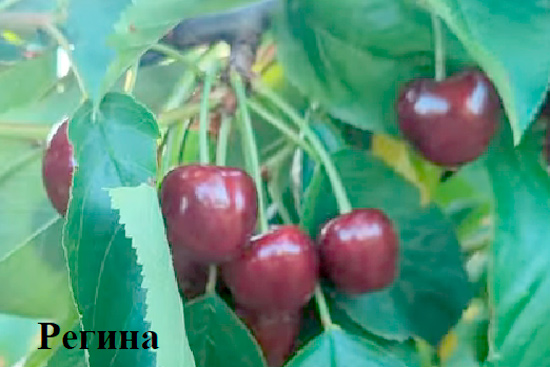
Regina
German cultivar. Very late ripening - around 10 July. The fruits are large to very large, brownish-red, firm-fleshed, crisp, with a very long stem, aromatic and with very good organoleptic qualities. It ripens when the rainy period has already passed. With a wide-spreading crown, prone to bending under crop load. It is pollinated by Schneider’s Late, Hedelfingen, Kordia and Lambert.
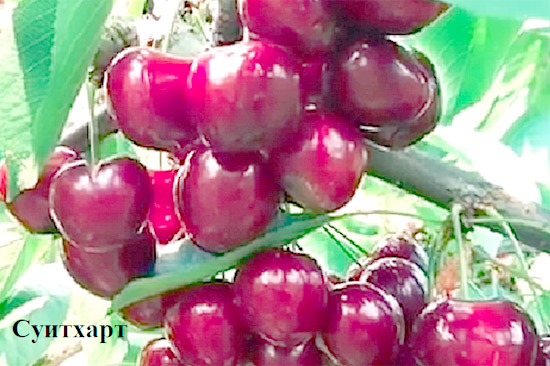
Sweetheart
Canadian cultivar, similar to Staccato, obtained by crossing Van and New Star. The fruits are very large, juicy, firm and with excellent taste. The tree is strongly vigorous in height and requires appropriate pruning. With good productivity. Ripens 15–20 July. A self-fertile cultivar. Tolerant to cracking.
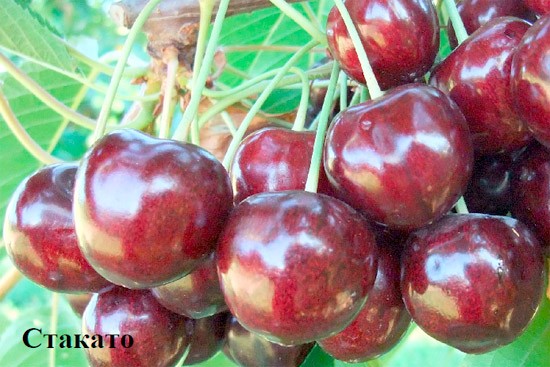
Staccato
Canadian cultivar obtained as a result of open pollination of the cultivar Sweetheart. The tree is moderately vigorous. Large fruits with firm, crisp, juicy flesh. Flowering is medium-early. It ripens around the end of July and the beginning of August. Self-fertile. Tolerant to cracking.
Cultivation of cherries – breeding objectives, problems and prospects
Especially for the “Plant Protection” journal, the Deputy Director of the Institute of Agriculture – Kyustendil, Assoc. Prof. Dimitar Sotirov, shared the breeding objectives for cherries pursued by the Institute of Agriculture – Kyustendil.
The main objectives that the Institute pursues in its breeding work are large fruit size (so-called “bigarreau” type cherries), taste, tolerance to stress factors – cold, cracking and self-fertility. “The most important objective for us is for the new cultivars to be tolerant to changing climatic conditions – late spring frosts and cracking during ripening,” explained Assoc. Prof. Sotirov.
Such cultivars are Dima and Alekston, approved in 2015, which are self-fertile, as well as Daneliya and Stefania (the pride of the Institute of Agriculture).
“So far we have bred dozens of new hybrids, from which elites have been selected, which the Executive Agency for Variety Testing, Field Inspection and Seed Control must test for distinctness, uniformity and stability. After the testing, a procedure will follow for their approval as new cherry cultivars,” added the Deputy Director.
The distinctive taste of Kyustendil cherry fruits cannot be replaced; they are sought after and preferred.
The Institute will continue, just as persistently and purposefully, to breed cultivars with important economic traits, but there must be growers to cultivate them. In order to have a Cherry Festival, in order to have producers, they must have an assured market, with prices of at least BGN 3 per kg of fruit, so that we can speak of modern and sustainable agriculture in the region.
This year the cherry crop was good and of high quality, despite the rains during pollination and ripening. A large part of the production, however, was not harvested, since most purchasing points were not operating, and the remaining ones purchased mainly yellow, small and greener cherries. Other unfavourable factors leading to problems in cherry production are the lack of pickers and of sufficient processing enterprises.
Producers do not have direct contacts with traders and retail chains and rely on purchasing points and processing enterprises. Thus, fruit growers sold at rock-bottom prices, because processing enterprises and the few existing purchasing points bought cherries at prices of BGN 1–1.20/kg.
Additionally, the high cost of cherry picking – BGN 0.70/kg of fruit – rendered the efforts of the people of Kyustendil pointless, not to mention the increased prices of fuel, synthetic fertilizers and plant protection products.
Harvest and sell in a single day
In order not to lose their livelihood, fruit growers must seek markets within the EU as well, or direct sales channels and short supply chains on site. Where there is a will, there is a way, but given the mass production in the region, it would still be advisable to have an established wholesale market or exchange. In this way, transport costs will be reduced to a minimum and the production will be sold immediately – harvest and sell in a single day.