

![MultipartFile resource [file_data]](/assets/img/articles/weinrebe-bluete.jpg)
In this period, the vines are in the phenophase “full flowering” to the phenophase “pea-size berry” - “cluster closure”.
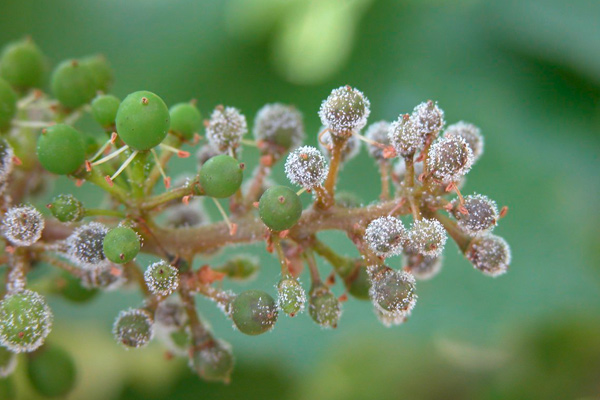
Downy mildew of grapevine
On young leaves the disease appears as pale green, rounded, oily spots, which are visible against the light. The spots enlarge and turn yellow-brown, and on their underside a white sporulating growth is formed. Under severe attack the leaves become deformed, dry out and fall prematurely. The inflorescences, pedicels and small clusters attacked are covered with white growth, dry out and some even drop. The enlarged berries become infected from the pedicels, the skin around them turns pale brown, the berries wilt, turn brown and mummify.
Pest control strategy
The variable weather, frequent showers and the intensive growth of vines in June necessitate the continuation of treatments against downy mildew of grapevine. When using contact fungicides, the spraying intervals are from 3 to 7 days, with locally systemic fungicides from 7 to 10 days, and with systemic ones from 10 to 14 days. In the case of frequent showers and presence of infection, the intervals are shortened.
Authorized plant protection products: Alial 80 WG - 75-330 g/da; Bordeaux Mix 20 WP – 0.5-0.6%; Vinker WG – 200 g/da; Vitene Triplo R - 400-450 g/da; Vitra 50 WP, Quadris 25 SC - 0.075-0.1% (75-100 ml/da with 100 l/da spray solution); Cuproxide 50 WP – 0.15%; Delan 700 WG – 0.05%; Dimix 500 SC - 30 ml/da (in combination with a product containing mancozeb) or 34 ml/da (in combination with a product containing folpet); Cabrio Top – 0.15% – treatment interval 7-10 days - 0.2% at 10-14 days; Mikal Flash – 0.3%; Momentum Extra WG - 300 g/da; Pergado Med 27 WG - 500 g/da; Pergado F – 0.2%; Profiler 71.1 WG - 200-225 g/da; Sphinx Extra, Vinostar - 180 g/da; Follow 80 WG, Friller 80 WG, Flowet 80 WG - 187.5 g/da; Folpan 80 WG - 0.15%; Funguran OH 50 WP – 0.15%; Champion WP / Macc 50 WP / Champ WP – 0.15%; Delan Pro - 300 ml/da; Equation Pro - 40 g/da; Kocide 2000 WG - 0.12%; Leymay - 37.5 ml/da; Metomor F - 100-150 ml/da; Orvego - 80 ml/da; Pergado F - 200 ml/da; Ridomil Gold R - 500 g/da; Solofol - 188 g/da; Ceraxel - 250 ml/da; Cuprocin 35 WP - 220-300 g/da; Lieto - 220-300 g/da; Zorvec-Vinabel - 50 ml/da; Topaz - 30 ml/100 l spray solution.
Powdery mildew
High atmospheric humidity and the sustained warming of the weather during the month are prerequisites for the development of the disease. On the upper side of the affected leaves yellow-greenish spots appear with a grey-white coating under which the tissues necrotize. The affected leaves become deformed, scorch, but remain on the vines. The infected shoots also become deformed. On affected berries, small spots covered with a grey-white coating appear. When this coating is rubbed off, the berry tissues underneath, which have a net-like brown structure, become visible. The berries crack deeply and their seeds are exposed.
Pest control strategy
Treatments should be carried out every 8-10 days, depending on climatic conditions, cultivar susceptibility, degree of infestation and the mode of action of the fungicide used.
Authorized plant protection products: Acoidal WG - 0.25%; Vivando - 20 ml/da; Dynali 090 DC - 50-65 ml/da; Cabrio Top - 0.2%; Orius 25 EW, Dynasty 25 EW, Tebumax 25 EW - 0.04%; Solfoliquid 800 SC – 400 ml/da at a 7-day treatment interval; 1210 ml/da at a 10-day treatment interval; Talendo 20 EC - 20-25 ml/da; Talendo Extra - 7.5-25 ml/da; Thiovit Jet 80 WG – 0.3% (before flowering); 0.2% (after flowering); Flint Max 75 WG - 0.016%; Folicur 250 EW, Horizon - 0.04%; Folpan 80 WG - 0.15%, Sercadis - 15 ml/da.
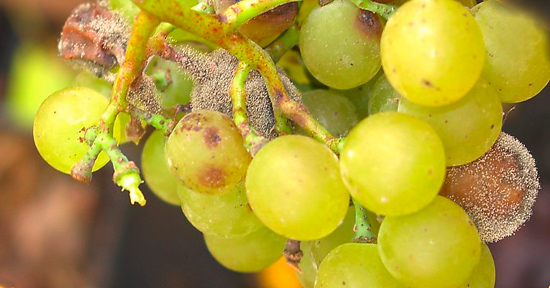
Grey mould
In the phenophase “full flowering” brown spots appear on the flowers and flower stalks, which become covered with the sporulation of the pathogen. These symptoms are known as early grey mould.
Pest control strategy
In rainy and warm weather, immediately after flowering, at the appearance of pea-size berries and at cluster closure, spraying is carried out with one of the registered plant protection products.
Authorized plant protection products: Cabrio Top – 0.2%; Cantus - 100 g/da; Prolectus 50 WG - 120 g/da; SWITCH 62.5 WG - 0.08; Follow 80 WG, Friller 80 WG, Flowet 80 WG - 187.5 g/da; Folpan 80 WG - 0.15%; Avalon - 250 ml/da, Banjo - 100-150 ml/da.
Pests
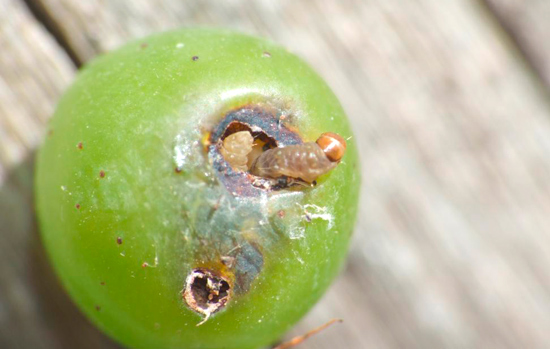
European grapevine moth
In June, moths of the second generation of the pest are flying. They lay their eggs on berries of pea size (young berries). The larvae damage the young berries by gnawing and eating out the inside of the berries together with the seeds. The damaged berries are slightly webbed with silk threads. One larva damages from 7 to 24 berries.
Pest control strategy
Treatment should be carried out at the ETL (economic threshold level): for table grape cultivars 6-7 larvae per 100 young berries, and for wine grape cultivars 11-12 larvae per 100 young berries.
Authorized plant protection products: Aphicar 100 EC - 40 ml/da; Decis 100 EC - 12.5-17.5 ml/da; Dipel 2 X - 0.1%; Efcimetrin 10 EC, Ciper 10 - 40 ml/da; Karate Zeon 5 CS - 0.02%; Coragen 20 SC, Voliam - 15-27 ml/da; Mageos - 10 g/da; Rapax - 75-100 ml/da; Sumi Alpha 5 EC, Sumicidin 5 EC - 0.025%; Foray 48 B - 0.15%; Cyclon 10 EC - 50 ml/da; Citrin Max, Ciperkil 500 EC, Cipert 500 EC, Poli 500 EC - 6 ml/da; Sherpa 100 EC - 40 ml/da, Delmur - 50 ml/da, Kedu - 40 ml/da.
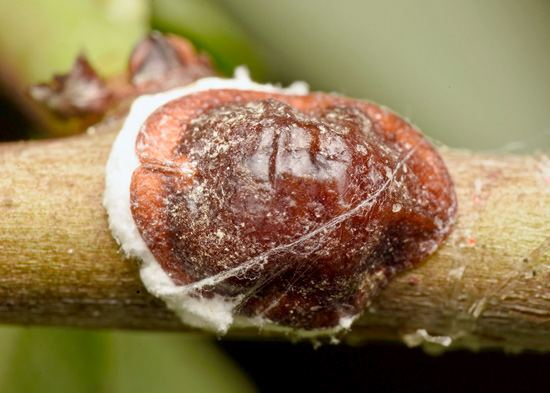
Grape vine scale (mobile form)
During the month, mass hatching of larvae occurs and they spread over the leaves, shoots and clusters, from where they suck sap. As a result of the damage, the vines are weakened.
Pest control strategy: Chemical control is carried out against the young larvae.
Authorized plant protection product: Movento 100 SC - 0.075-0.095%; Ovipron Top – May-August - 1000-2000 ml/da (1000-2000 ml/100 l water);
Yellow grapevine mite
In June all stages are harmful - larvae, protonymphs, deutonymphs and adult mites from the different generations of the pest. They suck sap from the underside of the leaves. During feeding they secrete enzymes which degrade the pigments in the leaves and their colour changes, depending on the cultivar, to yellow, yellow-green, brown, rusty brown, violet or violet-red. The leaves become deformed, coarser and crunch when crushed. The shoots of heavily infested vines are delayed in their development.
Pest control strategy:
A treatment against adults and larvae should be carried out when the ETL is reached - 5-8 individuals/leaf - by the end of June.
Authorized plant protection products: Apollo 50 SC - 30-40 ml/da; Nissorun 5 EC - 0.05%; Danitron 5 SC - 100 ml/da; Shirudo (former Masai WP) - 25 g/da.