

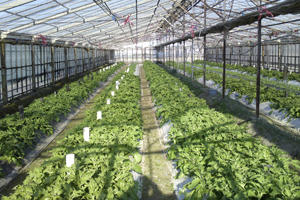
Greenhouse production. In glass greenhouses, crops can be in various stages of development - from the beginning of vegetation to harvest. It is necessary for the selection of plant protection products (PPPs) used to treat the plants to be appropriate for the development stage, in order to protect the produce and the environment from chemical contamination. At the beginning of the vegetation period, the pesticides indicated for seedlings are applied, and during the harvest period - PPPs with a shorter pre-harvest interval. Upon detection of the first disease spots, colonies of aphids, eggs, or hatched caterpillars, the infested plant parts are collected in polyethylene bags, removed from the greenhouse, and destroyed. In young crops, monitoring for damage from mole crickets, slugs, and centipedes is conducted. If detected, baits are scattered in a 10-15 cm band on both sides of the row, preferably in the evening – 300 g/da bait. It is advisable to place colored sticky traps for pests near the doors and vents.
During this period, an attack from root rot, sclerotinia rot, and gray mold (botrytis) is possible. The identification of the causative agent of the rot should be done by a specialist. Regardless, diseased plants are carefully removed without scattering soil, after which the spots are "burned" with a 2% solution of copper sulfate or ammonium nitrate – 3-4 l/m2. The remaining plants, or those adjacent to the diseased ones, are watered with a combination of 0.1% Topsin M + 0.15% Proplant 722 SL or with 0.1% Topsin M + 0.3% well-neutralized Bordeaux mixture - 0.25-0.5 liters each, depending on the development stage. To protect plants from the causative agents of the "root rot" complex, biopreparations based on the fungus Trichoderma can be introduced into the soil, and only for cucumbers - fusaclin at 5 g/plant at planting and 2 g/plant in the phase of the VII – VIII leaf. To combat sclerotinia rot, the plants and the soil around them are sprayed with 0.1% Topsin M. Against gray mold (botrytis), the damaged parts on the stems and stalks are cleaned and smeared with a paste of Topsin M, and the crop is sprayed with 0.07% of the same product. For tomatoes, there is a real danger of the appearance of early blight (alternaria) and powdery mildew, and for cucumbers - powdery mildew. To combat them, the PPPs indicated for seedlings are applied. If the cultivated tomato varieties are not resistant to late blight, an attack from this disease is possible. There are no registered PPPs against it. Treatment with 0.07% Topsin M gives good results.
The predominant part of the listed diseases develop under high air humidity and when the soil is over-moistened. Mites and powdery mildew develop under low air humidity. Therefore, it is important to regularly ventilate the cultivation facilities and maintain an optimal temperature-humidity regime.
During this period, preparation for transplanting in unheated glass and polyethylene greenhouses begins. Plant residues and the sisal from the previous vegetation are collected, weeds and self-sown plants are cleaned. The soil is worked to a fine tilth. If necessary, it is pre-moistened. The soil profile is formed, depending on the crop to be cultivated. If fumigation with fumigants was carried out in the autumn, a degassing test is conducted.