

![MultipartFile resource [file_data]](/assets/img/articles/antonomus-pomorum-L-1.jpg)
The apple blossom weevil causes damage mainly in orchards where regular plant protection is not carried out. It attacks apple and pear, but apple to a greater extent.
It develops one generation per year. It overwinters as an adult insect among the fallen leaves under the canopy of the infested trees or in neighbouring orchards, under old cracked bark, in the mosses and lichens of forest trees, and in other shelters.
In spring, the beetles appear at the bud burst phenophase, at an average daily temperature of 6-8°C.
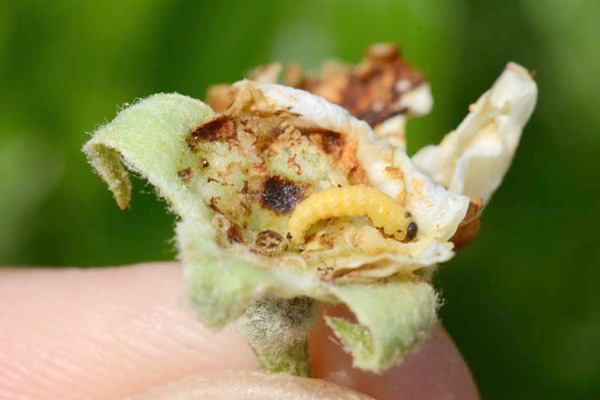
They feed on flower and leaf buds and later on the flower buds. Fertilized females lay one egg per flower bud, at the base of the stamens. The larva feeds on the pistil and stamens, gnawing also the base of the petals.
Damaged flower buds do not open, turn brown and dry out. This is the most characteristic damage. In years with excessive flower formation, a low level of infestation by the pest may have a beneficial effect by thinning the flowers. Heavy infestation leads to the destruction of a large proportion of the flowers in the rosette.
The larvae pupate inside the flower. The adult insect emerges in May, gnawing a circular hole and coming out. It feeds on the leaves and very rarely gnaws small pits on the fruits.
Before undertaking chemical control, the population density of the apple blossom weevil must first be determined. Therefore, shake the branches. Sampling by shaking branches and visual observations is carried out in the phenophase from bud burst to the appearance of flower colour.
The economic injury level (EIL) for apple is 4-6 adults per tree at the “green tip” stage or 15% damaged buds; for pear – 5-8 adults per tree or 8-10% damaged fruit buds.
Chemical control should be directed against the adults, before oviposition – early in spring, after bud swelling (when the EIL is exceeded).
Registered products against apple blossom weevil – with the active substance deltamethrin (Deca EC and its other trade names – Desha EC, Dena EC, Decis, Poleci – 30-50 ml/da).