

![MultipartFile resource [file_data]](/assets/img/articles/2ч_Заглавна_снимка_4x3_NN_scales_wheat.webp)
Optimizing mineral nutrition in field crops is a major prerequisite for high and stable yields. Nitrogen deficiency is one of the main factors affecting the yield and quality of wheat. Efficient grain production depends mainly on the choice of an appropriate variety for the specific agro-ecological conditions and on the agronomic practices implemented, which increase the yield and quality of the production.
The use of biostimulants and nitrogen-fixing bacteria for regulating the growth and development of crops will become a main practice for obtaining environmentally friendly plant production under conditions of climate change and in the context of the „Green Deal”. Their application is environmentally friendly and contributes to better uptake of nutrients by the roots in the soil. Observance of the application stages is mandatory for their effectiveness.
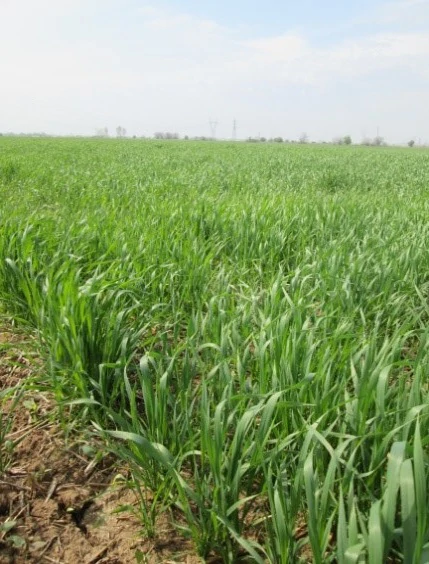
The aim of modern agricultural production is to reduce production inputs without negatively affecting the yield and quality of the production. Biostimulants are plant extracts and contain a wide range of bioactive compounds. These products are capable of improving the efficiency of nutrient use by the plant and increasing tolerance to biotic and abiotic stresses.
Amalgerol Essence is a high-quality organic biostimulant containing 7 components. It supports root growth, activates life in the soil and helps increase humus content. It helps retain water in the soil and ensures a good harvest even during dry periods. Amalgerol Essence contains antioxidants that have a positive effect on plants under biotic and abiotic stress.
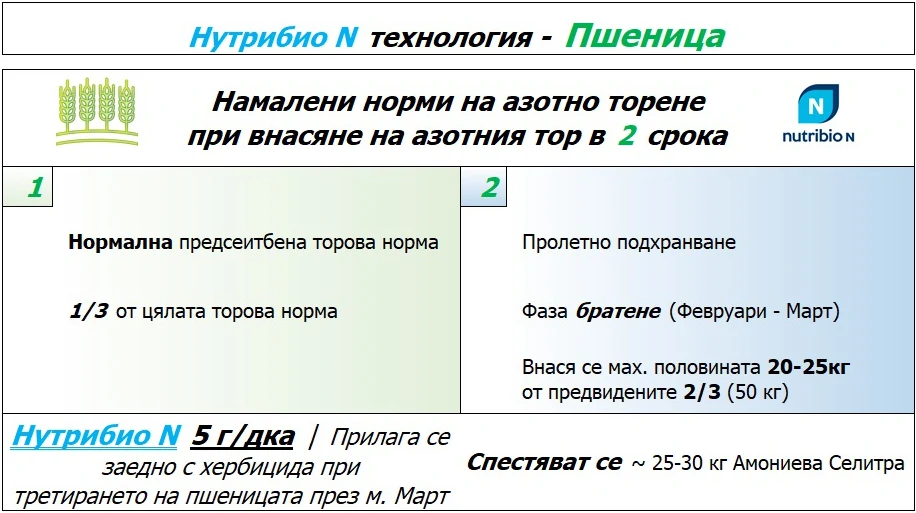
Nutribio N is a unique organic microbial foliar fertilizer, developed on the basis of mycorrhizal fungi, nitrogen-fixing bacteria (CERES Azotobacter salinestris) and others, which promotes plant growth and improves nutrient use efficiency. The bacteria in the product remain alive for 4 years thanks to an innovative bacterial drying technology.
Nutribio N is compatible with the most commonly used fertilizers and agrochemicals, but is not compatible with products with an alkaline reaction, copper products, bactericides and biocides.
The application of biostimulants and nitrogen-fixing bacteria allows a reduction in mineral fertilization without decreasing the yield and quality of the production, while at the same time maintaining nitrate levels below the limits imposed by EU regulations.
The aim of the trial conducted at IPGR Sadovo is to establish the effect of the biostimulant Amalgerol Essence and the product Nutribio N on wheat yield, as well as the possibility to compensate for the amount of mineral nitrogen.
Material and methods
The trial was established with a Bulgarian variety bred at IPGR, registered in 2020. The wheat was sown within the optimal period for the region of Southern Bulgaria (16.10.2020) at a seeding rate of 25 kg/ha. Before sowing, a compound mineral fertilizer NPK 15:15:15 was applied at a rate of 20 kg/ha. To determine the effect of foliar fertilizers and biostimulants and their advantage over the standard cultivation technology, several variants were set up. Each variant was harvested on an area of 100 m2 in four replications.
Results and discussion
1) From a climatic point of view, the farming year (2020-2021) during which the trial was conducted was typical for the region of the town of Sadovo. The beginning of the summer was accompanied by low temperatures for the season and heavy rainfall, and the second half – by very high temperatures and a sharply pronounced drought.
2) The plants emerged and reached the tillering stage before the onset of the winter period and overwintered successfully without damage. After the active vegetation of the wheat, the rainfall in spring favoured the development of the crop. On 02.03.2021 the stand was treated with a herbicide against grass and broadleaf weeds. Nitrogen fertilizers were applied once in March (09.03.2021). On 31.03.2021 the combination of Amalgerol Essence and Nutribio N was applied on the recommendation of the company „Medi plus R“ Ltd. Harvest was carried out at the optimal time for the region (22.07.2021).
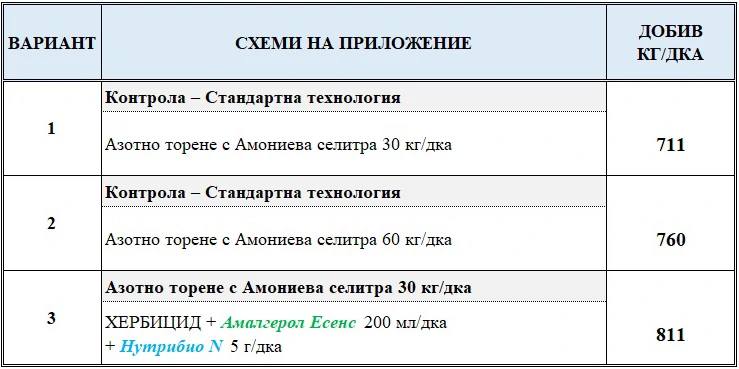
The results of the trial show that the combination of Amalgerol Essence and Nutribio N at a fertilization rate of 30 kilograms per decare surpasses in yield the standard fertilization technology of 60 kilograms per decare ammonium nitrate shown in variant 2 of the table.
In the third variant, the advantage of the products and their effectiveness is clearly evident even at a reduced rate of mineral nitrogen. We attribute this to the excellent combination and symbiosis between Amalgerol Essence and Nutribio N and their ability to fix atmospheric nitrogen.
The tested biostimulants have a positive effect on wheat productivity, as well as improve the overall phytosanitary status of the stands.
The use of biostimulants increases crop resilience and ensures high yields in the implementation of environmentally friendly and organic farming.
The trials are directly related to the standards and requirements of modern good agricultural practices in accordance with the „Green Deal”. The team that conducted the trials at IPGR Sadovo strongly recommends the company’s products to farmers for increasing yields and implementing scientifically based modern agriculture.
The data from the trials are processed statistically, and the differences in yields between the individual variants are proven by analysis of variance. Using linear regression and an exponential equation, the possibilities for reducing mineral nitrogen in wheat have been established.
Assoc. Prof. Stanislav Stamatov, PhD and Chief Assist. Prof. Nikolaya Velcheva, PhD
Institute of Plant Genetic Resources „K. Malkov” – town of Sadovo
E-mail: stanislav44@abv.bg; nikolaya_velcheva@abv.bg
Expect the continuation of the article (Part III) soon!
For more information: https://www.mediplusr.com/nutribio-n/