

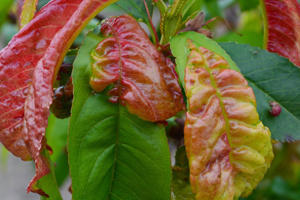
During the warm days of February and the first half of March, spraying should be done against the overwintering stock of: eggs of the European red mite, brown apple mite, green apple aphid, rosy apple aphid, apple-grass aphid, pear-bedstraw aphid, pear-coltsfoot aphid, black cherry aphid, mealy plum aphid, green peach aphid, leaf-curling aphid, large peach aphid, small and large plum aphid, small winter moth, large winter moth, rose leafroller, hawthorn leafroller, brown-spotted leafroller; larvae of San Jose scale, yellow pear scale, false San Jose scale, comma scale. Against these pests on apple, pear, cherry, sour cherry, apricot, peach, and plum, Para Zomer – 3% is used. For simultaneous control of peach leaf curl, pear and peach scab, shot hole disease and brown rot on stone fruits, bacterial canker (gummosis) on cherry, sour cherry, and apricot caused by Pseudomonas syringae, and plum pox (sharka) on plum, one of the copper-containing fungicides is added to Para Zomer - Bordeaux mixture-1%, Funguran OH 50WP-0.3%, Champion WP- 0.3%, Kocide 101 WP-0.3%.
In pear trees, the development of the common pear psyllid should be monitored, specifically their emergence from winter shelters and the dispersal of overwintered adults onto swelling buds, where they begin to suck sap. At a high density of the psyllid (1 individual per 10 bagged twigs), spraying against the adult individuals before egg-laying is necessary. Very often, the treatment against this pest coincides with the winter treatment, and then one of the following insecticides is added to Para Zomer: Vaztak Nov 100 EC – 0.02%, Decis 2.5 EC – 0.03%, Deca EC – 75 ml/da, Sumicidin 5EC – 0.03%. In cherry and sour cherry trees during this period, a shaking test is performed to determine the density of the cherry weevil, and if 3 adults per tree are found, spraying with Nurelle D/Sanmba/ – 0.08% is done.
In the picture: Peach leaf curl