

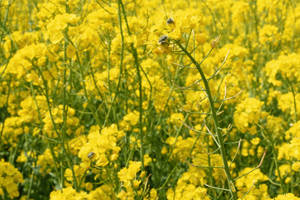
Test of the key professional competencies of agricultural producers
There are several starting points for reflections on the role of plant protection in rapeseed. First, let us recall that this crop is of strategic importance for our agriculture. Its basic parameters for profitability are impressively high. This refers to the yield-price ratio and opportunities for market realization. And it is no coincidence that the most profitable grain crop continues to attract the attention of domestic agricultural producers.
The key question under these circumstances is: does the Bulgarian agricultural producer have sufficient professional competencies to successfully grow this crop, to create sustainable production in an uncertain climatic environment, to achieve a high yield result, so that, after drawing the line, they can enjoy a good profit thanks to the correct investment. If we define answers to these difficult questions with cheerful pathos and a strong dose of emotional positivity, there is a real danger of being accused of approaching the matter formally and irresponsibly, of trying to circumvent the truth. Because the truth, whatever it may be, must first and foremost contain a real idea of what is happening - we mean climate changes and anomalies, the increased aggression of pests, expert assessments of technological actions, the possibilities for formulating an informed choice, market attitudes and expectations...
From a purely agronomic point of view, rapeseed is a difficult crop. What do we mean? Its vegetation lasts a full 10 months - across three seasons - autumn, winter, spring, which is a precedent in agricultural practice. During this time, many unforeseen situations can and do occur in the field. The uncertain climatic environment provokes force majeure turbulence, whose centrifugal vortices very often strongly change and deform the phytosanitary situation in a negative direction. In professional language, this means - the disease-causing potential and the infectious background are activated and restarted with unsuspected force. This super-powerful harmful avalanche is launched onto the rapeseed with maximum destructive energy and sweeps away everything in its wake. On the other hand, rapeseed has fragile resistance forces, it is highly vulnerable to diseases, pests, and weeds.
What is the horizon of counteraction, do our agricultural producers have a useful move? This is the place to state loudly, with a maximum dose of certainty, that plant protection, its profile, multifunctionality, activity, creativity, and effectiveness are the key limiting factor for the successful production of rapeseed in an uncertain climatic environment.
And as I open the topic of plant protection, directly responsible for the health status of the rapeseed crop, we are obliged to pay attention to two circumstances. On the one hand - in its role as a target market, Bulgarian agriculture has all the world innovations of the agrochemical industry. Which is a sign that a technological and product format capable of ensuring and guaranteeing security and powerful action against all biotic and abiotic factors that determine the behavior of the harmful potential is positioned and activated here. In other words: this multifunctional capital can minimize to the maximum extent the action and aftereffects of any arisen phytosanitary fire. Its capacity for prevention is also of maximum dimensions and high professional characteristics.
We come to the question: is the Bulgarian agricultural producer competent to assess and manage the risks and direct dangers of the harmful scourge? Many people practice on the topic. Few analysts claim that modern plant protection has its own logic of development and technological advancement, which conflict with the management vision of agricultural production. Other experts are of the opinion that the Bulgarian agricultural class continues stubbornly to reveal and demonstrate its severe agronomic illiteracy, clinging to ever more insane scenarios for a large-scale phytosanitary collapse, produced and directed by emissaries, advisors, oracles, and trusted explainers of various caliber and breed. This destructive dependency deforms reality, blocks attempts at adequate behavior and the formation of correct decisions and the use of good plant protection practices to protect plants.
What is the position of the magazine "Plant Protection"? We greet the above statements with mixed feelings. At the risk of offending their authors, we allow ourselves to briefly present our view on the current topic.
The national administrative system for plant protection ceased to exist after being transformed into a marginal sector of the Bulgarian Food Safety Agency (BFSA), whose severely curtailed departments have a perimeter of action only in the regional centers. Municipalities and mayoralties are completely deprived of state agronomic security, regardless of the fact that it is precisely there that the production of agricultural products is concentrated. The former Institute of Plant Protection was thoroughly scattered to the wind. Only the Faculty of Plant Protection at the Agricultural University in Plovdiv remains. Sitting crookedly, judging straightly, this educational mechanism hums in the wind because its graduates do not find realization in practice. The agronomic profession, according to official statistics, is one of the least sought-after on the labor market.
On the other hand - in Bulgaria, about 5000 large farmers, tenants, and several hundred cooperatives are the structure-determining factor - they cultivate and manage more than 80% of the agricultural land. It is curious how many of these formats have at least one agronomist. In any case, they are much fewer than 5000!
So what are we talking about?
We are talking about the fact that the state has no relation to the lack of agronomic presence in the field, that is - it does not care whether more grain and other agricultural products will be produced.
We are talking about the fact that for the branch organizations, in this case we refer to the Association of Grain Producers and the Bulgarian Association for Plant Protection, the topic of agronomic presence in the field is not on the agenda, is not of interest, is not discussed.
We are talking about the fact that more large farmers and tenants are of the opinion that agronomic presence is not of vital importance for the success of their production.
We are talking about the fact that the deficit of agronomic presence continues to increase. This significant deformation, naturally, leads to a repetition of mistakes. So what if the agrochemical industry, in the person of multinational companies, offers technologies and products for sharp and rapid intensification and modernization of plant protection here? This capital in most cases is blocked and frozen because in field production there is a lack of agronomic presence, a lack of the toolkit to be used for its intended purpose.
We return to the topic. Rapeseed is a crop that needs high-class plant protection. Such high class for now cannot be provided here on a random basis. Not only products are needed, but also knowledge. More and more knowledge! If we still want to approach European standards in plant protection, since otherwise we will continue to produce non-competitive agricultural products, change is mandatory, a radical change in the thinking, decisions, and actions of all levels. And until that happens (there is no doubt - sooner or later it will happen) those various emissaries, advisors, oracles, and trusted explainers of different caliber and breed will continue to play their games, to speculate and manipulate Bulgarian agricultural producers.