

Diseases
Late blight on tomatoes
The risk of occurrence of the disease in late tomatoes persists – in the presence of morning dew and meteorological depressions
Pathogen – Phytophthora infestans
Symptoms/Damage
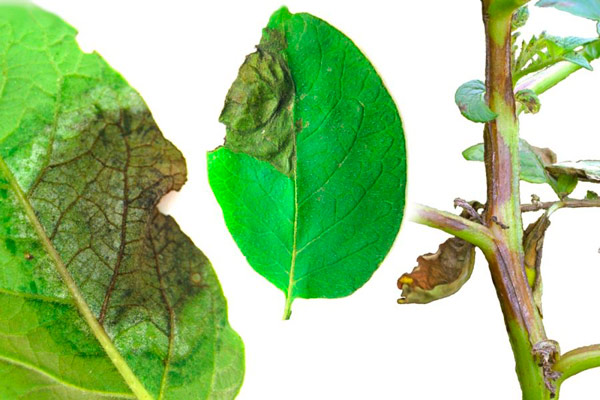
Appearance of large watery spots on the oldest leaves, covered on the underside with a sparse whitish mould. Later they enlarge, scorch and turn brown.
The spots on the petioles and fruit stalks are dry, dark brown, while on the stems they are large, watery and completely encircle them.
The spots on the fruits are brown, rough, with a radiating structure and rapidly increase in size. In humid weather they are covered with a sparse whitish mould.
Life cycle
The pathogen persists in the soil on plant residues;
Favourable conditions for infection – presence of “critical periods”:
- Rainfall on two consecutive days – total amount at least 10 l/sq. m;
- Minimum temperature in the range of 10-120C, maximum – 18-250C;
- Relative air humidity above 80%;
- Retention of water droplets on the plants for at least 4 hours.
Control
- In the presence of favourable conditions (critical periods), preventive treatments are carried out;
- Upon detection of the first symptoms, PPPs with locally systemic and systemic action should be used;
- Authorised PPPs: Azaka 80 ml/da; Acrobat Plus WG 200 g/da; Golbex WG 250 g/da; Kilate WG 250 g/da; Keefol WG 250 g/da; Valbon 180-200 g/da; Vinker WG 200 g/da; Dithane DG 200 g/da; Dithane M-45 200 g/da; Zoxis 250 SC 70-80 ml/da; Captan 80 WG 150-190 g/da; Karial Star 60 ml/da; Corsate 60 WG 20-30 g/da; Manfil 75 WG 210 g/da; Pencozeb 80 WP 200 g/da; Revus 250 SC 50 ml/da; Ridomil Gold MZ 68 WG 0.25%; Sancozeb 80 WP 200 g/da; Simbal Flow 50 ml/da; Sinstar 70-80 ml/da; Taegro 18.5-37 g/da; Tazer 250 SC 80-100 ml/da.
Since the period coincides with mass harvesting, PPPs with a shorter pre-harvest interval should be used.
Downy mildew (cucurbit downy mildew) on cucumbers
(observed both in the open field and in greenhouses)
Pathogen – Pseudoperonospora cubensis
Symptoms/Damage
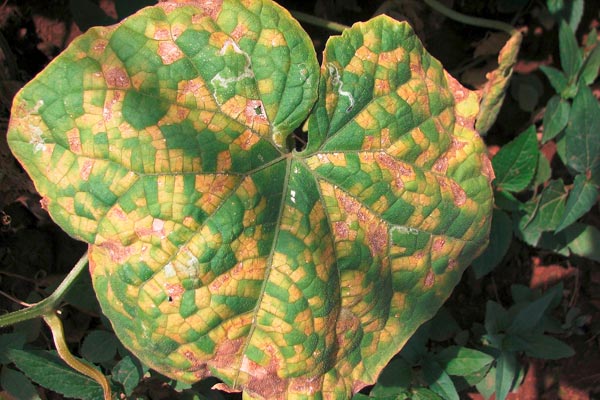
On the lowest leaves, yellowish spots of irregular shape appear, delimited by the veins.
In humid weather they are watery, and their lower surface is covered with a sparse grey-violet mould.
Later the spots enlarge, merge and the entire leaf scorches.
Life cycle
It persists with plant residues in the soil.
It develops under conditions of high relative humidity.
Optimum temperature – 16-220C.
Control
- Regular inspection of the crops;
- Preventive treatments with PPPs in the presence of favourable conditions;
- Authorised PPPs: Golbex WG 250 g/da; Kilate WG 250 g/da; Keefol WG 250 g/da; Bordeaux Mix 20 WP 375-500 g/da; Zoxis 250 SC 70-80 ml/da; Corsate 60 WG 20-30 g/da; Ridomil Gold MZ 68 WG 0.25%; Taegro 18.5-37.0 g/da.
PPPs with a short pre-harvest interval should be applied.
Powdery mildew on cucurbits
Observed both in the open field and in greenhouses
Pathogen – Podosphaera xanthii; Erysiphe cichoracearum
Symptoms/Damage
Appearance of small spots covered with a white powdery coating on the lower and upper surface of the leaves.
Later the spots enlarge, merge and the entire leaf appears as if dusted with flour.
In cases of severe infestation the leaves dry out.
Spots on the petioles and stems are rarely observed.
Life cycle
It overwinters as conidia on plant residues, or as active mycelium and spores on plants grown in greenhouses.
The spores germinate at high relative air humidity and reduced leaf turgor.
It develops during hot and dry months.
Control
- Cultivation of resistant varieties;
- Balanced nitrogen fertilisation;
- Treatment with PPPs upon appearance of the first spots;
- Authorised PPPs: Bayfidan 250 EC 0.02%; Vivando 20 ml/da; Dagonis 60 ml/da; Domark 10 EC 50 ml/da; Zoxis 250 SC 64 ml/da; Indar 5 EW 100 ml/da; Karamat 2.5 EW 200 ml/da; Kozavet DF 500 g/da; Collis SC 40-50 ml/da; Kumulus DF 750 g/da; Legado 80 ml/da; Miklofil 20-60 ml/da; Ortiva Top SC 100 ml/da; Reflect 125 EC 100 ml/da; Ritual 20-60 ml/da; Sivar 80 ml/da; Systhane 20 EW 37.5 ml/da; Systhane Ecozome EW 65-165 ml/da; Taegro 18.5-37.0 g/da; Topaz 100 EC 35-50 ml/100 l spray solution; Flosul 750 ml/da; Fontelis SC 200 ml/da; Cidely Top 100 ml/da.
Due to mass harvesting during the period, PPPs with a shorter pre-harvest interval should be selected.
Powdery mildew on pepper
Pathogen – Leveilula taurica (Oidiopsis taurica)
Symptoms/Damage
Appearance of small yellowish spots on the upper side of the leaves.
The lower side is covered with a sparse white coating formed by the sporulation of the fungus.
Spots may also appear on the upper surface.
Later the spots enlarge, merge and the leaves fall. The plants are defoliated.
Life cycle
It persists until the next vegetation as conidia.
It develops more strongly during dry and hot months.
Control
- Cultivation of resistant varieties;
- Balanced nitrogen fertilisation;
- Treatment with PPPs upon appearance of the first spots;
- Authorised PPPs: Vivando 30 ml/da; Dagonis 60 ml/da; Zoxis 250 SC 64 ml/da; Kozavet DF 500 g/da; Miklofil 20-60 ml/da; Ortiva Top SC 100 ml/da; Ritual 20-60 ml/da; Systhane 20 EW 30-37.5 ml/da; Systhane Ecozome EW 65-165 ml/da; Topaz 100 EC 35-50 ml/da; Phytosev 200 ml/da; Flosul 500 ml/da; Cidely Top 100 ml/da.
Due to mass harvesting during the period, PPPs with a shorter pre-harvest interval should be selected.
Downy mildew on cabbage
The risk of occurrence of the disease in transplanted plants persists
Pathogen – Peronospora parasitica
Symptoms/Damage
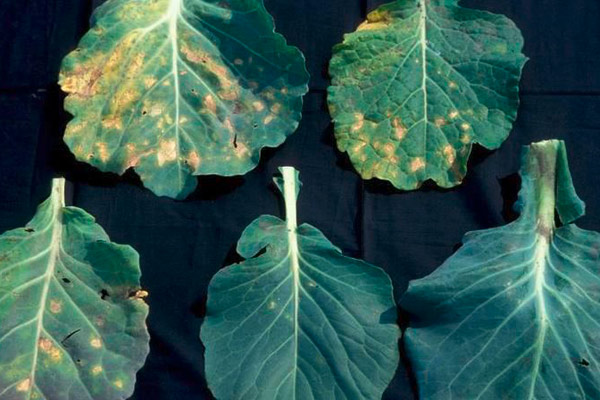
On the leaves, sunken spots appear, covered on the underside with a whitish to ash-grey mould.
Later the mould disappears and the spots scorch.
Life cycle
It persists as oospores in plant residues.
A temperature of about 160C is favourable for mass infections, and 20-240C for haustoria formation.
Control
- Regular inspection of crops to establish the occurrence of the disease;
- The first symptoms should be sought on broccoli, which are attacked by the pathogen earliest;
- Treatment is carried out upon appearance of the first spots;
- Authorised PPPs: Bordeaux Mix 20 WP 375-500 g/da; No other PPPs are registered; Fungicides based on mancozeb, dimethomorph, cymoxanil, fenamidone, fosetyl-aluminium may be used;
An adjuvant should be added to the spray solutions.
Black leaf spot on cabbage (alternariosis)
Pathogen – Alternaria brassicae
Symptoms/Damage
The first symptoms appear on the lowest leaves in the form of small dark spots with a concentric structure (about 1 cm in diameter).
Later the tissue scorches, tears and falls away.
At high air humidity the spots are covered with a black coating.
If the infestation is severe, the leaves turn yellow and dry out.
Life cycle
It persists as spores on the seed coat or as mycelium in the seeds.
The main source of infection for the next vegetation is infected plant residues.
It survives in weeds or perennial crops.
The spores are spread by wind, water, tools and animals.
Control
- Introduction of a 2-3 year crop rotation;
- Sowing of seeds free from infection;
- Treatment with PPPs upon appearance of the first spots;
- Authorised PPPs: Dagonis 100 ml/da; Difcor 250 SC 50 ml/da; Zoxis 250 SC 70-80 ml/da; Ortiva Top SC 100 ml/da; Tazer 250 SC 80-100 ml/da.
An adjuvant should be added to the spray solutions.