

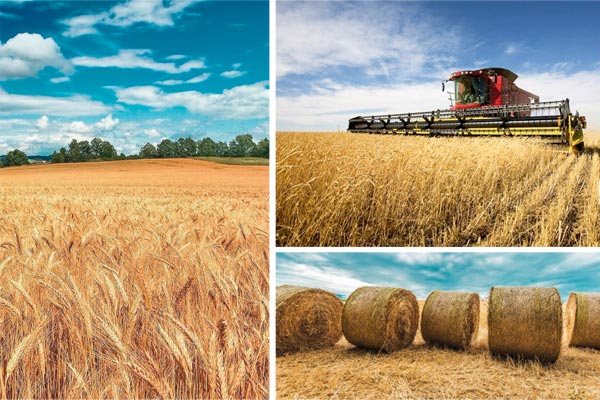
Harvest 2020 was a true fiasco for the whole of Eastern Bulgaria. Dobrudzha, the key wheat-producing region of the country, suffered the heaviest collapse. The preliminary balance at national level is impressively alarming – 2 million tons of wheat less than last year.
According to the prevailing opinion, the culprit for this downturn is nature – more precisely, the prolonged drought – in the autumn, winter and spring, practically throughout the entire vegetation period of the winter cereal crops. Undeniably, the uncooperative nature took its blood toll – a massive investment resource has been wasted – a sum of capital, labour and hopes.
Undoubtedly, today our national grain production is a subsector with very high structural, technological and product intensity. The agrochemical industry, represented by leading global companies, has radically resolved problems of biotic nature. This means that it has provided Bulgarian agricultural producers with effective plant protection products and top-class technologies for combating diseases, weeds and pests. The climate, however, is not subject to “training” or tailor-made manipulation. One thing remains – a reliable system for managing the risk factors that limit the environment – low and high temperatures, drought, waterlogging.
Let us be frank – Bulgarian agriculture does not have at its disposal a reliable expert toolkit for risk management. This was also demonstrated by the merely formal existence of the Risk Assessment Centre. To this uncertainty we should add the barely noticeable National Agricultural Advisory Service, guided by the principle – the best thing we can do is to do nothing! In other words: the agronomic presence in the field is below the critical minimum. And when the specialist is absent, who could forecast and give warning of one danger or another?
We thus come to the only “weapon” of the country’s farmers, which they use in their “dispute” with natural and climatic anomalies – the wheat and barley varieties. What has happened on our seed market over the last 10 years? Foreign breeding has made a furore, an incredible breakthrough. And it won the competitive race in an indisputable manner, by a knockout. High-quality Bulgarian genetics, resistant to biotic and abiotic stress factors, with excellent baking qualities and adaptability to the production environment, was turned away from, undervalued and half-forgotten...
This is the place to recall that the Ministry of Agriculture, Food and Forestry and the Agricultural Academy did not even make a timid attempt to protect Bulgarian breeding output, Bulgarian achievements, the Bulgarian genius, which are duly respected in Turkey, a country where the natural conditions for growing cereals are far worse than in our country, given the chronic moisture deficit there, as well as the predominantly extremely high temperatures. Regardless of the lost market presence, the Bulgarian breeding complex – the institutes in the towns of General Toshevo, Sadovo and Karnobat and the private seed companies „Sadovo“ and „Agronom“ in Dobrich – continue to work at high speed... They are successfully creating, in defiance of reality and the contracted market.
In the years when foreign genetics was comfortably settling in the Bulgarian fields, here and there timid voices could be overheard, muffled voices claiming that Western European varieties do not have the capacity to overcome extreme stress factors. Today, the voices are clear and strong – the main culprit for the production failure in Eastern Bulgaria are the foreign varieties! Is this the whole truth? It is not for an outside observer to take sides; the only thing that could be said is that this year’s highly depressing situation is a sufficiently serious reason to analyse what has happened, to transform the current model, to define a new strategy capable of stabilising production and increasing its resilience in a dynamic, changing climatic and phytosanitary environment.
After the disappointing Harvest 2020, even though we Bulgarians tend to learn some things the hard way, it is more than imperative that the administration, science and producers sit at the same table and restore their dialogue. Such a dialogue, such collaboration, based on professional and academic competences, expertise and objectivity, is capable of contributing to the rehabilitation of Bulgarian wheat and barley breeding. The national discovery science certainly deserves to be recognised as a basic structure-determining factor, as a reliable solution in an uncertain environment.
The disappointing Harvest 2020 is a clear indication that a change in the imposed stereotype is not only necessary, the change is mandatory! This is not about a total repudiation of Western European genetics, nor about yet another swing of the pendulum, but about a balance that will make it possible to reduce the asymmetry between foreign and Bulgarian breeding. Thus, the much-needed landing will begin after the unsuccessful attempt to fly on the wings of super-high (unfortunately, unrealised) expectations. It will put an end to speculation. It will allow the formation of a realistic horizon with guarantees for stability and peace of mind.
Let us not forget: the production of wheat and barley in Bulgaria is above all an export-oriented business, a highly sensitive business. And imbalances, regardless of their origin and magnitude, lead to colossal losses and disappointments.