

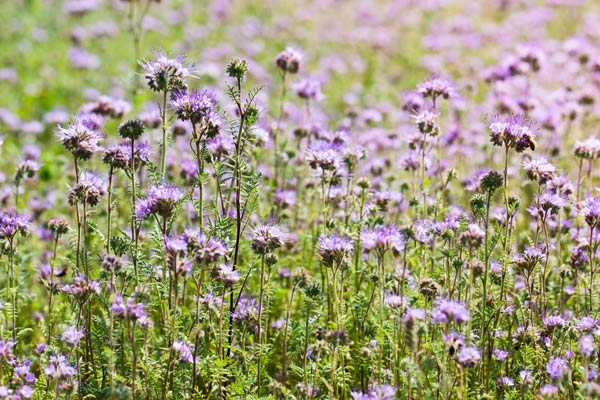
Phacelia (Phacelia tanacetifolia Benth.) is an annual herbaceous, melliferous plant from the family Waterleaf (Hydrophilaceae). It has simple or branched stems, which are glabrous or hairy, reaching a height of 20 to 80 cm. Its leaves are alternate, usually from simple to bipinnate. The flowers are sessile or on short pedicels, arranged in a scorpioid monochasium. The calyx consists of 5 to 8 sepals, fused at the base, without appendages between the lobes, densely hairy. The corolla is disc-shaped to campanulate, with overlapping lobes. The stamens are longer than the corolla and bear appendages at the base. The fruit is a bilocular capsule with two to four seeds. The center of origin of phacelia is North America, but it is widely cultivated in Europe and Asia. In Bulgaria it is grown on very limited areas (Yordanov, 1982; Bizhev et al., 2003).
In recent years, interest in phacelia has increased, which has prompted a search for suitable herbicides that would have a beneficial effect on the seed yield of phacelia.
In April 2018, a field trial with one phacelia accession (B8E0166), of Bulgarian origin, was established at the experimental field of the IPGR in Sadovo. The trial was set up in two randomized replications, on a total area of 10 m², with an inter-row spacing of 12 cm and a seeding rate of 1 kg/da. No soil herbicides were applied before or after sowing of the crop. Three herbicides were tested in a single application (as recommended by the manufacturer) – Sirtaki SC, Select Super 120 EC and Bismarck SC, at a rate of 6 ml herbicide dissolved in 6 l water. The crop was treated when the plants reached a height of 10 cm, before the budding stage. A visual assessment of the crop was carried out after 14 days. The seed yield of phacelia from the herbicide-treated plots was determined and recalculated per unit area – kg/da.
It was found that when the crop was treated with Sirtaki SC, the average seed yield was 29.6 kg/da. The plants developed normally and reached their usual height in the range of 50–65 cm. The yield from the plots treated with the other two herbicides (Select Super 120 EC and Bismarck SC) differed very slightly and did not exceed 13.3 kg/da. In the untreated plots, due to severe infestation with annual and perennial grasses and broadleaf weeds, the phacelia plants exhibited suppressed growth and were characterized by a height in the range of 15–20 cm.
In the case of a heavily weed-infested phacelia crop with annual and perennial grasses and broadleaf weeds, without application of herbicides before and after sowing, it is recommended to use the selective herbicide Sirtaki SC, with active substance 360 g/l clomazone, at a rate of 15 ml/15 l water per decare. It does not affect the vegetation of phacelia and does not have a negative impact on seed yield.
The study of wild relatives of cultivated plants, as in the present study where the object is phacelia, is an important priority in the scientific activities related to the conservation and management of plant genetic resources of Bulgarian origin. Bulgarian materials are of particular importance for breeding work with phacelia, as they possess agro-biological characteristics corresponding to the agricultural practices applied in our country and to the natural and climatic conditions.
You can learn more about phacelia as a melliferous plant important for the conservation and management of plant genetic resources of Bulgarian origin from issue 7/2020 of the journal "Plant Protection"