

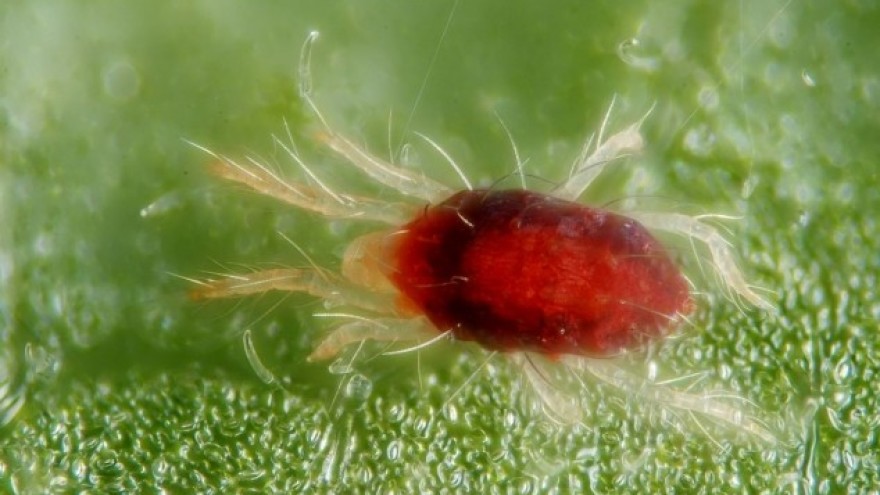
Species – Panonychus ulmi Koch
Symptoms
The European red mite does not directly damage the fruits, but it suppresses the assimilative activity. The larvae, nymphs and adults are harmful, sucking sap and chlorophyll grains from the developing buds and from the underside of the leaves. They secrete enzymes that break down the pigments in the leaves. The reduction of chlorophyll in the leaves leads to a decrease in photosynthesis; as a result of the numerous punctures on the leaves, transpiration increases and disturbances appear in the water balance of the infested trees. Damage is particularly severe in dry years, when the root system absorbs less water from the soil than the leaves evaporate. All this leads to a reduction in the size and quality
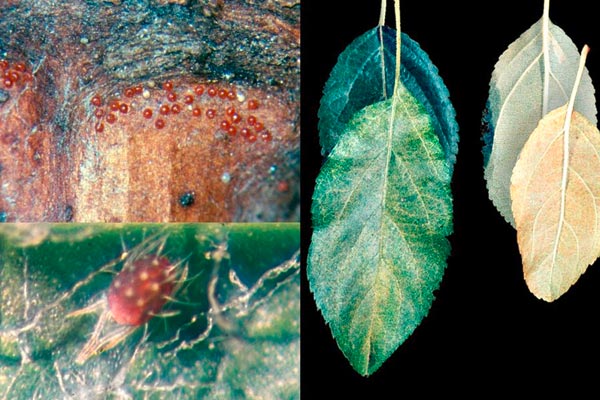
of the fruits, to feeding and formation of a smaller number of fruit buds, to a decrease in the dry matter content and winter hardiness of the trees, and makes them susceptible to attacks by diseases and pests. As a result of the damage, the colour of the leaf blade changes slightly. From a distance, the leaves appear grey-brown and have an upward-curled margin. It attacks apple, pear, peach, plum, etc.
Life cycle
The European red mite overwinters as an egg in the cracks of the bark, around the folds of the buds, in the branch ramifications and twigs and on the bark of the trunk. On apple trees the European red mite develops 8–9 generations, and on grapevine 6–8. It overwinters as an egg on the bark of the trees, mainly on one- and two-year-old shoots. On grapevine, the eggs are laid on spurs, buds, in crevices and in other places.
Control
When the economic threshold of harmfulness is reached, spraying must be carried out. One of the following acaricides is used: Apache EW – 100 ml/da, Bermectin – 60–96 ml/da, Valmec EC – 60–96 ml/da, Vertimec 018 EC - 100 ml/da, Voliam Targo 063 SC – 75 ml/da, Danitron 5 SC – 100–200 ml/da, Zoom 11 SC – 25–50 ml/da, Laota - 60–96 ml/da, Milbeknock – 25 g/da, Naturalis SC - 100–150 ml/da, Nealta SC – 100 ml/da, Nissorun 10 WP – 75 g/da.