

At the beginning of April, agrometeorological conditions will be determined by changeable and cool weather. The forecast precipitation until the middle of the first ten-day period will keep the upper soil layers waterlogged in many parts of the country, which will delay the pre-sowing tillage and the sowing of sunflower. The agrotechnical deadlines for sunflower sowing in Southern Bulgaria expired at the end of March. Until the middle of the first ten-day period of April is the optimal period for sunflower sowing in the Danube Plain, and until the end of the ten-day period – in Northeastern Bulgaria, in the coastal areas and the high fields of Southwestern Bulgaria.
An increase and normalization of temperatures and activation of vegetation processes in the winter crops and the sown spring crops is forecast for the end of the first and the first half of the second ten-day period. In mid-April, the predominant growth stage of winter cereal crops will be stem elongation, and for rapeseed – budding. For rapeseed in the budding stage (from green to yellow bud), it is necessary to carry out monitoring for the presence and population density of one of the most dangerous pests – the rape blossom beetle. When the pest population exceeds the economic injury level (EIL >5 beetles per plant), timely treatment must be carried out before rapeseed enters the flowering stage.
During the second half of the month, the development of agricultural crops will proceed at a faster pace, at temperatures around and above the norm for the period. Rapeseed will be predominantly in full flowering. In wheat, the stages of stem elongation and the transition from stem elongation to heading will be observed. At the end of April, in some of the crops that entered stem elongation earliest – during the second ten-day period of March (agrometeorological stations Silistra, D. Chiflik) – the heading stage will also be observed. During this period, winter cereal crops should be monitored for the appearance and harmful activity of the sunn pest, the cereal leaf beetle and the wheat thrips.
At the beginning of the third ten-day period, the soil temperature in the 10 cm layer in the field areas will have suitable values for sowing grain maize, and at the end of the month – also for the thermophilic spring crops (cotton, peanuts, beans, watermelons and melons, etc.).
The significant precipitation at the beginning of spring, which in many places exceeded 30-35 l/m², increased soil moisture reserves in the one-metre soil layer. In most of the country, with the exception of some locations in the eastern and far southern regions, moisture reserve levels above 90% of field capacity have been measured in winter cereal crops. The expected precipitation in April, around and above the norm, will provide moisture for the normal course of the initial stages of vegetation of the sown spring crops and of the autumn-sown crops that have entered the reproductive stage of their development.
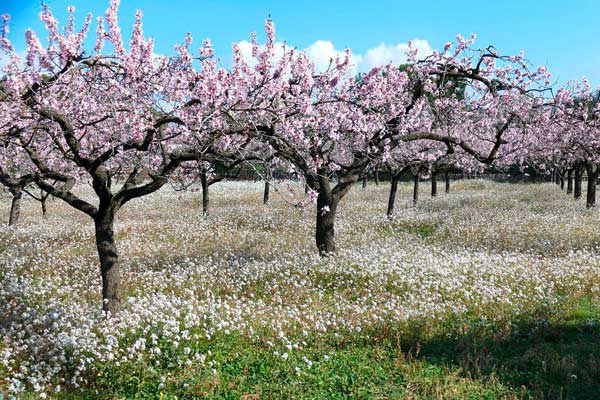
During the month, the forecast minimum temperatures, down to minus 2°C, will be yet another trial for fruit trees advanced in their development. More suitable conditions for carrying out plant protection spraying in fruit crops not affected by spring frosts will occur in the second half of the first, at the beginning of the second, and in the middle of the third ten-day period.
Source: NIMH