

-Дражев.jpg)
Ivan Drazhev, Marketing Manager of Corteva Balkans, Product Manager of Corteva Bulgaria, presented the company’s innovative product portfolio for the 2020 season, as well as some strategic objectives of the corporate engineering for increasing the intensity and sustainability of agricultural production
A conversation with Emil Ivanov
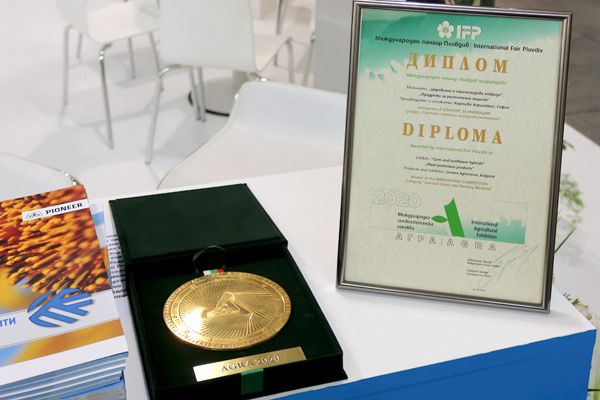
The fact that Corteva is the winner in the Innovation Contest of the International Exhibition AGRA 2020 with its new maize and sunflower hybrids, Pioneer breeding, is not a surprise for the farmers in the country. From a professional point of view, the interesting question concerns the profile, characteristics and qualities of this top-class genetics.
Every year Pioneer introduces 4–5 new hybrids, both in maize and in sunflower. In order to introduce a new hybrid, it must meet several mandatory conditions. The first and most important condition is that the new genetics must surpass, in terms of yield potential, the analogous hybrids introduced so far, with a minimum of 3% higher yield obtained in 3-year trials in our country. I will immediately give an example – in maize the new hybrid P0217 produced on average 7%–9% higher yield than the introduced hybrid P0216, and in sunflower the new P64LE136 produced on average 4%–7% higher yield than the introduced hybrid P64LE25. The second condition is that the new hybrids have an improved phytosanitary status. And here I will immediately give examples – in sunflower the new P64BB400 has a higher level of tolerance to the main diseases compared to the introduced hybrid P64BB01. The third condition is that the new hybrids have increased resistance to lodging, “less dancing” of the plants. And again, an example in sunflower – the new hybrids P64LE136 and P64LE137 have a shorter and stronger stem. The fourth condition is that the new hybrids have a higher level of tolerance to adverse climatic factors. Here I will give an example with maize – the new AQUAmax hybrids can now pollinate and fertilize at +37–38 degrees, unlike the “old AQUAmax hybrids”, which pollinated and fertilized up to +36–37 degrees. One degree is little, but it is also a lot under these adverse, dry and stressful conditions. Our new genetics, which we are introducing in 2020, meets these four main requirements, as well as some others (for example new parental lines). In addition to this, I would like to say that our company has the largest database of results from over 120 trials in each of the two crops every year across the entire country. I believe that our award is fully deserved and, as proof, I would note that Pioneer has been the market leader in maize and sunflower for many years, and this is not accidental, but is the result of the exceptional breeding that we implement in practice.
The EU has significantly tightened the regulatory regime regarding the environmental profile of plant protection products. What is Corteva’s response to the “green” ambitions and policies of Brussels in this key intensive factor in agriculture?
There will be quite a few changes in plant protection, i.e. many active substances will be withdrawn from use for certain reasons, the application rates of other active substances will be reduced, etc. This will apply most strongly to fungicides (for example – propiconazole, chlorothalonil, thiram, etc.) and insecticides (thiamethoxam, chlorpyrifos-ethyl/methyl, etc.), and to a lesser extent to herbicides.
Corteva Agriscience, as an R&D company, is working intensively on the introduction of new PPPs. In this regard, I will give several examples of new active substances. We are introducing a new herbicidal active substance ARILEX/ARILEX for post-emergence broadleaf weed control in wheat, barley, rye, oats, triticale, rapeseed and sunflower. ARILEX will solve the control of some weeds for which there was no solution until now. Of course, ARILEX will be combined with already introduced active substances in order to enhance the effect against weeds. We are introducing a new fungicidal active substance INATREQ/INATREQ for the control of the most important diseases in cereal crops. INATREQ is a new active substance from an entirely new chemical group – Pycolinamidies, with a completely different mode of action from the fungicides commonly used in practice so far (triazoles, strobilurins, morpholines, carboxamides = SDHI). We are introducing a new fungicidal active substance ZORVEC/ZORVEC for the control of downy mildews in vineyards, potatoes and vegetables, as well as for seed treatment in sunflower for the control of downy mildew, including the newest virulent races. Of course, we are also working on introducing new additional uses of our products already implemented in practice – for example – we expect an additional registration in maize of a herbicide authorized in cereals, we expect an additional registration in maize against European corn borer of an insecticide authorized in vineyards. Finally, I would like to inform the agricultural audience that Corteva has for several years been offering the insecticide CYNEIS 480 SC, which is registered as a biological insecticide (in the context of green policies) in a large number of crops against a large number of pests.
What is the current plant protection with the Corteva brand in April? More precisely: what are the reliable solutions of the structure-defining company in the uncertain climatic and phytosanitary environment?
For the plant protection campaign in April, Corteva offers the following solutions to the following problems in the main field crops.
In winter cereal crops – for the control of broadleaf weeds DERBY SUPER ONE – a proven effective classic in the “genre”. If I may use sports terminology – DERBY SUPER ONE always wins the derby matches against the most harmful broadleaf weeds in cereal crops since it was introduced in practice.
The other solution is STARANE GOLD for the control of weeds in an advanced growth stage, as well as for the control of field bindweed. For disease control we offer the fungicide ALLEGRO SC, with an additional growth-stimulating green effect (from BASF’s Agcelence line).
In sunflower – for post-emergence control of broadleaf weeds EXPRESS 50 SG (trademark of FMC) – the only registered herbicide in Express-tolerant sunflower hybrids. From 2020 we are already offering the selective post-emergence graminicide herbicide SHADOW EC (trademark of UPL OpenAG), which, in addition to sunflower, can be applied in 13 other broadleaf crops.
In maize – in this crop we have all kinds of solutions for all types of weed infestations. For post-emergence control of broadleaf weeds we offer three proven solutions – MUSTANG SC (incl. perfect control of volunteers from technological rapeseed and sunflower), STARANE GOLD (incl. perfect control of field bindweed, bramble and field horsetail) and KABADEX EXTRA (simultaneous soil and post-emergence action and a “bleaching effect” = whitening of the weeds).
For the control of grasses and some broadleaf weeds post-emergence we offer – VICTUS OD (a qualitatively improved formulation – oil dispersion and a flexible application rate from 100 to 150 ml/da depending on the growth stage of the weeds). For the simultaneous control of grass and broadleaf weeds post-emergence we offer two proven solutions – ARIGO WG + adjuvant TREND (for full weed control from the 2nd to the 8th leaf of maize) and PRINCIPAL PLUS + adjuvant TREND (for full weed control from the 2nd to the 6th leaf of maize).
For mixed weed infestation we offer two packages – VICTUS OD + KABADEX EXTRA and VICTUS OD + MUSTANG SC at extremely competitive prices per decare. An additional practical advantage of the packages is that the products can be applied simultaneously or separately depending on weed emergence.