

"MAIZE – QUEEN OF THE FIELD", the partnership project of the Agricultural University in Plovdiv, the company Corteva and the company Netafim, implemented at the experimental training facility, proves that the development of sustainable long-term solutions and visions for tomorrow changes the perspective and horizon of maize production in Bulgaria. This visionary project, an intensive investment instrument, generates new dynamics and energy, gives a clear signal that there are resources and potential to meet all expectations for effective yield management, to achieve a technological breakthrough, to reach avant-garde goals – an optimal balance between costs and revenues, maximum profit.
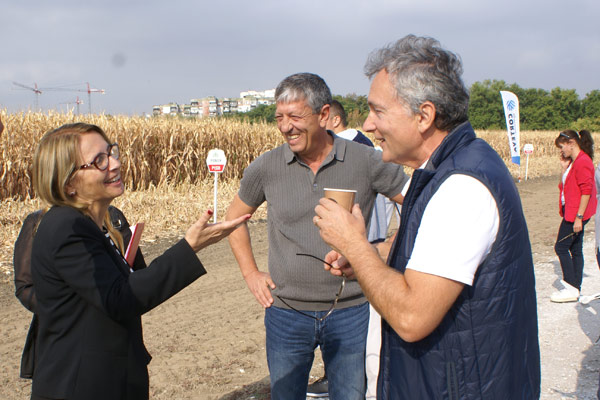
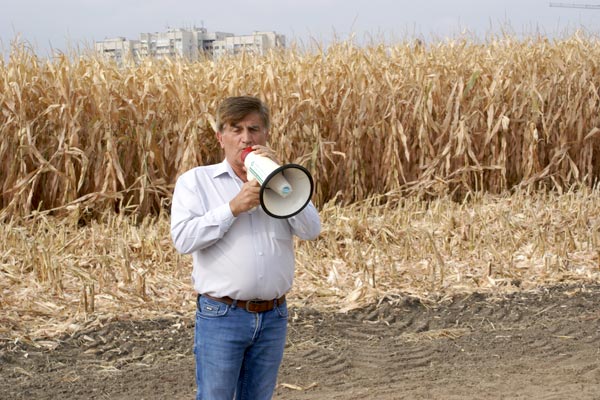
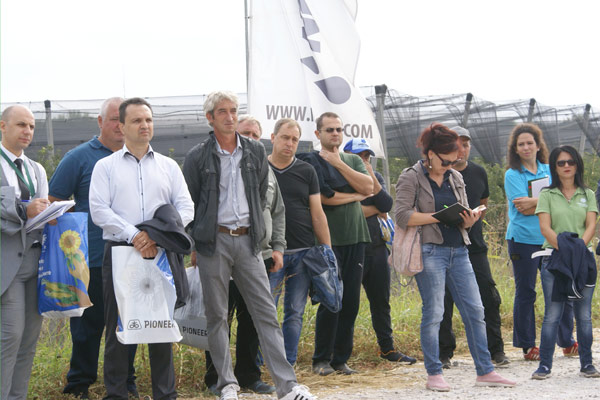
The results from the first year of this initial module were presented to a broad professional audience. The event was honoured by Prof. Hristina Yancheva, Rector of the Agricultural University in Plovdiv. Part of the management of Corteva was present: Chavdar Dochev, Managing Director of Corteva Balkans, Ivan Drazhev, Marketing Manager of Corteva Balkans, Product Manager Seeds Bulgaria, and Ivan Kostadinov, Sales Manager of Corteva Bulgaria and North Macedonia. The professional attendance was large – farmers from across the country, researchers, lecturers, agricultural specialists, students.
The basic parameters for defining the conceptual approach are several. On the one hand: maize is a unique natural phenomenon. It utilizes sunlight in an exceptional way, unlike any other agricultural crop. On the other hand: maize is one of the few crops (the others are rice and small-leaf tobacco) with very high self-tolerance. That is to say, it can be grown as a monoculture (on the same field) for 5–6 or more years. The organic matter remains in the field, and high fertilization rates can be applied (incl. bacterial fertilizers). Against this background, it is noteworthy that maize has significantly low compensatory capabilities. Adverse climatic conditions (primarily drought) in the early growth stages are a strongly limiting factor for future yield. For example, rooting is limited by the oxygen supplied with the water. Moisture deficit has fatal consequences for pollination and silk formation. To what has been said so far we add the imbalances during the grain-filling period when water is insufficient.
The project is a large-scale model for achieving very high yields and economic results in grain maize production. Its structuring includes several high-value characteristics. The experimental platform covers 54 decares. On this area a top-class system has been built for fully automated, autonomous subsurface drip irrigation, a high-quality product supplied by the reputable company Netafim. This ultra-precise system guarantees maximally accurate water supply to the plants at every moment of vegetation. What is interesting in this case – from a professional point of view – is that the area is divided into three irrigation zones. The thick-walled pipes with a 20-year service guarantee are positioned at three horizons – at depths of 20, 30 and 40 cm. Each of the nine maize hybrids of Corteva is sown in the three zones – at 20, 30 and 40 centimetres.
The objective of this year’s experiment is to record the effect of irrigation and fertilization in the different root-inhabited horizons – 20, 30 and 40 cm. The tillage and crop protection technologies are conventional for the three levels. Another essential characteristic of the project: maize hybrids from different FAO maturity groups have been used, in the range from 450 FAO (P0023) to 700 FAO (P2105). The concept is clear: reliance is placed on higher-yielding hybrids. The selection is diverse. P0023 (FAO 450), P0216 (FAO 460) and P0217 (FAO 490) are from the new Optimum AQUAmax generation. P0217 is the newest member of the Optimum AQUAmax club. P2105 (FAO 700) and P0704 (FAO 500) will be included in CORTEVA’s product portfolio for the domestic market in 2020. Plant density: 8,700 plants/decare, considered optimal at this maximum intensity of cultivation of the hybrid set. The nutrient regime is at a maximally high level. Part of the fertilizers were applied pre-sowing (with the final tillage), and the other part (water-soluble) were included in the irrigation cycle. The results achieved (recorded after harvest) show insignificant differences in yields in the different horizons. This gives Corteva grounds to present a table to the wider public.
Maize yields obtained at the experimental field of the Agricultural University – Plovdiv
1. P0023 – 1690 kg/decare, moisture 13.1% FAO 450
2. P0216 – 1706 kg/decare, moisture 12.8% FAO 460
3. P0217 – 1788 kg/decare, moisture 12.7% FAO 490
4. P0704 – 1818 kg/decare, moisture 13.2% FAO 500
5. P0937 – 1880 kg/decare, moisture 12.5% FAO 570
6. P1049 – 1843 kg/decare, moisture 16.8% FAO 620
7. P1241 – 1825 kg/decare, moisture 16.6% FAO 620
8. P1535 – 1724 kg/decare, moisture 18.0% FAO 650
9. P2105 – 1760 kg/decare, moisture 18.5% FAO 700
To be continued! In 2020 the project will be further developed. In the first irrigation zone (20 cm) the so-called No-till technology will be applied, meaning cultivation without any tillage, or Strip-till technology – shallow band tillage (at sowing depth). The second option (in the 30 cm irrigation range) – subsoiling and pre-sowing disking. In the third irrigation zone (40 cm) – conventional tillage – deep ploughing, pre-sowing and post-sowing operations. In all three farming systems the same sowing rates and the same quantities of macro- and micro-fertilizers will be used.
Corteva, the world leader in the seed and crop protection industry (following the 2017 merger of DuPont Pioneer, DuPont Protection and Dow AgroSciences) demonstrates the strength, charge and innovativeness of its corporate engineering. The project "MAIZE – QUEEN OF THE FIELD" is a clear signal from the Bulgarian team of the company that, together with the team of Prof. Tonio Tonev, part of the Agricultural University in Plovdiv, it will attempt to bring maize back to Bulgarian fields, more precisely south of the Balkan Mountains. This team has the product resources (seeds and pesticides), ambition, motivation and high expertise to accomplish this remarkable mission. A mission that includes a large-scale transfer of knowledge and information.