What can you read in the new issue of the magazine "Plant Protection"
Author(s): Растителна защита
Date: 11.05.2019
24201
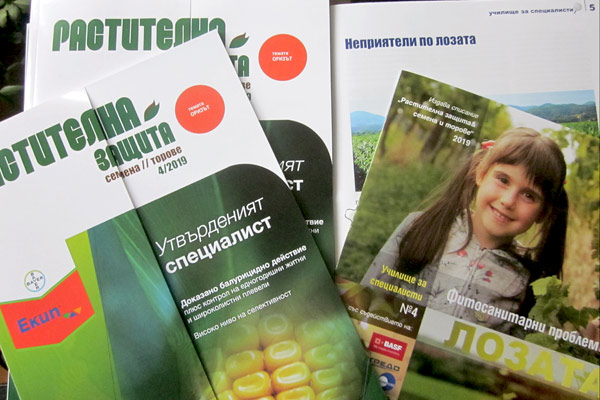
See which topics are current in this issue.
For the topic of the May issue of the magazine „Plant Protection” we have chosen to present one of the most valuable cereal crops in the world – rice. It is grown in 113 countries and, together with maize and wheat, is considered a staple food. Interestingly, this is a crop that can be grown everywhere except Antarctica.
The protein and starch content are the two dominant factors in modern agriculture that determine grain quality. Rice, besides being an important source of carbohydrates and proteins, also provides a rich range of microelements, which ranks it among the leading crops in the context of the growing need of the population for healthy food.
In Bulgaria today, due to objective (climate, limited suitable soils) and subjective reasons (continuous reorganizations, restructuring, changes in ownership, etc.), temporary declines and subsequent recoveries of the cultivated areas have been observed over the last two decades. Nevertheless, in the last few years there has been a certain trend towards yield increase, with 124,000 decares harvested in 2015. In 2017 the rice farms in Bulgaria numbered 85, the size of the fields where rice is grown ranges from 30 to 600 ha, with an average size of 150 ha. Processing is carried out in 17 rice mills on the territory of the country.
From the magazine you can learn even more about the history, traditions, trends and challenges in rice production in Bulgaria.
The analysis of the state of rice production in the country reveals relatively favourable prospects for its future development. Rice is a crop that allows for full mechanization in the absence of heavy physical labour. The newly introduced varieties, the effective herbicides and the modern cultivation technology are also excellent preconditions that in recent years have encouraged farmers to turn to the cultivation of this crop. Last but not least, we should note the fact that, technologically, one person can take care of 300-500 decares. If the blocks are consolidated and adequate irrigation and drainage facilities are used, the harvested areas and, accordingly, the yield can automatically be increased.
In this issue of the magazine you will also read about the Bulgarian rice varieties created at IRGR “K. Malkov”, Sadovo, which are characterized by productive potential exceeding that of the country’s standard variety Osmancik 97 (Turkey).
Unfortunately, rice is attacked by a large number of viral, bacterial and fungal diseases which, under suitable climatic conditions and when susceptible varieties are grown, can cause serious damage. Also, more than 200 species of plant-parasitic nematodes are associated with rice. You will receive complete information on all rice diseases, pests and weeds from this issue.
Enjoy your reading!
Here is what else you can expect in this issue:
The Topic
T. Georgieva – Rice in Bulgaria – trends and challenges
S. Tosheva – A new look at tradition
M. Nakova – Which are the most harmful diseases?
D. Markova– The rice nematode is a serious threat
M. Dimitrova – Rice fields without weeds
Attention: Invasive species
I. V. Karpchev – Snails of the genus Pomacea (apple snail)
II. D. Staneva – Rice root-knot nematode
III. D. Staneva – Japanese rice cyst-forming nematode
Anti-stress
A. Harizanova, L. Koleva – Valkova – Silicon – a beneficial nutrient increasing tolerance to abiotic stress
Quarantine
S. Stamenova – Implementation of International Standard No. 15 for regulating wood packaging material in international trade
Traffic light
*** – Agropal recommends: Schemes for the protection of potatoes and pepper from diseases and pests
School for specialists
A. Harizanov – Pests on grapevine
Magazine „Plant“ Protection Seeds and Fertilizers has no involvement with the information presented in the published advertisements and PR materials. Responsibility for their content lies entirely with the advertisers. The authors of the publications bear responsibility for the information in the authored materials.