What you will read in issue 4/2020 of the journal "Plant Protection"
Author(s): Растителна защита
Date: 20.05.2020
10651
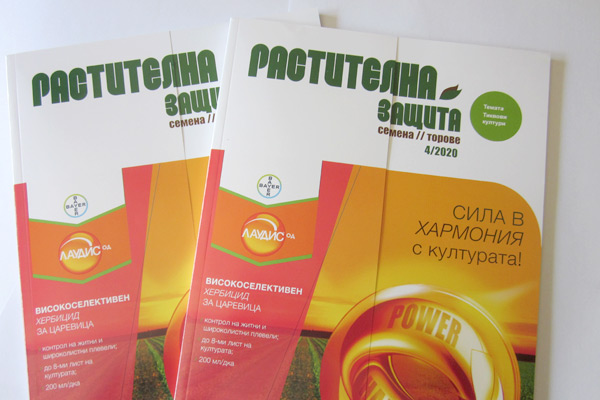
See which are the current topics in this issue.
The May 2020 issue of the journal „Plant Protection” is dedicated to crops from the family Cucurbitaceae (Cucurbitaceae), which are characterized by a wide polymorphism that in turn determines the great diversity in cultivation technologies and in their use. They are suitable both for fresh consumption and for the canning industry – for sterilized products, purees, juices and jams, where they take a significant share. A number of species such as bottle gourd, luffa and other wild species of different origin have little importance for agriculture, but are of interest to science as a valuable source of genetic plasma.
In recent years, the production of watermelons and melons has been continuouslyincreasing. In Bulgaria in 2019 the year-on-year growth was 5.3%, with production nearly 30% higher than in 2018, at an average yield of 1,800 kg per decare. Popular and much loved, especially during the summer season, these crops from the family Cucurbitaceae in our country are grown under field and greenhouse conditions. Field cultivation is definitely preferred and therefore it is important to know how to select suitable areas for their production, how to prepare the soil, everything about their sowing, the establishment of healthy seedlings and, last but not least, the special care after sowing, including thinning of the variety, second hoeing, irrigation and so on. The choice of variety and the correct agronomic practices are among the important prerequisites for successful production, but the nutritional regime is the factor that has the strongest influence on plant development and their productivity.
The earliest vegetables offered on the market are courgettes, together with early potatoes and green peas. You can read in this issue of the journal about the entire process of growing pumpkins and courgettes, types of varieties, nutritional regime, care during vegetation and harvesting. Fertilization is a basic agronomic practice for stabilizing and increasing yield and product quality.
Like all other agricultural crops, Cucurbitaceae are attacked by a significant number of pathogens, some of which have greater economic importance and must be regularly monitored for their occurrence in order to protect the harvest (powdery mildew, downy mildew, anthracnose, Fusarium wilt, viral diseases). The pests of Cucurbitaceae are often polyphagous and attack all representatives of this family. Monoculture cultivation is a prerequisite for their mass multiplication. Under severe infestation this can lead to deterioration of product quality and sometimes to complete loss of yield.
What the conventional control measures are and what the alternatives are is described in detail in this issue.
Enjoy your reading!
Here is what else we will present to you in this issue:
The topic
N. Velkov – Crops from the family Cucurbitaceae have a wide polymorphism that determines a great diversity in cultivation technologies
N. Velkov – Watermelons and melons
N. Velkov – Pumpkins and courgettes
H. Boteva – Fertilization of watermelons and melons
H. Boteva – Fertilization of pumpkins and culinary courgettes
S. Masheva – Diseases of cucurbit crops
V. Yankova, D. Markova – Pests of cucurbit crops
V. Yankova, D. Markova – The insecticide Exalt – a new solution against pests in vegetable crops
Orchard – apple
*** – Establish an apple orchard
D. Aleksandrova – Diseases
D. Stefanova – Pests
Quarantine
D. Panayotova – New pests on tomatoes
Traffic light
M. Borovinova – In the orchard in May
V. Yankova, D. Markova – In the vegetable garden in May – plant protection care for potatoes
Interview
V. Shishkova – Summit Agro has the ambition and expertise to be a leading factor in the trade in products for agricultural production in Bulgaria
Comment
E. Ivanov – In the conditions of a pandemic storm, agriculture is the locomotive of the economy, a generator of optimism and security
The journal „Plant Protection & Seeds and Fertilizers“ has no involvement with the information presented in the published advertisements and PR materials. Responsibility for their content lies entirely with the advertisers. The authors of the publications bear responsibility for the information in the authored materials.