Issue 1/2019 of the journal "Plant Protection"
Author(s): Растителна защита
Date: 12.02.2019
27963
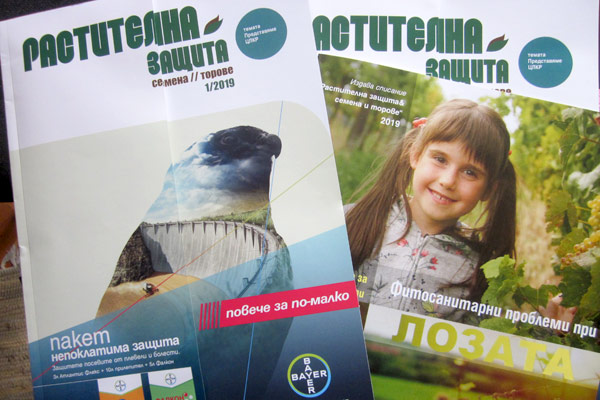
For the topic of the first February issue of the magazine “Plant Protection” for 2019, our team has chosen to present the Central Plant Quarantine Laboratory, which is part of the European laboratory diagnostic system for plant health. In this issue we acquaint you in detail with the history, objectives and priorities of the laboratory over the years, as well as with the long and professional path of the specialists in this field, which in 1993, by an official order of the Minister of Agriculture and Agrarian Reform, divided the Central Laboratory into two: Central Laboratory for Control of Residues of Pesticides, Nitrates and Heavy Metals and Central Plant Quarantine Laboratory (CPQL).
Today the laboratory is faced with the challenge of being at the same time the National Reference Laboratory for Plant Health, related to the activities of the phytosanitary control of the BFSA, and of meeting all European requirements and being the competent authority for the control of quarantine pests on plants. You can also read in the magazine about the structure and departments of the Central Plant Quarantine Laboratory, as well as about their tasks and the studies they carry out.
Especially for the readers of the magazine, Denitsa Staneva, Chief Expert in Nematology at the CPQL, will reveal why Bursaphelenchus xylophilus ranks among the first places of the 100 invasive species of global importance.
In a conversation with Zlatan Yordanov, Head of the “Plant Protection” Department at the Regional Food Safety Directorate – Varna, we discuss current topics such as phytosanitary control at the Black Sea border, phytosanitary monitoring programmes, control of the export of Bulgarian plants and plant products from the Port of Varna, and the introduction of new invasive species into the country.
In the section “PP Consultant” Prof. Dr. Ivan Kiryakov from the Dobrudzha Agricultural Institute near the town of General Toshevo explains which are the specific factors related to the course of the pathological process in wheat, on which the efficacy of fungicides against foliar pathogens depends.
In the section “Pests” you will find out why the damage caused by psyllids is not well recognized by fruit growers and is often attributed to other pests. The control of the small beetles is difficult, requires a complex of measures, but is not impossible.
This year, for our garden and the calendar of diseases and pests during the individual months, we rely on the valuable advice and practical schemes of the company Agropal. In this issue you will learn how to calibrate your sprayer correctly in order to achieve optimal results.
In this issue we are guests at the birthday of the company Summit Agro, which has completed 20 years on the Bulgarian market! The anniversary was celebrated with an elegant event in the city beneath the hills.
Enjoy your reading!
The Topic
We present
*** – The Central Plant Quarantine Laboratory – part of the European laboratory diagnostic system for plant health
– History
– Today
– Near future
– Structure
V. Shishkova – Phytosanitary control is a key part of the system for achieving a high health status of plants
PP Consultant
S. Misheva, V. Yankova – The efficacy of fungicides against foliar pathogens in wheat depends on specific factors
Pests
A. Kharizanov, A. Kharizanova – Psyllids on fruit crops
Quarantine
D. Staneva – Bursaphelenchus xylophilus among the first 100 invasive species of global importance
Traffic Light
*** – Agropal recommends
Events
*** Summit Agro – 20 years on the Bulgarian market
School for Specialists
Prof. Venelin Roychev – Viticulture in Bulgaria – state and prospects / phytosanitary problems
The magazine “Plant“ Protection Seeds and Fertilizers has no relation to the information presented in the published advertisements and PR materials. Responsibility for their content lies entirely with the advertisers. The authors of the publications bear responsibility for the information in the authored materials.