Pepper – a major vegetable crop
Author(s): проф. д-р Стойка Машева, ИЗК "Марица" Пловдив
Date: 03.06.2024
9730
Pepper (Capsicum) originates from the Americas, where it has been cultivated for thousands of years. Later its cultivation began worldwide and it became one of the main vegetables in human nutrition. In addition to its primary use, it is also used as a spice and in medicine. Christopher Columbus brought it to Europe and by the middle of the 17th century pepper had been cultivated in Southern and Central Europe as a spice and medicinal plant.
The genus Capsicum consists of 20–27 species, of which 5 are cultivated: C. annuum, C. baccatum, C. chinense, C. frutescens and C. pubescens. The fruits of Capsicum may vary significantly in colour, shape and size both between and within species. Peru is considered to be the country with the greatest cultivated diversity of Capsicum varieties. Bolivia, on the other hand, is the country where the greatest diversity of wild peppers of the genus Capsicum is consumed.
The diversity of pepper varieties is determined by the intended use of the production. Some are grown for earliness, for others the fruit size, colouration and yield are of importance, while for a third group the biochemical composition of the fruits and other traits are significant. Along with the selection of specific fruit qualities such as taste and colour, continuous work is carried out on resistance to specific pests, diseases and abiotic stress. Pepper is grown both in the open field and in protected cultivation facilities, on soil and by the hydroponic method. In recent years, in addition to conventional production, emphasis has also been placed on organic production.
The pepper breeding programme in Bulgaria is aimed at developing: higher-yielding varieties; resistant to economically important diseases and pests; with excellent taste qualities, determined by the content of dry matter, sugars, acids and vitamin C – at technical maturity over 150 mg%, at botanical maturity – over 200 mg%; high pigment content in varieties for grinding – over 200 ASTA units and preservation of these pigments during storage of ground pepper.
In recent years, worldwide efforts have been directed towards the development of varieties adapted to different regions, which reveal their biological potential under specific climatic conditions.
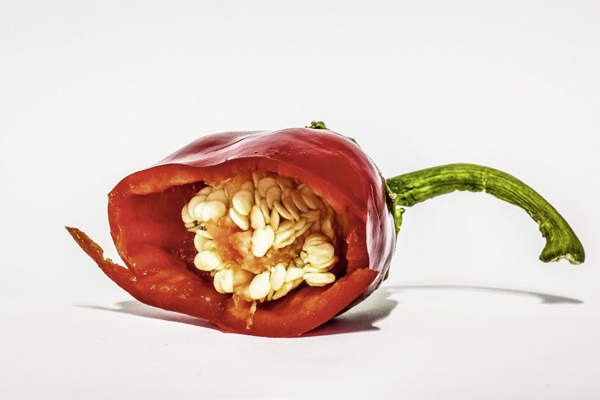
Globally, in addition to sweet peppers, a significant quantity of hot peppers is also produced. The pungency characteristic of certain pepper types is due to the increased capsaicin content in the fruits. It is present in large quantities in the placental tissue (which holds the seeds), the internal membranes and, to a lesser extent, in other fleshy parts. The seeds themselves do not contain capsaicin, although the highest concentration of it is found in the white core around them. The amount of capsaicin in hot peppers varies considerably depending on the variety. In 2013, world production of hot peppers (fresh and dried) was 34.6 million t. Of this production, 47% was from China, and India was the largest producer of dried hot peppers – 1.4 million t. Hot peppers are important in indigenous American medicine, and capsaicin is used in modern medicine – mainly in topical preparations – as a stimulant of blood circulation and as an analgesic. The addition of capsaicin to vegetable oils or the fruits of such peppers can be used in horticulture as a natural insecticide.
Pepper – importance, varietal diversity and production directions
Pepper fruits have high nutritional value. Their vitamin C content is higher than that of oranges. They contain over 100% of the recommended daily value for this vitamin. The content of vitamin B6 is also significant. Dried pepper has a different nutritional value due to dehydration and the concentration of vitamins and minerals.

The fruits (pods) of the genus Capsicum can be consumed raw or processed. Those used in cooking are usually of the species C. annuum and C. frutescens.
Pepper prefers well-drained loamy soils with pH 5.5–6.8. It is distributed over a wide range of altitudes, with rainfall between 600–1250 mm. Waterlogging and drought are harmful for most varieties. Seeds germinate best at 25–30 °C. Optimal temperatures for production are between 18–30 °C. Lower night temperatures down to 15 °C favour fruit set, although flowering is delayed when temperatures fall below 25 °C. Flower buds usually cease to develop if night temperatures reach 30 °C. Pollen viability is significantly reduced above 30 °C and below 15 °C.
Pepper is sensitive to a large number of pests and diseases. Viruses cause the most serious damage. The best control method is the use of resistant varieties. Few varieties with viral resistance have been developed. The viruses of greatest economic importance for pepper are Cucumber mosaic virus (CMV), Tobacco mosaic virus (TMV), Tomato spotted wilt virus (TSWV), Potato virus Y (PVY), Pepper mottle virus (PMV), Pepper mild mottle virus (PMMV), Tobacco etch virus (TEV). Anthracnose, caused by Colletotrichum spp., is a major problem on ripe fruits and must be controlled in order to minimise the source of inoculum through seeds or volunteer host plants. Partial resistance to this pathogen has been established.
Other important fungal diseases are late blight – Phytophthora capsici, Verticillium wilt – Verticillium dahliae, leaf spots – Cercospora capsici, as well as bacterial leaf spots – Xanthomonas vesicatoria, X. euvesicatoria, X. gardneri. The main pests are thrips (Frankliniella occidentalis), aphids (Myzus persicae), mites, cutworms and others. Since most of them are polyphagous, control is difficult. Resistance is still not available, but field tolerance is observed in some varieties. Unsuitable pesticides or their excessive use often increase pest problems in pepper. All of them cause significant yield losses. To overcome the many related problems, integrated pest management is appropriate.
The largest pepper producers in Asia are China, in the Americas – Mexico and the USA, and in Africa – Morocco, Nigeria and Egypt. In Europe the main „players“ at present are Spain and the Netherlands.
According to data from Agrostats, in Bulgaria in 2023 pepper production amounted to 52,000 thousand tonnes. Compared to 2022, a certain increase in harvested area, average yields and total quantity of production is observed, which demonstrates the importance of this crop. For 2024, an increase of 2.1% in the sown area with pepper is observed compared to the previous year 2023.
* The article was updated on 02.06.2024.