The official EU opinion on neonicotinoids is expected in November
Author(s): Растителна защита
Date: 06.04.2017
5211
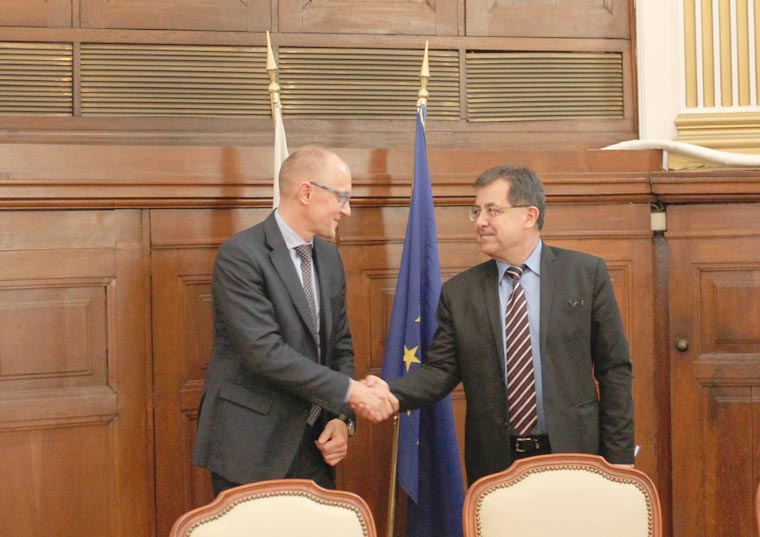
In November, the European Food Safety Authority (EFSA) will publish its new scientific opinion on neonicotinoids and the impact of their use on bee health. At the meeting in Sofia, the Executive Director of EFSA, who was visiting the country, expressed hope that more Bulgarian scientists would apply during the renewal of the composition of EFSA’s scientific panels and committees, which started in June this year and will be completed in 2018.
During the visit of Dr Bernard Url to Bulgaria, Executive Director of EFSA, at a conference held at the Ministry of Agriculture and Food, the pressing issue of neonicotinoids and their effects was discussed. The host of the visit was the Risk Assessment Center on Food Chain (RACFC). The visit is part of an EFSA initiative under which, within 3 years, the Executive Director will visit all risk assessment institutions in the EU Member States.
“The European Food Safety Authority (EFSA) is working on its latest scientific opinion on neonicotinoids and the impact of their use on bee health. It will be published in November this year. The data we have gathered so far confirm that there is a risk and they must be thoroughly analysed from a scientific point of view, after which the most appropriate decisions must be discussed and taken by the EC. There will probably be other factors that will have an influence – economic and social. We are responsible for the scientific part of the problem”, stated Dr Bernard Url during his meeting with the Minister of Agriculture and Food, Prof. Hristo Bozukov.
For his part, the Bulgarian Minister of Agriculture expressed confidence that all interested parties could work together to take the most appropriate decision, the Ministry of Agriculture and Food reported. In this regard, EFSA informed that it is collecting new scientific opinions related to the issue from various stakeholders – NGOs, beekeepers and plant protection product manufacturers.
“As a scientist, I believe that this treatment is hardly the biggest problem facing beekeeping, but the protection of bees is a global issue and obliges us to carefully discuss the situation with pollinators and to take the necessary decisions at European and national level.”, the Minister Bozukov further said.
The Executive Director of EFSA also gave a positive assessment of the Risk Assessment Center on Food Chain and the Bulgarian Food Safety Agency for the measures taken to stop and limit the spread of Lumpy Skin Disease on the territory of Bulgaria.
Another important part of the meeting at the Ministry of Agriculture and Food was the endorsement and promotion of mutual cooperation between national and European scientific organisations, encouragement of work on joint thematic projects and the involvement of new participants in them. Dr Bernard Url expressed hope that more Bulgarian scientists would apply during the renewal of the composition of EFSA’s scientific panels and committees, which started in June this year and will be completed in 2018. The programme of Bernard Url also included meetings with scientific organisations in Bulgaria which are part of the list under Article 36 of Regulation (EC) No 178/2002 of the European Parliament and of the Council, which established EFSA as a single body for risk assessment in the food chain at EU level. These organisations are entitled to apply for scientific projects announced by EFSA.
More on the topic:
Only science can impartially resolve the conflict between beekeepers and farmers, but the final word will rest with the European Union! Part 1
Only science can impartially resolve the conflict between beekeepers and farmers, but the final word will rest with the European Union! Part 2